








Released in 2023, Zwigato offers a quiet yet powerful window into the everyday realities of India’s gig workers. With Kapil Sharma stepping away from comedy to play a delivery worker, the film captures
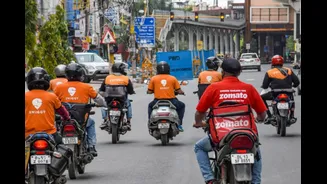
the invisible struggles that lie behind app notifications and doorstep deliveries. One particularly unsettling episode reveals just how vulnerable gig workers are to an unforgiving system: a false complaint is filed against his character, and in an instant, he is removed from his work. There is no inquiry, no opportunity to explain—only retribution. As Sharma’s income disappears, leaving him unable to manage even basic household expenses, his struggle begins. Through moments like these, Zwigato transcends storytelling to become a commentary on the absence of job security, dignity, and social protection in the gig economy, reminding readers that behind every quick delivery lies a life teetering in search of some balance. The film’s message feels especially poignant when viewed in light of real-life events. Switch to 2021, during the brutal second wave of Covid-19. While most people remained indoors, avoiding all contact, delivery workers were on the streets, risking their lives to deliver food and essentials to households. In the same year, a Bengaluru-based model accused a Zomato delivery partner of assault, leading to his arrest and temporary suspension from the platform before he was later released on bail. The timing itself added a layer of irony. At a moment when gig workers were being hailed as essential lifelines, a single allegation was enough to upend a worker’s livelihood. The quiet desperation portrayed in Zwigato is no longer confined to the cinema; it has found expression on the streets as well. On New Year’s Eve, thousands of gig workers across the country went on strike, calling for better pay, safer working conditions, and basic dignity at work. But the very system they were protesting against diluted their collective voice. The New Year rush, coupled with a lack of organisation among gig workers, meant that the strike’s impact was visible only in pockets, even as discontent simmered widely beneath the surface. At the heart of their protest lies a stark contradiction. Behind the glossy rhetoric of flexibility and independence lies a fragile existence marked by uncertainty and constant pressure. Many gig workers say they clock up to 14 hours a day for a single platform, yet remain unrecognised as employees. Officially labelled as “partners” or “independent contractors”, they are excluded from the rights and protections that generally accompany such long hours of labour. What they seek is not privilege, but fair and reasonable compensation for the work that fuels India’s fast-growing digital economy. The absolute absence of security is starkly evident in the fact that when mishaps occur, gig workers are left without any support. In her book OTP Please, which examines gig economies in India and South Asia, author Vandana Vasudevan recounts meeting a delivery agent at a protest in Rajasthan whose right thumb was severed while helping a customer move goods. Despite the injury, he received neither compensation nor medical assistance from the logistics start-up he worked for. India’s gig economy has become a defining feature of its labour market, employing an estimated 7.7 million platform-based workers in 2020-21, a number projected to rise to nearly 23.5 million by 2029-30. Even the government has recognised this fact. In an article published on December 9, 2025, the Press Information Bureau (PIB), while acknowledging the gig and platform workforce as a “crucial driver of the new economic ecosystem, powered by young demographics, digital adoption, and rapid urbanisation”, highlighted how, in recognition of their role, the Code on Social Security, 2020 (SS)—one of the four labour codes implemented in a recent labour reform—formally brings gig and platform workers under a broader protection umbrella. It claims that the “reform institutionalises long-overdue security for a workforce that has long powered India’s digital economy without commensurate protections”. Gig workers operate without the security of fixed employment, functioning instead in a freelance-like arrangement. This vast workforce includes delivery partners for platforms such as BigBasket, Zomato, Swiggy, and Blinkit, as well as drivers associated with cab aggregators like Ola and Uber. They are paid per delivery or per ride, not through a guaranteed monthly income. There is no fixed salary, no allowances, no pension, and no paid leave—only earnings that fluctuate with demand, algorithms, and physical endurance. As the film, the book, and the protests held at regular intervals together reveal, flexibility may define the gig economy, but its cost is borne almost entirely by the workers who keep it moving. A day spent with a gig worker will reveal that the struggles depicted in the film or the book are not exaggerated. Whether it is the scorching heat of June, the biting cold of January, or the relentless rains of July, when stepping outside feels unbearable, our instinctive response is simple—let’s order online. It feels effortless to us. What we rarely pause to consider is that someone is riding a two-wheeler through these very conditions to bring that order to our doorstep. If a delivery is delayed, frustration often turns into anger directed at the worker, who absorbs complaints, impatience, and blame while continuing to do the job. Nearly 90 per cent of these workers have no savings to fall back on. A short illness of even a few days can mean empty kitchens and unpaid bills at home. They are not permanent employees who can rely on paid leave, loans, or advances in times of need. This crisis is not confined to gig workers alone; it runs through the entire unorganised sector, where labour survives in the absence of strong laws and meaningful protection. In urban India, domestic workers, largely women, form the quiet backbone of everyday life, enabling households to function smoothly. Yet their work remains largely invisible and chronically undervalued. Many continue for years without a fixed salary or annual increment, trapped at stagnant wages even as the cost of living steadily rises. What makes their reality even harsher is that their struggle is not limited to the workplace. The imbalance of power inside private homes often exposes them to mental and physical abuse, with little recourse. Their hardships do not end at the employer’s doorstep. Many women return home only to face violence within their own families. In a painful irony, some earn more than their husbands, yet enjoy little respect or agency in their households. Their financial contribution rarely translates into dignity; instead, it often exists alongside neglect, control, and abuse. And yet, every morning, they step out once again—not by choice, but by necessity—to earn for themselves and their children. Their lives mirror those of gig workers and millions of others in the informal economy: stories shaped by uncertainty, resilience forged under compulsion, and labour that keeps society functioning while remaining largely unprotected. Yet, in comparison to gig workers, domestic work carries one fragile but significant difference—continuity. Many domestic workers remain employed in the same households for years, sometimes even decades. Over time, this constancy can foster a personal bond with employers, one that occasionally softens the harsh edges of informal labour. Unlike app-based workers governed by algorithms, domestic workers are at least seen and known by the families they serve. This familiarity can translate into limited but meaningful support. Advances or small loans are often easier to access, and in many cases, employers step in to help with children’s school fees, medical emergencies, or even wedding expenses. When a crisis strikes, a domestic worker may still find a door to knock on, someone who knows her story and circumstances. While this support is no substitute for legal protection or fair wages, it highlights a crucial contrast within the unorganised sector. Gig workers, despite powering billion-dollar platforms, often lack even this basic human connection. The story of the gig economy cannot be reduced to a single narrative. As Vasudevan highlights in her book, platform work has expanded choice and opportunity. She writes that in different parts of South Asia, women have used these jobs to gain financial control and a stronger sense of agency. Ride-hailing platforms have also reshaped everyday mobility, offering people with physical disabilities greater independence and allowing the elderly or mobility-restricted the comfort of safe travel and access to services.
Pragati Pandey is a Noida-based freelance writer who writes on books, pop culture, and ideas. Views expressed are personal and do not necessarily reflect those of News18.