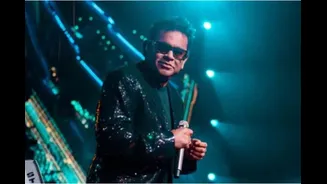









AR Rahman may have recently spoken about receiving fewer offers from the Hindi film industry over the last eight years, but the composer insists the same period has also been among the busiest phases of his
career. In a new interview, Rahman revealed that between 2019 and 2025, he worked on nearly 20–30 films across industries, a creative surge he describes as intentional.
Calling it a “rampage,” Rahman explained that the decision came from a desire to reassert himself in front of a new generation of listeners and filmmakers.
‘Nostalgia Can Quietly Harm Your Thinking’
Reflecting on how legacy often shapes perception, Rahman said that being constantly reminded of past glory can subtly impact an artist’s confidence. “For the past six years, to be frank, when people come to you, the ’90s generation have a certain nostalgia, certain affinity towards your music. The same goes for those born in the 2000s and the next decade,” he said.
According to Rahman, such compliments are not always harmless. “They say, ‘In the ’90s, you did Roja. That’s very good music, sir!’ That feels like now you’re not doing good music, right? It actually harms your thinking if you’re not in your best mood.”
Why Rahman Chose Quantity With Purpose
Rather than retreating into comfort, Rahman decided to flood the present with work. “So I thought, what if I go on a rampage and keep doing movies, songs after songs?” he said. The approach, he believes, has shifted how directors now view him.
“Every director who comes to me now says, ‘You’ve done such a great sequence in Mani sir’s Thug Life. All the examples now are from the last six years. I’ve done 20–30 movies in the last six years. So I’m safe now. I’ve got enough for the next generation. That was intentional,” Rahman told The Hollywood Reporter India.
Films Across Languages And Continents
Over the last six years, Rahman’s work has spanned industries and languages. His projects include Blinded by the Light in Hollywood; Sarvam Thaala Mayam, Bigil, Iravin Nizhal, Cobra, Vendhu Thanindhathu Kaadu, Ponniyin Selvan: I & II, Pathu Thala, Maamannan, Ayalaan, Lal Salaam, Raayan, Kadhalikka Neramillai and Thug Life in Tamil; Shikara, 99 Songs, Dil Bechara, Mimi, Atrangi Re, Heropanti 2 and Tere Ishk Mein in Hindi; and Malayankunju in Malayalam.
‘Drop Your Formulas, Even If It Fails’
Rahman said this phase reflects a conscious evolution rather than a defensive move. “It’s the modern, the new me. You want to keep evolving, drop your formulas. We’re growing old, so is the listener,” he explained.
He added that instinct now matters more than signature style. “Whatever comes out of the radio or TV, I should like it first. I should not think I’m still doing my own style.” Reinvention, for him, also means letting go. “Whatever I’ve learnt, some of the stuff I keep, some of it I just throw. You jump onto what’s next. Even if it’s going to fail, it’s fine.”
Ramayana And Collaborations Ahead
Looking ahead, Rahman revealed that much of his time will now be devoted to co-composing the score and songs for Nitesh Tiwari’s ambitious two-part adaptation of the Ramayana, slated for theatrical releases this Diwali and next. He is also composing music for upcoming films by long-time collaborators Imtiaz Ali and Mani Ratnam.
‘Awards Can Become A Burden’
At the core of this renewed momentum lies a personal reset. “I love that stuff, but within me, I need to get my self-esteem and confidence back, and prove myself,” Rahman said, adding that accolades from the past no longer drive him.
“Not rely on the past and be like, ‘Oh, I’ve won 33 Filmfare Awards and two Oscars.’ That thought drains you. It can be a burden.” In line with that belief, Rahman noted that his social media bios carry no mention of awards. “It’s a fresh start. 2026.”