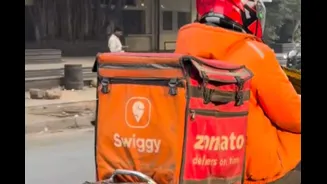

Even as food delivery platforms ensure that tips reach riders in full and gently nudge customers to tip during checkout, very few users actually do so. According to industry experts, only about 3–5 percent
of customers on platforms like Zomato and Swiggy leave a tip foe delivery partners, making such gratuities a marginal contributor to their earnings.
With food delivery and quick commerce apps serving 30–35 million unique monthly transacting users, this means roughly one in every 25 users tips their delivery partner, according to senior executives at large delivery platforms who spoke to Moneycontrol.
Several industry sources told the news outlet that most users, across food delivery and quick commerce, do not tip their delivery riders. “Only around 3–5 percent of transacting users tip delivery partners,” one top executive said, adding that the average tip amount is also modest.
As per the executive, most tips fall in the Rs 15–Rs 25 range per order, an amount that offers limited financial upside. While appreciated by riders, such sums “hardly move the needle” in terms of overall income, the executive noted.
For delivery workers, tips remain an occasional bonus rather than a reliable income stream. Riders told the news outlet that tips typically add Rs 800–Rs 1,000 a month, depending on how many peak-hour or high-value orders they complete. Tips are more likely during bad weather or late-night deliveries but are too unpredictable to be factored into daily earnings.
“Some months you get a few decent tips, other months almost nothing,” a Zomato delivery partner told Moneycontrol, adding, “It helps, but you can’t plan around it.”
Across all platforms, delivery partners would have earned a maximum of Rs 150 crore in tips in calendar year 2025, as per two industry sources. While the total amount may seem large, it represents the amount earned in tips by at least over 600,000 delivery partners present in the food and quick commerce ecosystem, or just around Rs 2,500 per head, on average, per year.
“Tips being low in our industry is understandable. Food delivery and quick commerce users are in contact with the delivery person for just a few seconds which makes it extremely difficult to complete the process of tipping,” another executive at one of the large platforms told Moneycontrol.
He explained that the nature of food delivery itself limits tipping. Unlike restaurants or cab rides, where customers spend 15–20 minutes interacting with service staff, delivery partners typically meet customers for just a few seconds.
While some may opt to tip their riders directly, there are hardly any users who tip outside the platforms as per companies’ conversations with tens of thousands of delivery partners, Moneycontrol has learnt.
The limited scale of tipping becomes clearer when applied to platform volumes. Swiggy, with around 25 million monthly transacting users, likely sees only 0.8–1.25 million users tipping in a typical month. Eternal—the parent company of Zomato and Blinkit—with about 45 million monthly users, may see 1.5–2.5 million tippers monthly, though overlaps exist.
Order-level data tells a similar story. Of the 280–300 million quarterly orders processed by Swiggy, only 2–4.5 percent are tipped. Eternal’s platforms, which handle 340–380 million orders a quarter, see a similarly limited share receiving gratuities.
Despite this, platform executives stress that riders receive 100 percent of tips, with no deductions. Zomato founder Deepinder Goyal recently said that tips are transferred instantly, with the company absorbing payment gateway costs. On average, tips worked out to ₹2.6 per hour in 2025, up slightly from the previous year.
While delivery partner pay has improved—average hourly earnings on Zomato rose to Rs 102 in 2025, up nearly 11 percent year-on-year—most of a rider’s income still comes from hours worked rather than tips.