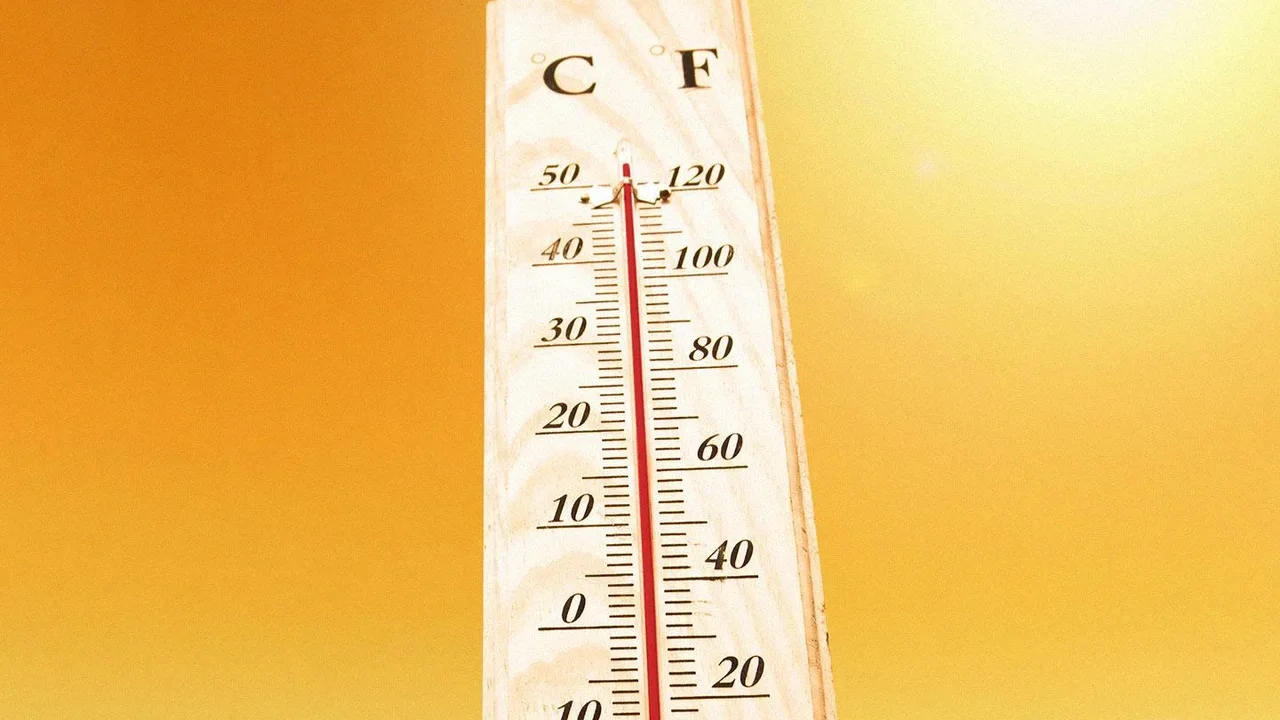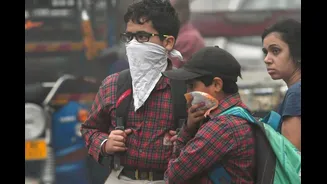








Mumbai’s persistent heat and humidity have coincided with a rise in air pollution, putting the city fifth on a global list of the world’s most polluted urban centres and first among Indian cities featured
in the ranking. The assessment by air quality monitoring platform iQAir comes after a rain-deficient monsoon and the early withdrawal of seasonal rainfall.
Mumbai registered an Air Quality Index (AQI) of 152 on Thursday, a level classified as unhealthy by iQAir, a US-based air quality monitoring organisation. Ground-level ozone (O3) was identified as the main pollutant behind the reading.
The city’s unusually high temperatures have added to concerns about air quality. According to a report in The Indian Express, Mumbai has experienced three of its hottest days in at least a decade this month, with maximum temperatures exceeding seasonal averages by 4-5°C on several days.
Weak Winds And High Temperatures May Be Contributing To Pollution
Atmospheric scientist Gufran Beig, chair professor at the National Institute of Advanced Studies (NIAS), Indian Institute of Science (IISc), linked the conditions to an El Niño-like climate pattern, high temperatures and a marked slowdown in wind speed.
Speaking to The Indian Express, Beig said weaker winds and hot, humid weather were limiting air circulation, allowing pollutants to accumulate closer to the ground instead of dispersing.
El Niño refers to the periodic warming of surface waters in the central and eastern equatorial Pacific Ocean. The phenomenon can influence weather patterns in different parts of the world, although its effects vary by region.
Ground-level ozone is different from the ozone layer in the upper atmosphere, which protects Earth from harmful ultraviolet radiation. At ground level, ozone forms when nitrogen oxides and volatile organic compounds react in sunlight. Hot, sunny conditions can encourage this chemical reaction, potentially increasing ozone concentrations.
Delhi And Kolkata Also Feature On iQAir’s List
The iQAir ranking included 122 cities worldwide. Delhi occupied sixth place with an AQI of 151, just below Mumbai, while Kolkata ranked tenth with a reading of 124. Mumbai therefore recorded the highest AQI among the Indian cities listed in the assessment.
However, the figures reported by iQAir differed from those displayed on the Central Pollution Control Board’s (CPCB) dashboard, which showed Mumbai’s city-level AQI at 98 – a category classified as satisfactory.
Local Monitoring Stations Record Higher Pollution In Some Areas
The CPCB’s station-level figures showed that pollution varied considerably across Mumbai. Of the city’s 23 operational air quality monitoring stations, 12 recorded satisfactory conditions.
Deonar reported an AQI of 156, while Bandra Kurla Complex (BKC) recorded 145 and Khindipada in Bhandup registered 129. At these locations, PM2.5 and PM10 were identified as the main pollutants by the CPCB.
The AQI figures from the two platforms should be read in the context of their respective monitoring and reporting systems. City-wide readings and individual station measurements can differ depending on the locations covered, calculation methods, averaging periods and data used.
Waste Burning Could Affect Neighbouring Areas
Pollution from waste burning can spread beyond the site where it originates, according to an official of the Maharashtra Pollution Control Board (MPCB). “If garbage or plastic waste are being burnt at Deonar, the air over there doesn’t stay confined to that place,” the official said. The official pointed to nearby Chembur and Kurla, where unhealthy AQI readings were also being reported, explaining that polluted air can travel between neighbourhoods.
The concern draws attention to the potential impact of burning garbage and plastic waste on air quality beyond the immediate location, particularly in surrounding residential and commercial areas.
BMC Orders Pollution Hotspot Checks Across 26 Wards
The Brihanmumbai Municipal Corporation (BMC) has instructed officials in all 26 wards to locate pollution hotspots and take measures suited to local conditions.
The exercise comes as Mumbai contends with above-normal temperatures, humid weather and elevated pollution readings at some monitoring stations. Identifying the sources of pollution in affected areas and implementing targeted measures are central to the civic body’s response.