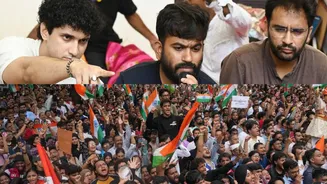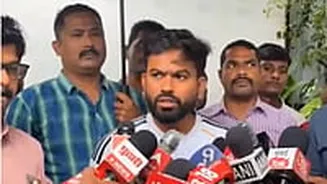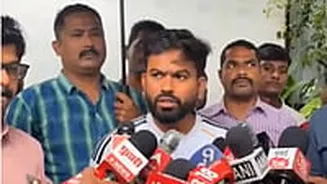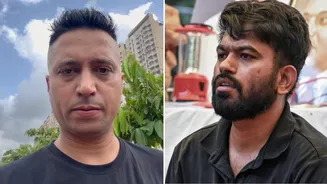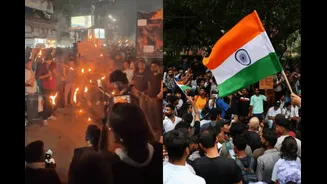









Abhijeet Dipke, the founder of the Cockroach Janta Party (CJP), announced on August 5, 2026, that his organisation will function strictly as a political pressure group. Speaking to reporters ahead of a core
committee meeting in Chhatrapati Sambhajinagar, Maharashtra, Dipke stated that the country needs a public, people-led movement rather than entry into mainstream electoral politics. This decision follows theCJP’s high-decibel 37-day student protest at Jantar Mantar, which forced the resignation of Union Education Minister Dharmendra Pradhan over the NEET-UG paper leak controversy.
WHAT IS A PRESSURE GROUP?
A pressure group is an organized group of people who seek to influence public policy, corporate decisions, and government legislation without contesting elections or holding political power. They act as a liaison between the public and policymakers, focusing on specific causes or collective interests.
STORY | CJP to act as pressure group for now: Abhijeet Dipke
The Cockroach Janta Party will function as a pressure group for now, as that is what India needs at the moment, CJP founder Abhijeet Dipke said on Wednesday.
Speaking to reporters ahead of the CJP’s core team meeting… pic.twitter.com/zI3xFauBa8
— Press Trust of India (@PTI_News) August 5, 2026
HOW DO PRESSURE GROUPS WORK ACROSS THE WORLD?
Pressure groups use a variety of strategies based on their goals and political environments:
Lobbying and Consultations: They directly meet with bureaucrats, ministers, and lawmakers to present research, policy briefs, and draft bills. This is heavily structured in countries like the United States and the United Kingdom.
Media and Publicity Campaigns: They use social media, advertising, and television to build public awareness and shift public opinion.
Public Protests and Demonstrations: Groups mobilise the public for rallies, marches, and strikes to force immediate government attention, as seen in global environmental and labor movements.
Boycotts and Economic Pressure: They organize consumer boycotts against unethical companies to impact their corporate revenue and reputation.
Litigation: If policy changes fail, they file lawsuits or mount legal challenges to enforce accountability through the courts.
THE WORLD’S FAMOUS PRESSURE GROUPS
The world’s most influential pressure groups are organized below by their primary focus areas:
1. Environmental & Climate Advocacy
- Greenpeace: Known globally for direct, high-profile actions and media campaigns. They successfully pressure governments and corporations to ban toxic chemicals, stop commercial whaling, and transition to renewable energy.
- World Wildlife Fund (WWF): Armed with millions of global supporters, WWF heavily influences international conservation policies, climate targets, and sustainable corporate supply chains.
- Extinction Rebellion (XR): A newer, decentralized group that uses mass civil disobedience, public blockades, and disruptive protests to pressure global governments into declaring formal climate emergencies.
#WATCH | Cockroach Janta Party (CJP) Founder Abhijeet Dipke says, “I am ready to show documents related to my education loan and the scholarship letter. I also request Narendra Modi to show his degree.” pic.twitter.com/CWfLP36Y7T
— ANI (@ANI) August 3, 2026
2. Human Rights & Social Justice
- Amnesty International: A massive watchdog that mobilizes millions of citizens to lobby governments. They successfully pressure regimes to release political prisoners, abolish death penalties, and rewrite discriminatory laws.
- Human Rights Watch (HRW): Focuses heavily on high-level legal and political lobbying. HRW publishes deeply researched reports that pressure world leaders, the UN, and regional bodies to sanction human rights abusers.
3. Healthcare & Humanitarian Policy
- Doctors Without Borders (Médecins Sans Frontières / MSF): Beyond providing frontline medical aid, they act as a highly effective pressure group. They actively lobby global pharmaceutical giants and governments to lower drug prices and remove restrictive patent laws for life-saving medicines.
- British Medical Association (BMA): One of the oldest and most influential professional medical associations in the world. The BMA serves as a classic sectional pressure group, successfully striking and lobbying the UK government to alter public health policies and National Health Service (NHS) funding.
4. High-Impact Industry & Political Lobbies (USA)
- American Israel Public Affairs Committee (AIPAC): Frequently cited as one of the most powerful foreign-policy interest groups in Washington. AIPAC aggressively lobbies US lawmakers to ensure continued military and diplomatic support for Israel.
- National Rifle Association (NRA): A highly influential American single-issue pressure group. The NRA spends millions lobbying politicians, funding campaigns, and mobilising voters to successfully block firearm restrictions and protect gun ownership laws.
HAS INDIA SEEN PRESSURE GROUPS IN THE PAST?
India has a long and rich history of pressure groups and interest organisations that have actively shaped public policy and political movements since both the pre-independence and post-independence eras.Business Associations: Groups like the Federation of Indian Chambers of Commerce and Industry (FICCI), established in 1927 under leaders like G.D. Birla, acted as powerful pressure groups during the freedom struggle and post-independence economic planning.
Peasant and Agrarian Movements: The All India Kisan Sabha (AIKS), founded in 1936, organized rural farmers and lobbied for tenancy rights and relief from exploitative land systems.
Who doesn’t love chai? pic.twitter.com/LP8SQQy2Gz
— Abhijeet Dipke (@abhijeet_dipke) August 5, 2026
Trade Unions: Labor organizations like the All-India Trade Union Congress (AITUC, founded in 1920) and later the Indian National Trade Union Congress (INTUC) strongly advocated for workers’ rights, wages, and labor laws.
Social and Environmental Movements: Grassroots and issue-based campaigns like the Chipko Movement in the 1970s and the Narmada Bachao Andolan later on functioned as potent pressure groups challenging state development models.
ARE THEY EFFECTIVE?
Pressure groups are highly effective. They successfully change laws, enforce corporate responsibility, and shift national policy. For example, environmental groups like Greenpeace have successfully driven bans on toxic chemicals, while trade unions globally have secured fundamental workplace safety and wage protections.
However, their effectiveness varies based on their funding, size, access to power, and public support. While they strengthen democracy by giving a voice to specific causes, critics argue that well-funded groups (like major business lobbies) can sometimes hold disproportionate influence over the interests of the general public.
CAN CJP BE A POLITICAL PRESSURE GROUP?
The CJP leadership has ruled out entering mainstream electoral politics or launching a political party for now, stating that India needs a strong public movement and accountability group rather than another political party.
The group centres its efforts on grassroots mobilization, public awareness, and dialogue with authorities regarding specific grievances like examination irregularities and transparency.
It relies on collective citizen engagement, protests, and public discourse to keep pressure on the government.