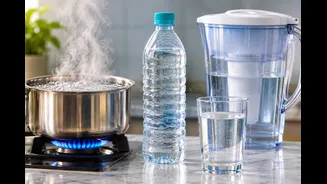









You can see dirt in water, but you cannot see arsenic, lead, fluoride or certain chemical contaminants. That’s what makes drinking water safety particularly tricky. The recent FSSAI-Bisleri controversy
has brought bottled water back into the spotlight, with questions over chemical contamination and quality checks. While the company maintains that its products are safe and disputes the findings concerning a particular batch, the episode is a reminder that a familiar brand or a transparent glass of water is not necessarily a guarantee of safety. So, should you boil your water, invest in an RO purifier or stick to bottled water? An infectious disease expert explains what each option can and cannot do.
The Food Safety and Standards Authority of India (FSSAI) recently sanctioned prosecution against Bisleri International after a regulatory sample of its packaged drinking water was declared unsafe in laboratory examinations. The initial test flagged bromate levels above the prescribed limit, while a referral laboratory subsequently detected polynuclear aromatic hydrocarbons (PAHs). Bisleri has disputed the findings, maintaining that the issue concerns a particular batch manufactured at its Goa facility in September 2025. The company says its independent testing found bromate within permissible limits and maintains that its products are safe for consumption. The controversy has also prompted wider regulatory scrutiny of packaged drinking water.
How do you know whether the water you drink every day is safe? Is boiling enough? Can bottled water be trusted? And does an expensive water purifier necessarily mean better protection? According to Dr Sandeep S Reddy, Consultant, Infectious Diseases and Travel Medicine, Ramaiah Memorial Hospital, Bengaluru, the first step is understanding what is actually present in your water.
“Your glass of water may look perfectly clean and still contain arsenic, lead or fluoride, none of which can be detected by sight. Most Indian households already follow a drinking water routine, but few know whether it adequately protects them. Boiling, bottled water and filtration each address different types of contamination, and no single method eliminates every risk,” he explains.
Boiling: Does It Kill All The Germs?
Boiling water is among the oldest and most accessible ways of making drinking water safer. It is particularly useful when there are concerns about microbial contamination, including bacteria, viruses and parasites.
“A rolling boil for one minute kills bacteria, viruses, and parasites such as Giardia and Cryptosporidium,” says Dr Reddy.
In high-altitude regions, where water boils at lower temperatures, longer boiling may be necessary. However, there is an important limitation to remember: boiling does not remove dissolved chemical contaminants. “Boiling kills germs, but it cannot remove chemicals like arsenic, lead, nitrate, and fluoride that stay in the water. As water evaporates, these substances become more concentrated, so boiled water can be free of germs and still be unsafe to drink,” he cautions.
Bottled Water: Is Packaged Drinking Water Always Safe?
The recent Bisleri controversy has made many consumers question whether packaged drinking water is necessarily the safer alternative. Packaged drinking water sold in India is subject to regulatory standards, including applicable FSSAI requirements and BIS specifications such as IS 14543.
However, a regulatory framework does not mean consumers can independently verify the quality of every bottle they purchase. “That is one reason many households turn to bottled water. Packaged drinking water in India must meet IS 14543 and FSSAI standards, which gives buyers a useful level of assurance. But the label does not show where the water came from or how it was treated, so the consumer has little control over what is inside,” Dr Reddy explains. Research has also raised concerns about microplastic and nanoplastic particles in bottled water. Heat exposure can increase the release of particles from plastic packaging, making storage conditions important. A bottle left inside a parked car, for instance, is not ideal. Beyond possible contamination concerns, buying packaged water every day also adds to household expenses and plastic waste.
“Given the daily cost and the plastic waste, bottled water works well for travel but makes little sense as a daily household habit,” he says.
Water Purifiers: Is RO Better Than UV And UF?
For households relying on municipal supplies or borewells, filtration can be a practical daily solution. However, not all water purifiers work in the same way. Choosing one without understanding the quality of your water can mean spending money on technology that does not address the actual problem.
Dr Reddy breaks down the commonly used options:
Carbon filters
These are useful for improving the taste and smell of water. They remove chlorine and certain organic compounds but do not adequately remove dissolved salts, arsenic or fluoride. A carbon filter alone may therefore be insufficient when chemical contamination is a concern.
Reverse osmosis (RO)
RO is among the more comprehensive options for removing dissolved contaminants. It can reduce salts, arsenic, fluoride, nitrate and lead. However, there are trade-offs. RO also removes some beneficial minerals and can waste considerable amounts of water during operation. Households concerned about mineral content can look for models designed to retain or add minerals, while remembering that this does not replace proper water testing.
UV and ultrafiltration (UF)
UV technology inactivates microorganisms, while UF physically removes many microbes and suspended particles. Neither is designed to remove dissolved chemical contaminants such as arsenic, fluoride or nitrates. They may therefore work best in combination with other filtration technologies, depending on the water supply.
Which Drinking Water Is Safest For Your Home?
There is no universal answer. A household using a treated municipal supply may have very different requirements from one dependent on borewell water, particularly in areas where groundwater contamination is a concern. Dr Reddy recommends starting with a laboratory test instead of buying a purifier based on advertising or recommendations from neighbours.
“Start with a laboratory test of your water, rather than buying a product first. If your supply is municipal and the results are satisfactory, a certified RO or carbon-plus-UF system is a sound daily choice. If you rely on a borewell or live in a known hotspot, choose a system matched to the contaminants your test reveals,” he advises.
Boiling should remain an option during public health advisories, floods and water-supply disruptions, when microbial contamination may be a concern. Packaged drinking water can be useful while travelling, provided it is purchased from reliable sources and stored properly. There is also one often-overlooked detail: maintaining your water purifier. “Replace filter cartridges on schedule. An exhausted filter can keep delivering water that looks clean while offering little protection, and that is the risk most people never see,” Dr Reddy says.