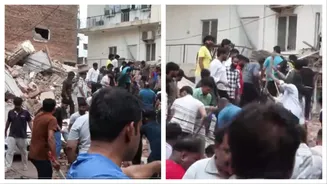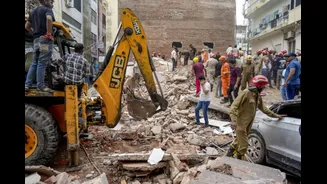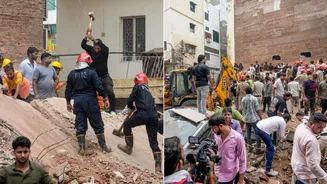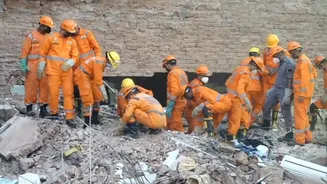










The deadly collapse of a five-storey building being used as a boys’ PG in Delhi’s Satya Niketan has brought the regulatory framework governing paying guest accommodations and fire safety under renewed
scrutiny.
Seven people have died after the building collapsed at around 1.30 pm on Sunday while repair work was underway.
Six people have been rescued from the debris, while multiple agencies continued rescue operations through the night. Police have registered a case against the building owner and others, and a magisterial inquiry has been ordered.
But the tragedy has also put the spotlight on how residential properties in Satya Niketan have gradually been converted into commercial student accommodation.
No Licence Required To Run A PG
Satya Niketan’s transformation has been closely linked to its location next to Delhi University’s South Campus, which lies within roughly 500 metres of the locality.
Also Read: Same Horror, Four Years Apart: How Delhi’s Satya Niketan Building Collapse Mirrors A 2022 Tragedy
As the student population seeking accommodation around the campus grew, residential properties in the neighbourhood increasingly began being used as PG accommodations and private hostels.
Under the current rules, an individual does not require a separate licence simply to operate a paying guest accommodation. This has made it easier for residential properties to be used for student accommodation without going through a licensing process specifically for running a PG.
The result has been a steady commercialisation of what was originally a residential neighbourhood.
Fire NOC Rule Has A Height Threshold
Fire safety regulations also have a height-based threshold.
The Delhi Fire Service says a Fire Safety Certificate is mandatory for buildings covered under Rule 27 of the Delhi Fire Service Rules, 2010.
For residential buildings other than hotels and guest houses, the threshold is more than 15 metres in height or ground plus four upper storeys.
Such buildings require fire-safety measures and a Fire Safety Certificate from the department.
This means residential structures below the applicable height threshold are outside this particular mandatory Fire NOC requirement.
The distinction becomes significant in localities such as Satya Niketan, where several small residential plots have over the years been adapted into multi-occupancy student accommodation.
Also Read: Delhi Satya Niketan Building Collapse: MCD Suspends Deputy Commissioner, 4 Other South Zone Officials
The neighbourhood has evolved into a major student housing hub because of its proximity to DU’s South Campus.
The Deadly Collapse
The building that collapsed on Sunday was around 50 years old and housed a boys’ PG. Repair work was reportedly underway when the structure came down.
Locals have alleged that the area has been facing persistent waterlogging and that the problem worsened after heavy rain over the previous two days. They also alleged that construction and repair work was being carried out in the basement.
Delhi Police has issued a Look-Out Circular against the building owner, Hariram, who is absconding.
The immediate cause of the collapse will be established through the ongoing investigation and magisterial inquiry.