






There was a time when urban Indian homes leaned toward a certain idea of perfection, clean lines, polished finishes, and mass-produced uniformity that felt aspirational but, in hindsight, somewhat impersonal.
Today, that idea is quietly, but powerfully, shifting. The modern Indian home is no longer just about looking contemporary; it is about feeling rooted. And at the heart of this transformation lies an unlikely yet deeply familiar protagonist: Indian textiles.
“In the soft folds of a quilt or the delicate sheen of a hand-embroidered cushion, I find that the soulful journey of Indian textiles truly comes alive,” says Suparna Handa, Managing Director, Sarita Handa. Her reflection captures something many urban homeowners are rediscovering, a longing for objects that carry meaning beyond their surface. What was once dismissed as “traditional” or relegated to heirlooms is now being reimagined as an essential part of contemporary living.
This renewed embrace is not accidental. It is, in many ways, a reaction to the fatigue of sameness. Handcrafted textiles, with their uneven weaves, subtle tonal variations, and tactile richness offer something that machine-made products cannot: individuality. As Mandeep N. Housego, Creative Director, Shades of India, points out, these “subtle irregularities in yarn” and “the tactile depth of natural fibres” are no longer seen as imperfections, but as markers of authenticity. They signal time, process, and the unmistakable presence of the human hand.
And perhaps that is what urban India is craving, a return to the human touch in an increasingly digital, fast-paced world.
Techniques like Phulkari, zardozi, and Ikat, once confined to occasion wear or family trunks, are now finding pride of place in living rooms, bedrooms, and even workspaces. But their appeal goes beyond aesthetics. As Handa reflects, each piece carries with it “the nimble hands of artisans, carrying forward techniques patiently handed down, infused with generations of memory and lived experience.” In a culture that is constantly negotiating between past and future, these textiles act as a bridge, tangible, intimate, and enduring.
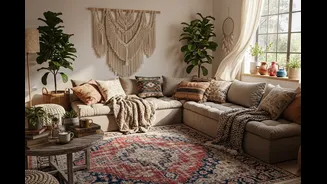
What makes this shift particularly significant is how seamlessly these textiles are integrating into modern interiors. They are no longer treated as accents, but as foundational elements that shape the mood of a space. Housego notes that materials like silk, wool, and cotton bring “warmth, softness, and layered texture,” allowing homes to feel “considered and lived-in.” In this sense, textiles are not just decorative choices, they are spatial storytellers, weaving continuity across rooms and styles.
Yet, this resurgence is not about nostalgia alone. It is also about evolution. Indian textiles are not frozen in time; they are dynamic, adapting to new contexts while retaining their core identity. As Housego observes, the craft continues to evolve through “a balance between established techniques and ongoing exploration,” with artisans experimenting with new fibres and structural approaches. This quiet innovation ensures that textiles remain relevant, not as relics, but as living traditions.
For homeowners, this translates into a more conscious way of curating spaces. The emphasis is shifting from “how it looks” to “how it is made.” There is a growing appreciation for sustainability, for materials that breathe, and for processes that respect both the environment and the artisan. In choosing handcrafted textiles, urban consumers are, perhaps unknowingly, participating in a larger ecosystem, one that values skill, time, and cultural continuity.
More importantly, these textiles are changing the emotional landscape of homes. “They are never just decorative; they are carriers of memory, lineage, and artistry,” Handa says. And in that lies their true power. A hand-embroidered cushion is no longer just an object; it is a story. A quilt is not just functional; it is a repository of craft, culture, and care.
In an age where homes are often designed for display, curated for social media as much as for living, Indian textiles bring back a sense of intimacy. They invite touch, evoke memory, and create spaces that feel inhabited rather than staged.
The journey from loom to living room, then, is not merely about design. It is about reclaiming a way of living that values depth over gloss, story over sameness, and connection over convenience. It is about recognising that the future of Indian homes may well lie in the wisdom of their past, woven, quite literally, into every thread.