






India has made it clear that walking away from its involvement in Iran’s Chabahar Port is not an option, even as the US sanctions waiver on operations there approaches expiry and New Delhi is in talks
with Washington on how to protect its interests.
“As you are aware, on October 28, 2025, the US Department of Treasury had issued a letter outlining the guidance on the conditional sanctions waiver valid till 26 April 2026. We remain engaged with the US side in working out this arrangement,” foreign ministry spokesperson Randhir Jaiswal has said.
Last September, the United States had enforced stringent economic sanctions on Iran, while allowing India a temporary six-month exemption for its involvement in the Chabahar port project. That exemption is set to expire on April 26. Previously, sources had indicated that following talks with Washington, an additional six-month extension until April 2026 had been offered “as a special case” to facilitate an orderly exit. However, they clarified that such an arrangement is not acceptable to New Delhi.
India’s insistence is not without reason, as the Chabahar port has long been New Delhi’s only viable western corridor.
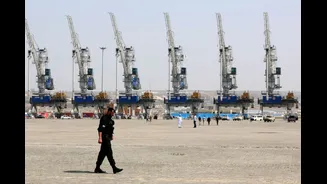
One of the biggest reasons Chabahar—which means four offpsrings—matters is that it gives India direct maritime access to Afghanistan and Central Asia without passing through Pakistan, whose land routes are largely closed to Indian trade. Chabahar sits on Iran’s south-eastern coast and offers a seaborne route that bypasses geopolitical barriers to India’s westward connectivity.
This access is especially important since India has historically faced challenges sending goods into Afghanistan due to Pakistan’s control over key land crossings. Chabahar cuts out that hurdle, making it a crucial node in India’s effort to integrate with wider regional economies.
According to Mint, Chabahar is more than a standalone port—it is a planned part of the International North-South Transport Corridor (INSTC), a multi-modal transport system linking India with Iran, Russia and Europe. By using sea, road and rail links, this corridor can shorten transit times and reduce logistics costs compared to traditional sea routes that go through the Suez Canal.
The port could also serve as a conduit for energy imports from Iran and Central Asia, helping diversify India’s energy supply routes and reducing dependence on longer or politically sensitive shipping lanes.
The Iranian port also acts as a counterbalance in a competitive region. From a geopolitical standpoint, Chabahar helps balance regional influence. China’s involvement in Gwadar Port in Pakistan, developed under the China-Pakistan Economic Corridor, presents a competing infrastructure project. Chabahar enables India to maintain a footprint in maritime connectivity in the same geographical neighbourhood, giving New Delhi a strategic alternative to routes dominated by its competitors.
But Chabahar is not just about strategy—it has a practical trade dimension too. By providing a gateway into land-locked regions, it expands India’s export reach and offers potential for increased commerce with Afghanistan and Central Asian countries. It also serves as a logistics hub for humanitarian assistance, as India has already utilised the port to send aid to Afghanistan.
For India, its involvement with Chabahar goes beyond short-term interests. In 2024, India signed a 10-year contract to operate a terminal at Chabahar and committed significant investment, demonstrating that its engagement is planned for the long haul.
News agency PTI, quoting sources aware of the development, reported that India is in the process of transferring approximately $120 million, the amount it committed for the project, as part of a move to end its direct exposure to the Chabahar port project.