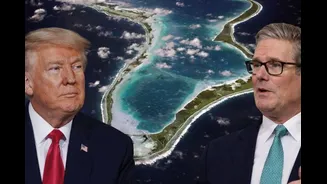






Donald Trump may have backed off for now on seeking complete ownership of Greenland, but his obsession with leverage has flared up a crisis elsewhere. This week, Trump dragged the Indian Ocean into his Greenland gambit,
playing the Diego Garcia card to pressure the United Kingdom. It is a dangerous and irresponsible move—and one that India is unlikely to view positively. Trump’s menacing bid for Greenland has now spilled far beyond the Arctic. His recent outburst against the UK’s decision to transfer sovereignty of the Chagos Islands to Mauritius marks a new front in his coercive diplomacy. The move has been hailed by some as a long-overdue act of decolonisation, and condemned by others as a strategic blunder. Trump, predictably, chose confrontation. In a Truth Social post, Trump slammed the UK plan as an “act of total weakness” and “great stupidity.” He declared that “our brilliant NATO ally, the United Kingdom, is currently planning to give away the Island of Diego Garcia… FOR NO REASON WHATSOEVER,” warning that China and Russia would exploit what he described as Western weakness. This, Trump argued, is precisely why the United States must acquire Greenland. There is almost nothing in this statement that is factually or strategically sound.
The Facts Trump Ignores
Diego Garcia, home to a critical US-UK joint military base, is part of the Chagos Archipelago, which legally belongs to Mauritius. When Mauritius gained independence in 1968, the UK retained control of the islands whereas the Chagossian population stood expelled from their own lands. Many settled in Mauritius and Seychelles, where they have long demanded the right to return.
In 2019, the International Court of Justice and the United Nations General Assembly ruled that Britain’s continued control of the Chagos Islands was unlawful and that sovereignty must be returned to Mauritius. The UK was obligated to comply.
London did comply after extensive backchannel discussions involving Washington, and with India backing Mauritius’ decolonisation bid. Under the agreement, the UK will transfer sovereignty of the Chagos Islands to Mauritius, while Mauritius will lease Diego Garcia back for military use under a 99-year lease.
There is no “giving away” of Diego Garcia. The US is not losing access. The base will remain intact, operational, and legally secure. Trump’s claim that American strategic interests are being abandoned is simply false.
Manufacturing a China–Russia Threat
Trump’s second argument that China and Russia will exploit the situation recycles a familiar narrative he has deployed on Venezuela and Greenland. But the reality in the Indian Ocean tells a different story. There is no Chinese military presence anywhere near the Chagos Islands. There is no Russian footprint either. The dominant strategic reality of the Indian Ocean is not Beijing or Moscow—it is India, which backed Mauritius in the talks with the UK.
A consistent advocate of decolonisation and a close partner of Mauritius, India backed the Chagos ruling precisely because it strengthens international law while preserving regional stability. New Delhi has shown no interest in destabilising Diego Garcia. The Chagos settlement with Mauritius only represents a legal correction.
The irony is hard to miss. In early 2025, the Trump administration fully supported the UK’s decision to leave the Chagos Islands. Trump personally told Starmer he was “inclined to go with your country” and expressed confidence that the deal would work out well. A formal US State Department statement followed, noting that the agreement secured the “long-term, stable and effective operation” of the joint military facility at Diego Garcia. Nothing has changed since then, except Trump.
By pressuring the UK to withdraw from a deal that Parliament was preparing to ratify, he has reopened a politically sensitive debate in Britain. UK Conservative opposition figures have long opposed relinquishing the British Indian Ocean Territory. Desperate to retain the last remnants of the empire, they have actively lobbied Washington to intervene. With renewed vigour, thanks to Trump pulling away, opposition leader Kemi Badenoch, along with Nigel Farage and Suella Braverman, have rained down heavily on Prime Minister Keir Starmer for “giving up” the islands. Starmer, now under pressure, is faced with a choice to either yield to Trump’s veto or move forward with the deal without American agreement, which would rupture the US-UK strategic alliance.
Greenland Leverage at Any Cost
So how is Trump suddenly “shocked” now? The answer is leverage. By weaponising Diego Garcia, Trump is attempting to pressure the UK on Greenland. He has long argued that the US must own Greenland outright, not merely have access to it.
By portraying the Chagos settlement as proof that allies cannot be trusted to safeguard American interests, Trump is advancing the narrative that sovereignty itself must be renegotiated in the name of security.
This is where the stakes rise sharply. Using one territorial issue as leverage for another normalises the idea that borders, treaties, and international rulings are transactional. If legally settled decolonisation agreements can be reopened for strategic bargaining, the international order that the US claims to champion itself weakens.
Should the UK be forced to abandon the agreement, relations with Mauritius would sour dramatically, triggering political upheaval on the island and further eroding Western credibility. The West already struggles to convince the Global South that it honours treaties and international law. This episode would only deepen that distrust.
Trump’s rhetoric shows little regard for the Chagossians, for Mauritius, or for international law. It raises unsettling questions: could this lead to talk of detaching Diego Garcia altogether? Of annexation, justified in the name of national security?
Diego Garcia remains a vital hub for US military operations. It played a central role in campaigns in Iraq and Afghanistan and supported strikes on Iranian nuclear enrichment facilities last year. None of this is under threat.
Yet despite the fact that this strategic presence is not under any real threat, Trump keeps opting for confrontation over diplomacy and manufacturing a crisis where none exists. These are not signs of a reliable power.