
In the middle of Bengaluru’s rush, between honking autos, wholesale lanes and half-hidden bylanes, there is a place where time slows down to the rhythm of clacking looms. Cubbonpete does not announce itself.
You stumble into it. And suddenly, you are watching a saree come alive thread by thread.
Tucked near KR Market and Chickpet, Cubbonpete is one of the city’s oldest weaving clusters. The area is home to power looms that produce everything from everyday synthetic sarees to silk blends, cotton-silk mixes and festive fabrics.
This is not a retail street. It is a working neighbourhood that is noisy, warm, unapologetically industrial, where sarees are still made in real time.
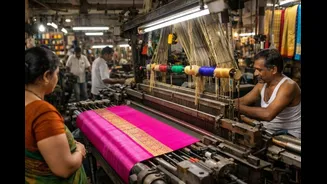
Step into one of the narrow units and you will see looms humming non-stop, spools of coloured yarn stacked against walls, and workers adjusting threads with the focus of muscle memory. Patterns are not just designed here; they are executed live, metre by metre.
Watching A Saree Being Born
What makes Cubbonpete special is not just the price or the variety. It is the experience. Buyers can stand next to a loom and watch their saree being woven. The colours they chose roll out slowly, the border takes shape, the pallu reveals itself inch by inch.
For many, this is the first time they understand what goes into making a saree — the coordination, the patience, the precision. It changes the relationship between buyer and fabric. This is no longer just a garment pulled off a rack. It is something you saw being made.
Bulk Orders And Wholesale Culture
Cubbonpete largely works on bulk orders. Most weavers and unit owners cater to retailers, boutique owners and traders who place large quantity requests. A single design may be woven in dozens or hundreds of pieces.
This means it is not the easiest place for someone looking to buy just one saree. Walk-in retail is rare. But if you know a wholesaler, or if you are willing to place a small bulk order for weddings or functions, doors open. And once they do, the experience is worth the effort.
The range here is wide. Synthetic sarees dominate daily production, but silk blends, cotton silks and festive fabrics are also woven depending on demand. Designs are often customised colour changes, border tweaks, pallu variations, all discussed on the spot.
Prices are lower than retail stores because there is no showroom mark up. What you pay for is fabric and labour, not air conditioning and display lighting.
A Living Craft In The City’s Heart
Cubbonpete is a reminder that Bengaluru is not just a tech city. It is also a manufacturing city, a trading city, a place where traditional livelihoods still survive between flyovers and metro lines.
For those who love sarees, Cubbonpete offers something rare, transparency. You see how your saree is made, who makes it, and how much work goes into every fold.
You may not walk out with a single neatly packed saree bag. But you walk out with something else – the quiet joy of having witnessed creation, right in the heart of the city.u