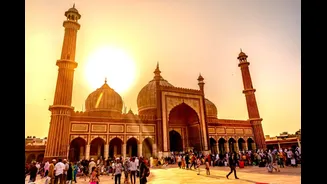






Eid ul Fitr 2026 Date, Significance: As the holy month of Ramadan draws to a close, Muslims in India eagerly prepare for Eid ul Fitr 2026. The festival marks the end of fasting and a time to celebrate
with family, friends, and community. However, one question arises every year: When exactly will Eid be celebrated? The answer to this question depends on an essential yet unpredictable event, the sighting of the crescent moon. Since the lunar calendar is based on the moon’s phases, the exact date of Eid varies every year.
But, what’s even more intriguing in India is that Eid is celebrated on different days across various states. This happens because of several factors, including regional moon sighting practices, geographical location, and even religious interpretations of the moon’s appearance. Let’s dive into the details of why Eid ul Fitr is not celebrated uniformly across India.
When Is Eid 2026? March 20 or 21?
In 2026, Eid ul Fitr will likely be celebrated on either March 20 or March 21 depending on when the crescent moon is sighted. The official date is only confirmed once the moon is observed, and this can vary across regions due to local customs and traditions.
On March 19, the 29th night of Ramadan, people will look to the skies for the crescent moon, which signals the beginning of Shawwal (the 10th month in the Islamic calendar). If the moon is visible that evening, Eid will be celebrated on March 20.
ALSO READ: Eid ul-Fitr 2026 Moon Sighting Date: Time To Watch Crescent Moon In India, Saudi Arabia And Other Countries
However, if the moon is not sighted, then Ramadan will complete its 30th day, and Eid will be celebrated on March 21.
This variability in moon sighting leads to Eid being celebrated on different days in different parts of India, a practice that has been followed for centuries.
Why Do Indian States Celebrate Eid on Different Days?
India is a large and diverse country, and one of the reasons for this difference in Eid dates is that various regions rely on different methods to determine when the crescent moon is visible. Here are the main factors contributing to Eid being observed on different days:
Traditional Moon Sighting vs. Astronomical Calculations
Some states follow traditional moon sighting methods, where the first visible crescent moon marks the start of Shawwal. This method can cause differences in when the moon is sighted depending on geographical factors like weather conditions, cloud cover, and local visibility.
ALSO READ: Eid-ul-Fitr 2026 Date, Moon Sighting, Prayer Timings And Wishes
In contrast, other regions rely on astronomical calculations to predict when the moon will be visible. This results in more consistent Eid observance across those regions, though it can still differ slightly due to varying sighting techniques.
Cultural and Religious Interpretations
While moon sighting is central to Eid ul Fitr, the interpretation of the moon’s appearance differs from community to community. Some states prefer to wait for local moon sighting reports from nearby mosques or local authorities, while others may rely on national announcements or even reports from Saudi Arabia.
ALSO READ: Eid Special: How To Make Flavorful Mutton Vermicelli Biryani At Home
This variation is especially evident in Uttar Pradesh, Delhi, and Maharashtra, where Eid is often celebrated on March 20 due to local sightings, while Kerala, Karnataka, and Andhra Pradesh may celebrate it on March 21 based on different moon sighting observations.
Eid 2026 Dates By State in India
Due to the differences in moon sighting methods, Eid ul Fitr will be celebrated on different dates in Indian states in 2026. Here’s when you can expect Eid to be observed in various regions:
- Uttar Pradesh, Delhi, Maharashtra, Bihar, West Bengal: March 20
- Kerala, Karnataka, Telangana, Andhra Pradesh: March 21
- Rajasthan, Gujarat, Punjab, Haryana: March 20
- Madhya Pradesh, Odisha, Assam: March 21
How Moon Sighting Decides Eid’s Date
The Islamic calendar is based on the lunar cycle, where each month lasts 29 or 30 days. Since Eid is celebrated on the first day of Shawwal, the date depends entirely on the sighting of the crescent moon. On Chand Raat, the 29th evening of Ramadan (March 19 in 2026), Muslims across the world look for the crescent moon that signifies the end of fasting and the beginning of Eid ul Fitr.
- If the crescent moon is visible that night, Eid ul Fitr will be celebrated on March 20.
- If the moon is not sighted, then Ramadan will complete 30 days, and Eid will be observed on March 21.
This practice creates the observed difference in Eid dates across India and even within different cities.
Eid 2026: Regional Traditions
The varying dates of Eid ul Fitr across India are a reflection of the country’s deep-rooted cultural diversity and religious practices. The different moon sighting traditions show how Islamic observances are interpreted and celebrated in various regions.
ALSO READ: Iftar Snacks To Make At Home: Easy And Delicious Recipes For Ramadan Evenings
Despite these differences, the essence of Eid remains unchanged, celebrating the end of Ramadan, giving to the needy, and spending quality time with family and friends.
These regional differences in the celebration of Eid only highlight the flexibility and richness of India’s Islamic culture. Whether it’s observed on March 20 or March 21, the message of Eid remains universal: gratitude, charity, and celebration.
FAQs About Eid 2026’s Regional Observance in India
Why do different Indian states celebrate Eid on different days?
Eid is based on the sighting of the crescent moon. Some states follow local sightings, while others rely on astronomical calculations or regional announcements.
When is Eid ul Fitr in India in 2026?
Eid ul Fitr 2026 will fall on either March 20 or March 21, depending on the moon’s visibility.
Why do some regions celebrate Eid on different days?
Differences in moon sighting methods, weather conditions, and local customs cause variations in when Eid is observed across different states.
Can there be confusion when Eid is celebrated on different days?
While it can be confusing, these differences have been part of India’s Islamic tradition for centuries. It doesn’t affect the religious significance of Eid.
What is the role of moon sighting in determining Eid’s date?
The crescent moon marks the beginning of Shawwal, and Eid is celebrated on the first day of this month. The moon sighting confirms the end of Ramadan.