







For years, humanoid robots have been trying to match human ability in the physical world — balancing, walking, lifting, and navigating controlled environments. While machines have surpassed humans in computation,
real-world physical endurance has remained a distinctly human domain.
That may be beginning to change.
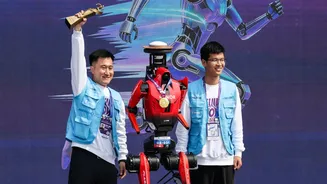
At a half-marathon in Beijing, a humanoid robot developed by Chinese smartphone brand Honor ran faster than the human world record, marking the first time a machine has outpaced elite human runners over such a long-distance race. The achievement is being seen as a technological milestone, underscoring the rapid gains in robotics and artificial intelligence.
What Exactly Happened In Beijing?
The robot, named Lightning, completed the 21-kilometre race in 50 minutes and 26 seconds, beating the human world record of 57 minutes and 20 seconds held by Ugandan runner Jacob Kiplimo.
50:26. Let that sink in — a humanoid just won the Beijing half marathon at a pace faster than the human world record. 🤯
The winner, “Lightning” from the Monkey King team, didn’t just finish — it ran a sub-51 minute race, while the human record sits at 56:42.
This one is built… https://t.co/GVGycitEd2 pic.twitter.com/vi3f0vV99q
— RoboHub🤖 (@XRoboHub) April 19, 2026
According to Reuters, several robot frontrunners were noticeably faster than professional athletes, beating the human winners by more than 10 minutes. The event saw more than 100 teams participate, up sharply from around 20 in its inaugural edition last year.
The contrast with that first race was stark. In 2025, the winning robot clocked 2 hours and 40 minutes, and many machines failed to even finish the course. This year, multiple robots not only completed the race but also outperformed human competitors.
The race itself was conducted with robots and over 12,000 human runners on parallel tracks to avoid collisions. Despite the gains, the event was not without setbacks — some robots fell at the start line or collided with barriers, according to AP.
What Changed In Just One Year?
The most important shift was not just speed, but autonomy — and that is fundamentally an AI breakthrough.
Nearly half of the robots in this year’s race navigated the 21-kilometre course independently, without remote control, interpreting terrain, maintaining balance and adjusting pace in real time. A year ago, most machines required continuous human guidance.
The half-marathon organiser wrote on social media that the winning robot’s autonomous navigation and burst power “proved key to winning the race.”
Hardware design also played a role. Honor engineer Du Xiaodi said the robot was developed over a year and built to resemble elite runners, with legs measuring about 90 to 95 cm. It also used liquid-cooling technology adapted from smartphones to manage heat during the run.
From an engineering perspective, this is significant. A half-marathon is not a fixed or predictable task — it requires continuous adjustments in balance, stride, and energy use over a long distance. For a humanoid robot to manage this in real time reflects major improvements in sensor systems, motion control, and AI decision-making.
Chinese state media outlet Global Times reported that a separate, remotely controlled robot from Honor reportedly finished even faster at 48 minutes and 19 seconds, but the autonomous robot was awarded the title under the event’s scoring rules. The second- and third-place robots, also from Honor and using autonomous navigation, finished in about 51 minutes and 53 minutes, respectively.
Why Does This Matter Beyond The Race?
Engineers involved in the project say the importance lies in what such performance enables. “Running faster may not seem meaningful at first, but it enables technology transfer, for example, into structural reliability and cooling, and eventually industrial applications,” Du Xiaodi said.
The race also highlighted improvements in how robots move and adapt. Spectators pointed to changes in posture and gait, with one engineering student saying the humanoid robots’ running form was “really quite impressive,” adding that he was surprised by the level of performance given how recent AI development has been, according to Reuters.
Are Robots Now Overtaking Humans In Physical Tasks?
The Beijing race suggests progress, but within limits.
The winning robot outperformed humans in a specific endurance task — long-distance running — under controlled conditions. But the race also showed existing constraints. A significant number of robots still required remote control, and some struggled with balance and navigation over the course.
As Reuters reported, the capabilities demonstrated in such events do not yet extend to broader industrial settings, where robots must perform complex, non-repetitive tasks in unpredictable environments.
How Does This Fit Into China’s Larger Tech Push?
The development comes amid a wider push by China to advance its robotics sector.
Beijing has been investing heavily in robotics for over a decade, identifying it as a key sector for upgrading its manufacturing base and reducing reliance on low-cost labour. A 2023 policy document described humanoid robotics as a “new frontier in technological competition,” setting a 2025 target for mass production and secure supply chains for core components.
This focus has carried into the country’s current five-year plan, which emphasises accelerating work in advanced technologies, including humanoid robots.
The impact is already visible. London-based technology research and advisory group Omdia recently ranked three Chinese companies — AGIBOT, Unitree Robotics and UBTech Robotics Corp. — as the only first-tier vendors in its global assessment for shipment numbers for general-purpose embodied intelligent robots. They all shipped more than 1,000 units of the robots last year, with the first two companies shipping more than 5,000 units, the report said.
The growth is also visible in public showcases. China has hosted robot sporting events, including the world’s first Humanoid Robot Games, while performances at the CCTV Spring Festival Gala featured humanoid robots carrying out coordinated martial arts routines.
China had also unveiled a new generation of humanoid robots performing kung fu, parkour and dance routines during its Spring Festival Gala in February. Two dozen humanoids performed martial arts sequences in what the Chinese embassy in Washington described as a demonstration of “precision, power, and perfect balance”.
How Did People React To The Moment?
For spectators, the moment was striking.
“I feel enormous changes this year,” said Sun Zhigang, who had also attended last year’s race. “It’s the first time robots have surpassed humans, and that’s something I never imagined,” he told AP.
Another viewer said the robots’ speed “far exceeds that of humans” and could signal the arrival of “a new era.”
One engineering student said he was impressed that robots could achieve this level of performance “considering that AI has only been developing for a short time.”
“The future will definitely be an AI era. If people don’t know how to use AI now, especially if some are still resistant to it, they will definitely become obsolete,” he told Reuters.
An 11-year-old student who watched the race said it inspired him to pursue robotics in the future, reflecting how such events are shaping public perception of the technology.