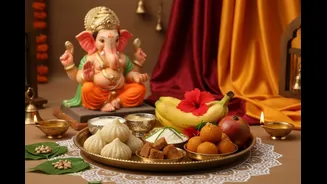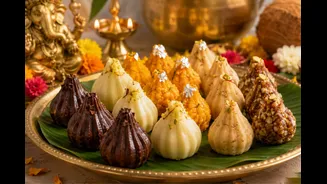








From milk and sugar to khoya, ghee, dry fruits and the rising cost of making and moving food, here’s what is really driving up the price of your favourite Ganpati sweet.
At 7pm, Neha Mehta is staring at
her Ganpati shopping bill with the kind of concentration usually reserved for tax returns. The Mumbai-based working mother has already bought the flowers, ordered the decorations and budgeted for the prasad. The modaks were meant to be the uncomplicated bit, the sweet, not the financial headache. Last year, she picked up boxes for the family and visiting relatives without giving the price tag much thought. This year, she is doing the maths before she does the ordering.
For Sunita Kulkarni, the strategy was supposed to be simple: make the modaks at home and save. Except her grocery basket has other ideas. Coconut, sugar, ghee and dry fruits have quietly turned a supposedly economical batch of homemade modaks into a more serious line item.
And then there’s Mahesh Patil, who runs a neighbourhood mithai shop. His customers want the same melt-in-the-mouth modaks they buy every Ganpati. The trouble is, the ingredients don’t come with last year’s price tags anymore.
So, what’s going on with the humble modak? Turns out, there’s a whole economy hiding inside that little sweet.
From milk and khoya to sugar, ghee, dry fruits, labour, energy and transportation, the cost of making festive mithai has been climbing and this year, that increase is showing up at the mithai counter.
The numbers tell the story. Reports from Maharashtra this festive season point to a significant rise in the cost of traditional sweets. In Pune, mithai makers have reported milk prices rising by around 16% in four months, while sugar that was previously around ₹38 per kg has, in some cases, reached as much as ₹76 per kg. Peda prices, meanwhile, have climbed from roughly ₹550–560 per kg to ₹750–780 per kg, with one mithai maker reporting that prices of nearly all sweets have risen by at least 30%.
Elsewhere in Maharashtra, reports have put the rise in festive mithai prices at around 15–20%, with higher costs of sugar, milk, khoya, dry fruits and other inputs adding pressure to both sweet makers and consumers.
So, if your modak box feels a little heavier on the wallet this year, there is a supply-chain story behind it.
The Modak Math: What’s Actually Inside That Price?
A modak may look deceptively simple. Rice flour or wheat flour, coconut, jaggery or sugar, perhaps some nuts, cardamom and a generous amount of festive sentiment.
But commercial mithai is a different calculation. For milk-based sweets and modaks, milk, khoya, milk solids and ghee can be major cost components. Then there is sugar, dry fruit, cooking fuel, labour, packaging, refrigeration or storage, transportation and the cost of maintaining food-safety standards.
“Festive mithai prices are being shaped by more than seasonal demand this year,” says Ravin Saluja, Director, Sterling Agro Industries Ltd. “The ongoing conflict in the Middle East has increased pressure on freight, energy and several imported ingredients, while domestic dairy and sugar costs are also influencing the economics of mithai.”
For modaks in particular, he points to the role of milk-derived ingredients such as khoya, milk solids and ghee in determining the final price.
That distinction is important. A mithai shop isn’t necessarily adding a bigger margin simply because it is Ganpati season. It may be passing on a higher cost base.
And milk itself has a longer story behind it. In Mumbai’s wholesale market, the price of “tabela” milk rose from ₹93 to ₹102 per litre from September 1, 2026, with producers citing higher fodder and transport costs.
In other words, by the time milk becomes khoya, and khoya becomes mithai, the original increase has travelled quite a distance.
The Sugar Problem Is Bigger Than Ganpati
If milk is one side of the equation, sugar is the other. India is entering one of the biggest sweet-eating stretches of the year, with Ganesh Chaturthi followed by the broader festive season. Sugar prices recently hit record levels before easing, but they still remained around 20% higher than two months earlier, according to Reuters. The government has responded by allowing duty-free imports of 1 million tonnes of sugar and asking mills to ensure adequate supplies during the festival season.
There is a seasonal element too. Sugar demand typically strengthens from August through November as Ganesh Chaturthi, Dussehra and Diwali drive demand for sweets and festive foods.
That creates an interesting paradox. The very period when families want to buy more mithai is also a period when sweet makers are dealing with a more expensive key ingredient.
Rajender Singh, Managing Director, Paras Dairy, points to this squeeze across the processing chain. “The rise in modak prices this Ganesh Chaturthi reflects pressure across the dairy-processing chain, not simply higher festive demand,” he says. “Sugar prices are still around 20% above their levels two months ago, while khoya, milk solids and ghee remain important cost components for traditional sweets.”
And the pressure doesn’t end when the sugar reaches the sweet shop. Milk has to be procured, chilled and processed. Ingredients need to be transported. Finished sweets need to be prepared, packaged and moved quickly because many traditional milk-based products have a limited shelf life.
Every step has a cost.
Homemade Modaks Aren’t Necessarily Cheap Anymore
For Sunita, making modaks at home was supposed to be the budget-friendly option.
There is no retail markup, no elaborate packaging and no shop rent built into the price. But there is one thing homemade modaks cannot escape: commodity prices.
Coconut is a good example. A 2025 report from Nashik found that coconut used in festive preparations had risen from around ₹300 per kg to ₹450 per kg over roughly one to one-and-a-half months. Dry fruits such as cashews, almonds and figs had also risen by around ₹50–100 per kg.
That matters because traditional modaks can be deceptively ingredient-heavy. A home cook buying a few kilos of ingredients may not notice the individual increases until the entire shopping bill lands on the kitchen counter.
And then there are the ingredients that turn an everyday modak into a festive one: cashews, almonds, pistachios, saffron, cardamom and ghee.
So while making sweets at home can still be cheaper than buying premium mithai, the idea that homemade automatically means inexpensive is becoming less straightforward.
For consumers like Sunita Kulkarni, the choice is increasingly between saving on labour and retail costs, or saving time by buying from a sweet shop.
The Modak Has Also Become a Luxury Product
There is another force at work, and it isn’t inflation. It’s premiumisation. The humble modak has evolved from a traditional prasad into a gifting product, an indulgence and, increasingly, an Instagram moment.
This year, a Nashik sweet shop has introduced a 24-carat “Golden Modak” priced at a staggering ₹27,000 per kg, alongside more than 25 varieties of modaks.
That doesn’t mean the average modak has suddenly become a ₹27,000-per-kg purchase. Far from it. But it illustrates how dramatically the category has expanded.
There are traditional steamed modaks, khoya versions, dry-fruit modaks and increasingly elaborate flavours and presentations designed for gifting. Premium mithai is also becoming a larger part of festive consumption, with brands anticipating growth in festive sales driven by premium products, gifting and corporate orders.
So when we talk about a “modak price rise”, we need to separate two things.
Inflation is one story. Premiumisation is another.
A basic modak becoming more expensive because milk and sugar cost more is inflation. A gold-leaf-covered, luxury-boxed modak costing thousands of rupees is a consumer choosing a very different product.
The two may appear next to each other in the same mithai shop, but economically, they are worlds apart.
And Then There Is the Ganpati Demand Boom
Of course, none of this would matter quite as much without the extraordinary amount of mithai Indians buy during Ganesh Chaturthi. Consider Mumbai’s Ladu Samrat, which expects to sell more than 10,000 kg of modaks during the 10-day Ganpati festival, including around 4,000 kg of mawa modak. Its demand for ukadiche modaks spikes dramatically on the first day, when it expects to sell 10,000–12,000 pieces. Those modaks are priced at ₹45 each. The scale changes the economics of the operation.
The shop’s factory runs around the clock during the festival, while preparation begins well before Ganpati. Staffing, storage, ingredients and logistics all have to be planned around a very short period of intense demand. The business even has to contend with road closures and increased storage requirements around Lalbaug during the celebrations.
Delhi’s appetite is growing too. At Dilli Haat INA, the Maharashtra Stall is producing around 1,000 modaks a day, while home chefs and Maharashtrian food entrepreneurs in the NCR are receiving bulk festive orders.
For a sweet maker, this is both an opportunity and a logistical headache. You have to produce enough to meet a huge spike in demand but not so much that a highly perishable product is left unsold. And every extra shift, delivery, batch of packaging and kilogram of raw material has to be accounted for.
The Price May Be Higher But Food Safety Can’t Be Cheaper
There is one part of the modak bill that consumers should not want to see cut: food safety. Festive demand creates an unusual pressure point for the sweets industry. More people want milk products, khoya, ghee and sweets at exactly the same time.
FSSAI has repeatedly flagged this seasonal vulnerability. Its festive-season guidance specifically calls for increased surveillance of sweets and milk products such as ghee, khoya and paneer, noting that the spike in demand can increase the economic incentive for adulteration.
The regulator’s 2026 Holi festive drive similarly called for inspections and sampling of milk and milk products, sweets, ghee and other high-demand foods because seasonal demand can create incentives for adulteration.
For organised dairy and sweet manufacturers, that means more attention to sourcing, testing, documentation, hygiene and traceability.
“There is also a stronger compliance dimension this year,” says Singh. “FSSAI-led festive surveillance is putting greater attention on milk products, ghee, khoya and sweets, which means organised manufacturers must maintain testing, sourcing and documentation standards.”
Those checks cost money but they are not costs consumers should necessarily resent.
As Saluja puts it, food safety cannot be compromised simply because input costs are higher. The priority, he says, should remain safe, genuine and good-quality mithai.
And that is perhaps the more important question to ask when staring at a suddenly expensive modak box.
Not simply: “Why does this cost more?” But: “What am I paying for?”
If the answer is higher-quality milk, genuine khoya, proper ghee, tested ingredients, trained workers, hygienic preparation and careful handling, some of that higher price is paying for something consumers actually want.
So, should you expect a more expensive Ganpati? Probably, depending on what and where you buy.
The evidence from Maharashtra this season points to meaningful increases in mithai prices, with milk, sugar and other raw materials putting pressure on sweet makers. Pune’s reported numbers are particularly striking: milk up around 16% in four months, sugar reaching as high as ₹76 per kg in some cases and peda prices rising by roughly 35–40% from their earlier levels.
But the final price of your modak is not determined by sugar or milk alone.
It is the cumulative cost of ingredients + labour + energy + logistics + packaging + wastage + compliance + demand.
And then there is the increasingly premium world of festive gifting, where a modak can cost considerably more simply because someone has decided to turn prasad into luxury confectionery.
For Neha, that may mean buying fewer boxes. For Sunita, it may mean making smaller batches at home. For Mahesh, it may mean explaining to customers why his prices have changed.
But for all three, one thing remains unchanged. Ganpati still needs his modak. The only difference this year is that Bappa’s favourite sweet comes with a little more economic baggage.