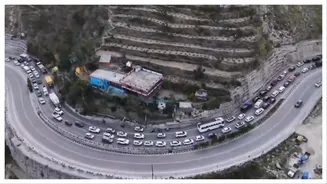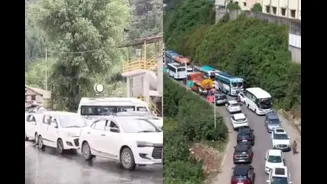









You packed your bags to escape 45-degree heat. You booked a hotel with a mountain view. You told yourself this summer would be different. And then you spent the next eight hours staring at the rear bumper
of an SUV from Gurugram, somewhere on a hairpin bend with no mobile signal and a children’s playlist stuck on repeat.
This is summer 2026 at India’s hill stations.
A severe heatwave scorching cities across northern, central, and southern India has triggered what tourism officials and locals alike are calling the heaviest tourist surge in recent memory. The destinations bearing the brunt are the ones that always do, Manali, Shimla, Mussoorie, Kodaikanal, but the scale this year is different. Roads that were already inadequate are now impossible. Parking lots that were already full filled up before breakfast. And the police, deployed in the hundreds, are fighting a losing battle against a tide of vehicles that simply has nowhere to go.
Manali
Manali has long held the dubious distinction of being India’s most traffic-congested hill station, and this summer it has done nothing to surrender that title. The town witnessed one of the heaviest tourist inflows of the season in the past week, triggered in part by fresh snowfall near Rohtang Pass that drew visitors hoping for a last look at snow before monsoon. Roads in and around Manali remained choked well into the night.
To make matters worse, Rohtang Pass now operates under a strict digital permit system, with a daily limit of 1,200 vehicles (permits that open at 10 a.m. and sell out in under 15 minutes on peak weekends). This means thousands of tourists who couldn’t secure permits are still driving up to the general Manali area, adding to congestion without the possibility of the Rohtang trip that motivated the journey.
Shimla
Shimla is not just facing a traffic problem. It is facing a reckoning. This week, reports suggest that more than 25,000 vehicles are entering the city every single day during peak tourist flow, double the normal volume. The city has approximately 20,000 parking slots in total. The arithmetic is unforgiving.
Police have deployed over 200 personnel to manage vehicle movement, with chokepoints forming at Victory Tunnel, Sanjauli Chowk, BCS, Khalani Chowk, Dhalli Chowk, Cart Road, and the road leading to the old bus stand.
Shimla is losing its charm like Mussoorie as vehicle traffic overwhelms roads that were never sealed for cars in the first place. Meanwhile, the overflow from Shimla is pushing into Kufri, Narkanda, Kasol, Dharamshala, and Kullu, saturating the entire state simultaneously.
Mussoorie
Mussoorie has always been the natural escape for Delhi. What has changed this summer is the speed at which people can get there, and that speed is now the problem. The newly operational Delhi-Dehradun Expressway has significantly cut travel time from the capital to Dehradun, making Mussoorie a viable one-day or overnight trip even for spontaneous travellers. The result is a flood of vehicles on mountain roads that were never designed to handle Delhi-scale traffic volumes.
Viral videos from this week show Mall Road reduced to a complete standstill. Uttarakhand Police have scrambled to deploy additional personnel, but Mussoorie’s fundamental geography — one main road, a ridge town with no bypass — makes systematic traffic management nearly impossible during surge periods. The expressway is a genuine improvement in connectivity. But for Mussoorie’s residents and the tourists already there, it has functioned this summer as a pipeline delivering problems at highway speed.
Kedarnath & the Char Dham Route
It is not only leisure travellers overwhelming the mountains. The Char Dham Yatra 2026 is breaking every record in its path. In just 30 days since the portals opened in late April, more than 15 lakh pilgrims have visited the four shrines of Kedarnath, Badrinath, Gangotri, and Yamunotri — numbers that the Uttarakhand government itself has described as unprecedented. Kedarnath alone drew over 4.5 lakh devotees in its first 20 days, with daily arrivals of around 32,000 — nearly double the 18,000-a-day average of 2025.
In May, pilgrims reaching Sonprayag were facing waits of two to four hours simply for a connecting bus. The administration has introduced mandatory Aadhaar-linked digital registration, banned mobile phones inside the temple, and deployed additional forces. But in a yatra where 50,000 pilgrims are arriving daily, these measures are managing a crisis rather than preventing one.
Kodaikanal
Down in Tamil Nadu, Kodaikanal is experiencing the southern version of the same crisis, and residents have run out of diplomatic language for it. The town’s narrow ghat roads were built for a fraction of the volume they currently carry. Long queues of vehicles are clogging the approaches to this hill station.
Sikkim
A video has gone viral on social media showing a massive bumper-to-bumper traffic jam of tourist vehicles winding through North Sikkim’s scenic Yumthang Valley en route to Zero Point. The viral footage underscores the immense tourist footfall heading toward Zero Point, which is situated roughly 160 to 170 kilometres north of the capital city, Gangtok.
Its surge in popularity comes in the wake of the indefinite closure of the famous Gurudongmar Lake. The route to Gurudongmar has remained blocked due to recurring, severe landslides across the Lachen and Chungthang valleys—a continuous environmental fallout triggered by the catastrophic October 2023 Glacial Lake Outburst Flood (GLOF).