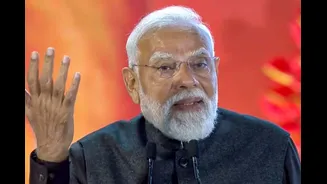





On the concluding day of the Viksit Bharat Young Leaders Dialogue 2026 on Monday, Prime Minister Narendra Modi not only addressed the nation on the role of youth in shaping a developed India by 2047, but
also engaged in an extensive closed-door interaction with young leaders, exchanging ideas and perspectives for the country’s future.
The final day began with presentations by finalists of the Viksit Bharat Track, who showcased their ideas across ten thematic areas.
This was followed by a detailed closed-door discussion involving Prime Minister Modi and Union Youth and Sports Minister Mansukh Mandaviya at the end of the four-day dialogue, during which more than 50 innovative ideas were deliberated upon — many of which could take shape as India approaches the centenary of its Independence.
Known for his strong connect with people across all sections of society, the Prime Minister shared several unique suggestions with the young leaders. He noted that while occasions such as Rose Day are widely celebrated across the globe, India could consider observing a Farmers’ Day to recognise the contribution of the Annadata in nation-building.
With innovative ideas, energy and purpose, Yuva Shakti is at the forefront of nation-building. Addressing the concluding session of Viksit Bharat Young Leaders Dialogue.#YoungLeadersDialogue2026
https://t.co/EqpOuO20Fu— Narendra Modi (@narendramodi) January 12, 2026
Sources say he also proposed the idea of celebrating a Rasoi Day — a tribute to traditional home-cooked recipes passed down through generations, from grandmothers and mothers to the present generation — highlighting India’s rich culinary heritage.
Looking at India’s global outreach, the Prime Minister discussed the possibility of organising an international quiz focused on India, including its local regions. Such an initiative, he said, could generate curiosity about the country worldwide and act as a catalyst for tourism and cultural engagement, sources said.
Emphasising India’s steady march towards Aatmanirbharta, Prime Minister Modi highlighted the importance of the startup ecosystem. He encouraged innovators and entrepreneurs to document their journeys through blogs, explaining their ideas and challenges, which could serve as inspiration for others aspiring to enter the startup space.
Reiterating his focus on preserving India’s heritage, the Prime Minister urged young leaders to accelerate the Manuscript Mission by using AI tools to digitise ancient manuscripts — an effort that would help showcase India’s centuries-old knowledge systems to the world.
On democratic participation, Prime Minister Modi described voting not only as a right but also as a celebration of India’s vibrant democracy. He called upon young Indians to popularise this “festival of democracy”, especially among first-time and young voters, encouraging them to become agents of change.
The Prime Minister also touched upon sustainability, suggesting the establishment of soil-testing laboratories to better understand soil quality, fertility and sustainability. He stressed the need to blend traditional sustainable practices with modern scientific approaches.
With a strong emphasis on fitness, Prime Minister Modi said that health is not limited to exercise, yoga or diet alone. He underlined the importance of understanding what we eat, how it affects the body, and why certain food choices are beneficial or harmful, the sources said.
Encouraging the use of technology for social good, the Prime Minister proposed the idea of developing a system to track an individual’s life journey — from birth to death — providing reminders for vaccinations, medical check-ups and other essential milestones.
In a lighter yet insightful moment, when asked which ministry he would choose if not the Prime Minister, Narendra Modi said Skill Development would be his preferred area of responsibility, describing it as one of his most important focus areas.
Addressing the concluding session, Prime Minister Modi reflected on the passage of time, noting that many young citizens present were not born when he first took oath as Chief Minister, and were still children when he became Prime Minister in 2014. Despite this, he said that his trust in India’s youth has remained constant and unwavering.