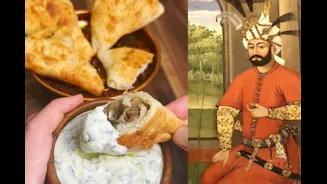





The samosa is one of the most widely enjoyed street foods across the world, with roots that trace back to ancient culinary traditions. Persian manuscript from Mandu shows how this popular street food began
as a rich, courtly dish, a royal delicacy than a quick snack Indians now love.
A post on social media platform X, shared a 500-year-old samosa recipe for the humble and ever-green favourite samosa that was featured in a Persian manuscript. As per the post, this manuscript, which later passed through the hands of emperors like Akbar and Tipu Sultan, eventually made its way to the British East India Company before being housed in what is now the British Museum.
The post talks about the recipe having first appeared in the book Ni’matnama, or “Book of Delights,” written between 1501 and 1510 for the Sultan of Mandu in central India.
What stands out is how different the recipe is from the samosa we know today.
Instead of the familiar potato filling, the dish used roasted aubergine pulp, dried ginger, and lamb cooked with onion and garlic, then fried in ghee. There were no chillies either both potatoes and chillies arrived in India later, after this manuscript was written.
The result was a much richer, more layered dish, something closer to a royal delicacy than a quick snack we now love.
The samosa is one of the most eaten street foods on the planet. This is a 500-year-old recipe for it, written in Persian in a manuscript sitting in the British Museum.
The manuscript is called the Ni’matnama, the Book of Delights, written between 1501-1510 AD, for the Sultan of… pic.twitter.com/uEjIe77zQl
— Dr. M.F. Khan (@Dr_TheHistories) April 8, 2026
Over time, as ingredients evolved and the dish moved beyond royal kitchens, the samosa transformed into the street food staple we recognise today — simpler, cheaper and adapted to local preferences.
The story has sparked interest online, with many pointing out how deeply food is tied to history. “This shows how food is also a part of history and culture,” one user wrote.
Most people were surprised that this much-loved snack is not an Indian invention. “Everyone links the samosa to India today. It’s an immigrant,” a user said.
Some others, however, were cynical of this history, claiming, “The samosa is an Indian invention. The Arabs brought it back from India after their invasion in the 7th century.”
What now feels like an everyday snack carries a long, layered journey — from royal courts to roadside stalls — shaped by trade, migration and changing tastes over centuries.