









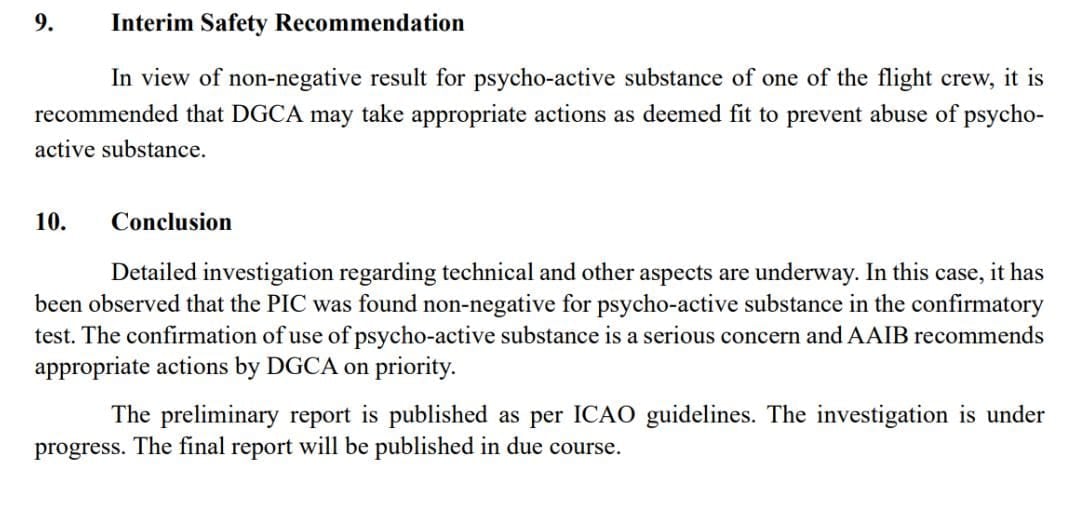
The preliminary report of the Aircraft Accident Investigation Bureau (AAIB) on the Air India Phuket-Delhi flight, which had suddenly lost 300 feet of altitude, on Friday confirmed that the Pilot-in-Command
had tested positive for a psycho-active substance in a confirmatory test.
The report, raising concerns over the pilot’s test, said, “The Pilot-In-Command was found non-negative for psycho-active substance in the confirmatory test. The confirmation of use of psycho-active substance is a serious concern and AAIB recommends appropriate actions by DGCA on priority.”
The Air India flight, operating from Phuket to Delhi on August 4, encountered a sudden 300-foot drop in altitude while flying over Odisha.
The incident left 20 passengers and four cabin crew members injured, prompting an investigation into the circumstances surrounding the sudden loss of altitude.
Also Read: Air India Pilot Couldn’t Stand Straight, Needed Help In Giving Sample For Dope Test
What Preliminary Report Revealed
The preliminary report said the aircraft lost all three hydraulic systems while cruising at 36,000 feet. The green hydraulic system failed first, followed seconds later by the blue and yellow systems.
The hydraulic failures caused the autopilot to disengage and triggered a brief stall warning. During the resulting altitude upset, the aircraft climbed 372 feet and then dropped 292 feet from its assigned level. The hydraulic systems recovered within seconds, after which the flight-control surfaces returned to normal.
The report said there was no adverse weather reported by either the crew or air traffic control during the incident. The sudden altitude change caused damage inside the cabin, including to overhead bins, ceiling panels and an emergency exit handle.
Also Read: ‘Pilot Was Not In Full Control, Things Started Floating’: Inside Air India Flight That Suddenly Lost 300 Feet
With the seat-belt signs switched off at the time, passengers and crew were injured. The flight continued to Delhi instead of diverting to the nearest airport.
Cause Of Incident Not Yet Established: Report
Meanwhile, investigators recovered the flight recorders, with the Cockpit Voice Recorder (CVR) and Digital Flight Data Recorder (DFDR) data now with the AAIB for analysis. Airbus experts also inspected the aircraft, while hydraulic components and samples were sent for testing.
The AAIB said its investigation into the technical and other aspects of the incident is still underway and that it has not yet established the cause of the accident. The final findings will depend on further analysis of the flight recorder data and other evidence.
On the psycho-active substance finding, the AAIB said the Pilot-in-Command was found non-negative in the confirmatory test and described the confirmation of psycho-active substance use as a “serious concern”. It has recommended that the DGCA take appropriate action on priority.
Also Read: Air India Flight Lost 300 FtAfter Triple Hydraulic Failure, Flight Controls Hit For 4 Seconds: Probe
What Happened On August 4?
The Airbus A320, carrying 137 passengers, including three infants, and eight crew members, was flying from Phuket to Delhi on August 4 when it experienced a sudden altitude variation of about 300 feet.
The aircraft later stabilised and landed safely in Delhi. After the incident, the pilot-in-command (PIC) of the Phuket-Delhi flight tested positive for marijuana in a confirmatory drug test.
The pilot-in-command of the Phuket-Delhi flight reportedly told investigators that he had been prescribed sleeping pills because of personal problems and claimed that the medication resulted in his positive drug test.
His conduct during the flight is also under examination after members of the cabin crew reportedly raised complaints about his behaviour.
With inputs from ANI