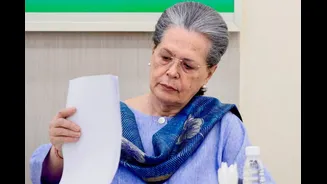






Congress Parliamentary Party chairperson Sonia Gandhi on Monday said the real controversy around the government’s proposed special session of Parliament is not women’s reservation but delimitation, warning
that the reported plan poses a serious threat to constitutional balance.
In an article published in The Hindu, Sonia Gandhi argued that any move to redraw parliamentary constituencies, especially one that increases the strength of the Lok Sabha, must be guided by political fairness and not reduced to a mere mathematical exercise.
She described the proposed approach to delimitation as “extremely dangerous” and an “assault on the Constitution.”
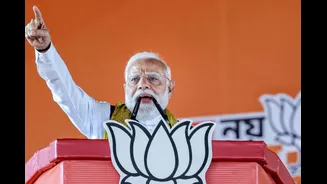
Sonia accused Prime Minister Narendra Modi of rushing through far-reaching constitutional changes during an election season to gain political advantage and keep the Opposition on the defensive.
She said the government was attempting to push legislation during a special sitting of Parliament of India while assembly elections are under way in Tamil Nadu and West Bengal.
Referring to the Nari Shakti Vandan Adhiniyam, passed unanimously in September 2023, Sonia noted that the law introduced Article 334-A, providing for one-third reservation for women in the Lok Sabha and state assemblies after the next Census and delimitation exercise.
She pointed out that the Opposition had demanded the immediate implementation of women’s reservation from the 2024 Lok Sabha elections, a proposal the government rejected at the time.
She questioned the government’s reported move to amend the law to enforce women’s reservation from 2029 instead, asking why it took over two years for the change of stance and why such urgency now justified a special session.
According to her, Opposition parties had repeatedly sought an all-party meeting after the conclusion of elections in West Bengal on April 29, but the request was turned down.
Sonia Gandhi also linked the special session to concerns over the delayed Census and the caste census. She accused the government of intentionally postponing the decadal Census. due in 2021, and alleged that the real motive behind the current legislative push was to further delay or weaken the caste census promised for 2027.
She rejected claims that a caste census would slow down population enumeration, citing the examples of Bihar and Telangana, where similar surveys were completed within months.
Highlighting the impact of Census delays, she said more than 10 crore people had been denied benefits under the National Food Security Act because population figures had not been updated.
She also questioned the government’s argument that the digital nature of the upcoming Census justified the urgency for delimitation, noting that official estimates suggest population data would only be available by 2027.
On delimitation, Sonia cautioned that states which successfully implemented population control measures, as well as smaller states, could lose political influence if seat allocation is based purely on population growth. A proportionate increase in seats, she warned, could still weaken their relative representation.
She further reiterated the Opposition’s demand for extending women’s reservation to include Other Backward Classes (OBCs), noting that while the 2023 law provides for reservation within Scheduled Caste and Scheduled Tribe quotas, it excludes OBC women.
Calling the government’s approach “deeply flawed and anti-democratic,” Sonia said there was no justification for rushing constitutional amendments during elections. She argued that the monsoon session of Parliament would have been a more appropriate forum after wider consultation and public debate.
“Reservation for women is not the issue, it has already been settled,” she wrote. “The real issue is delimitation, which, based on unofficial information, is extremely dangerous and undermines the constitutional framework.”
Parliament’s Budget Session has been extended, with a special three-day sitting scheduled from April 16 to 18, during which amendments related to the Women’s Reservation Act are expected to be introduced, even as polling continues across several states.