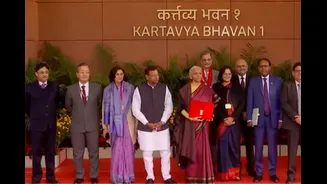

Finance Minister Nirmala Sitharaman opted for a handwoven Kancheevaram silk sari, honouring Tamil Nadu’s age-old weaving legacy, for her record ninth Union Budget speech on Sunday.
Over the years, Nirmala
Sitharaman’s sartorial choices on budget day have garnered as much attention as the budget speech itself, each one representing a different region of India and celebrating local weavers, crafts and textile heritage.
Here’s a look at her saree choices for past budgets presentations.
2025: Madhubani Art Saree (Bihar)
Her most talked-about choice was an off-white handloom silk saree adorned with Madhubani motifs such as fish and lotus designs. The saree, gifted by Padma Shri awardee Dulari Devi, paid tribute to Bihar’s folk art and women artisans. In an interview later, Devi said it had taken over a month to prepare the saree. Devi practices both ‘Kachnhi’ (line sketching) ‘and ‘Bharni’ (coloured) styles of Madhubani painting. Her work has been described by experts as “combining community traditions with modern themes”.
Full Budget 2024: Mangalgiri Handloom (Andhra Pradesh)
Nirmala Sitharaman chose an elegant off-white Mangalgiri saree with a bright magenta border in 2024. Known for its fine cotton texture and simple zari borders, the weave once again highlighted Andhra Pradesh’s handloom legacy.
Interim Budget 2024: Tussar Silk With Kantha Stitch (West Bengal)
For the interim Budget, the Finance Minister wore a blue tussar silk saree adorned with Kantha embroidery. The hand-stitched running threadwork is a signature craft of West Bengal and is valued for its intricate, storytelling patterns.
2023: Temple-Border Silk
Her maroon saree with a traditional temple border in 2023 reflected classic South Indian design elements, often associated with Karnataka’s weaving traditions. The look combined bold colour with cultural symbolism. The saree carried Karnataka’s Dharwad region’s hand-woven ‘Ilkal’ silk with traditional ‘Kasuti’ work. Kasuti is a traditional form of folk embroidery craft, with a geographical indication (GI) tag, said to be unique to Dharwad region. The hand-made kasuti work generally includes embroidery work of chariots, elephants, temple ‘gopura’, peacocks, deer, and lotus. The one worn by the Finance Minister had works of chariots, peacocks, and lotus on it. The heavy silk (800 gm) saree was designed by ‘Arathi Crafts’ owned by Arati Hiremath in Dharwad.
2022: Bomkai (Odisha)
In 2022, she opted for a rust-brown Bomkai saree from Odisha’s Ganjam district. The saree’s detailed threadwork and distinctive motifs showcased the craftsmanship of eastern India’s weavers. The colour brown is said to represent resilience and security, while red symbolizes warmth and power. The Finance Minister, who is known to prefer handloom weaves, completed the look with a white shawl and white face mask. The traditional ‘bahi khata’, meanwhile, which debuted in 2020, gave way to a Made-in-India tablet, wrapped in a red cloth with the emblem of the Government of India on it.
2021: Pochampally Ikat (Telangana)
In 2021, Nirmala Sitharaman wore a red and off-white Pochampally Ikat saree, known for its geometric patterns created through a complex resist-dyeing technique. The weave is one of Telangana’s most recognisable handloom exports.
2020: Yellow Silk With Blue Border
The yellow-gold silk saree with a blue border stood out for its bright, hopeful tone. Yellow is often associated with prosperity and optimism, making it a symbolic choice during a challenging economic period.
2019: Pink Mangalgiri handloom (Andhra Pradesh)
For her first-ever Budget presentation, Sitharaman wore a pink Mangalgiri saree with a gold border. The moment was also memorable for replacing the colonial briefcase with a traditional red bahi khata, signalling both cultural and political symbolism.
Nirmala Sitharaman’s saree choice every year is also of interest to political analysts since it usually indicates the ruling BJP’s electoral and political focus for that year.