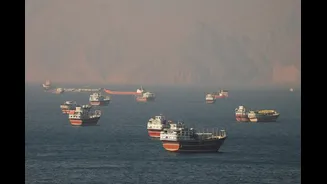










Soon after the United States and Iran announced that they had reached a peace deal, the Indian liquefied natural gas (LNG) tanker Disha became the first Indian merchant vessel to safely cross the Strait
of Hormuz on Monday.
Disha is operated and managed by the state-owned Shipping Corporation of India (SCI), and it was the first vessel to transit safely from Hormuz after nearly two months. The vessel was carrying Qatari LNG for India.
LNG tanker Disha’s transit through the Strait of Hormuz has given hope of safe passage to the other 34 Indian- and foreign-flagged ships, which are stranded in the Persian Gulf and are waiting to sail to Indian ports, The Times Of India reported.
Addressing the reporters on the recent developments in West Asia, Director in the Shipping Ministry, Opesh Kumar Sharma, said, “LNG carrier Disha has safely transited the Strait of Hormuz, and she is carrying 62,370 tonnes of LNG cargo. The vessel is supposed to enter Dahej, likely on June 18.”
Meanwhile, the joint secretary in the fertiliser department, Bandana Preyashi, said that out of the 16 important ships stuck in the strait, eight are carrying urea, four diammonium phosphate (DAP), three sulphur and one ammonia.
Also Read: Indian LNG Tanker Disha Among First Vessels To Cross Hormuz After US-Iran Deal Announcement
Will The Transit Of Ships Bring Relief To India?
If 16 of these ships, which are loaded with fertiliser, sail through the Hormuz, then it will augment the supply of the key soil nutrient, as per the policymakers.
However, any kind of improvement in energy supplies may not immediately translate into relief because of extensive damage to facilities like Ras Laffan in Qatar during the US-Iran war.
Even if shipping routes stabilise, India may not see an immediate improvement in energy supplies as significant damage to key gas facilities has cast uncertainty over when full operations can resume. The country relies on a long-term gas supply agreement with QatarEnergy’s Ras Laffan facility, making any disruption there particularly significant.
Also Read: ‘Hope This Time It Is For Real’: Shippers Want Tehran To Guarantee Safe Transit Through Hormuz
Officials said the UAE’s Habshan Gas Plant also suffered damage, affecting its operations. Around 60% of the plant’s capacity has already been restored, with recovery expected to reach 80% by the end of 2026 and complete structural restoration targeted for 2027.
They also revealed that two liquefied natural gas (LNG) processing trains at QatarEnergy’s state-owned Ras Laffan complex were damaged, reducing the facility’s capacity by roughly 17%.
India’s dependence on the region underscores the potential impact of any prolonged disruption. Before the conflict, the country imported more than 88% of its crude oil requirement, with nearly half sourced from West Asia.
More than 60% of India’s imported LNG passed through the Strait of Hormuz, while nearly 60% of its LPG imports also came from West Asia, with about 90% of those shipments transiting through the strategic waterway.