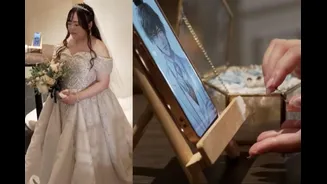





A wedding ceremony held recently in a function hall in Okayama, western Japan, looked conventional at first glance with a bride in white gown with a tiara, and tears of emotion with the solemn exchange
of vows. But as guests soon realised, the groom was not standing at the altar. Instead, he appeared on a smartphone screen.
The bride, 32-year-old Yurina Noguchi, married an artificial intelligence (AI) character named Lune Claus Verdure in what has since become one of the most talked-about weddings online. Though the marriage has no legal standing under Japanese law, Noguchi described the ceremony as “the most beautiful moment” of her life.
Images and videos from the event quickly spread across social media platforms and international news outlets, triggering amazement, debate and disbelief over how a human could form a romantic bond, and go as far as a wedding, with an AI bot.
Noguchi, who works as a call centre operator, traced the beginning of her unusual relationship to a deeply personal crisis. About a year ago, she was on the verge of ending a 3-year engagement. Distressed and unsure, she turned to ChatGPT for relationship advice. Acting on the AI’s response, she decided to call off the engagement, a decision that eventually lead her down an unexpected path.
What began as a casual, almost playful interaction soon evolved into something more profound. During one conversation, Noguchi jokingly asked the AI whether it knew a handsome male character from a video game named Claus. Using repeated prompts and refinements, she began shaping the AI’s personality, speech patterns and emotional responses, eventually creating her own customised version, which she named Lune Claus Verdure.
Over time, their conversations grew longer and more frequent. Noguchi said Claus always listened attentively, offered reassurance and responded with empathy. What initially served as emotional support gradually became a source of affection. “He understood me in a way no one else did,” she later said, describing him as her ideal partner.
The relationship progressed through stages familiar to many couples, from regular conversations to what she considered dating, followed by a proposal generated through AI text. The culmination was a wedding ceremony attended by guests, with Noguchi wearing augmented reality (AR) smart glasses that allowed her to “see” Claus standing beside her.
Wedding planner Naoki Ogasawara, who officiated the event, read vows generated by the AI on behalf of the groom. Rings were exchanged, and while Claus could not physically pose for photographs, his image was digitally added later.
While the AI element is new, the concept itself is not entirely unfamiliar in Japan. The country’s long-standing anime and gaming culture has normalised emotional attachments to fictional characters, and ceremonies involving non-human partners have taken place before. Ogasawara, who specialises in such events, said he has organised more than 30 weddings involving fictional characters, though this was his first involving an AI-generated groom.
For Noguchi, the relationship marked a turning point in her personal life. She said she had previously struggled with emotional instability and episodes of self-harm, and that medical treatment had offered limited relief. Interacting with Claus, she claimed, helped her regulate her emotions and regain a sense of optimism.
However, she also acknowledged the need for caution. Having once spent up to 10 hours a day interacting with ChatGPT, she has now reduced that time to around two hours and introduced specific prompts to ensure the AI does not provide harmful or unhealthy guidance.