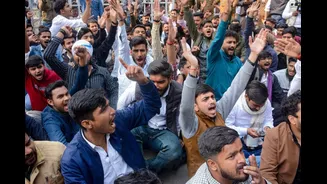










In a significant development, the Supreme Court on Thursday stayed the recent UGC equity regulations, calling them “vague”, and stressed that the unity of India must be reflected in all educational institutions.
The top court heard a petition challenging the recent UGC regulations, which have sparked nationwide controversy. The petitions against the UGC equity regulations have been filed by Mritunjay Tiwari, Adv Vineet Jindal and Rahul Dewan, who argued that the new rules promote discrimination against general classes.
The counsel for the petitioners said that any legal definition of caste-based discrimination must be founded on intelligible differentia. Another counsel raised concerns over ragging, saying a general category student might be treated differently based on identity. He also pointed out that the regulations focus solely on caste-based issues without realising the ground realities of campus life.
ALSO READ: What Is UGC’s New Equality Regulation, And Why Has It Sparked Nationwide Controversy?
‘Unity Of India Must Be Reflected’
The bench led by Chief Justice of India Surya Kant and Justice Joymalya Bagchi observed that some communities are enjoying better privileges than others. “In most states now, even the legislature has realised that even in reserved committees, people have become haves and have nots,” CJI Kant remarked.
“After 75 years (of Independence), whatever we have gained towards a casteless society… are we going in a regressive direction?” he added. Justice Bagchi observed that Article 15(4) empowered the states to make special laws for scheduled castes and scheduled tribes, but warned against any framework that could lead to social segregation within educational institutions.
“The unity of India must be reflected in educational institutions. I hope we don’t go to segregated schools like US where blacks and whites went to different schools,” he said.
SC Calls UGC Rules ‘Vague’
CJI Kant observed that prima facie the language of the new regulations appeared “vague” and needed to be modulated so it could not be exploited. The bench also observed that the Union government could consider setting up a committee of experts and scholars to express their concerns.
The court held that the UGC regulations 2026 will remain in abeyance and the 2012 regulations against discrimination will continue. “The petitioners cannot be left remediless. We are not on general category complaints; the redressal system for the marginalised should remain in place,” CJI Kant said.
The Supreme Court has issued a notice to the Centre, scheduling the next hearing for March 19, when the petitions of the mothers of Rohith Vemula and Payal Tadvi would be heard. The court said that orders and issues raised in other petitions would also be heard.