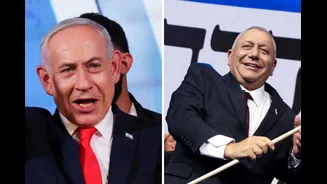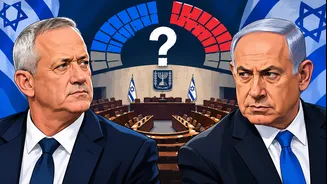






The counting of votes in Israel’s closely watched parliamentary election has concluded, leaving no political bloc with the numbers needed to form a government independently. While Netanyahu’s Likud has retained
its position as the country’s largest political party, the opposition, led by former military chief Gadi Eisenkot, has emerged with a substantial parliamentary presence. The Arab-led parties, meanwhile, have secured a record 19 seats, placing them in a potentially decisive position in determining the next government.
The final tally, released by Israel’s Central Elections Committee on Thursday, October 29, confirms a fragmented mandate, with the political battle now shifting from the ballot box to coalition negotiations.
According to the final results, Likud won 27 seats, followed by Eisenkot’s Yashar party with 21. Naftali Bennett’s B’Yachad secured 12 seats, while the Joint List won 11. The results underline how, despite finishing ahead of its rivals, Netanyahu’s party has failed to translate its electoral lead into a clear parliamentary majority.
Read More: Israel Election: 100% Votes Counted, Netanyahu Bloc Leads With 53 Seats But Falls Short Of Majority
The outcome also raises questions about whether Netanyahu can retain power through another coalition arrangement, whether his opponents can come together, or whether
The 53-seat tally represents a considerable decline from the 68 seats controlled by Netanyahu’s outgoing coalition. The result is particularly significant because Likud’s 27 seats make it the largest party, but the prime minister’s traditional political partners have not delivered the numbers required to keep his government in power.
The final count also confirms a strong performance by the Arab-led parties. Their combined 19 seats represent an almost twofold increase from their 10 seats in the outgoing parliament, giving them unprecedented leverage in the next round of political negotiations.
Netanyahu’s Election Setback: Why He Is Not Out Of The Race Yet
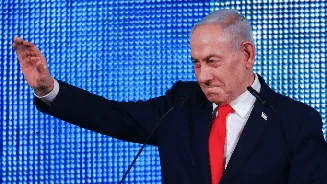
Despite losing his parliamentary majority, Netanyahu is far from politically finished. The prime minister’s supporters can point to one important outcome: Likud finished ahead of every other individual party, and Netanyahu’s bloc emerged as the largest of the two main political camps.
This gives him a legitimate claim to try to form the next government. More importantly, the fragmented outcome creates opportunities for political manoeuvring that could work in his favour.
Netanyahu remains prime minister while the coalition formation process unfolds. Even if neither camp manages to assemble a government immediately, he will continue in office in a caretaker capacity.
This is where the election setback could potentially turn into a political lifeline.
A prolonged deadlock would allow Netanyahu to remain at the helm of the government, retaining considerable authority over national security and foreign policy. It would also give his party additional time to regroup, negotiate with potential partners and exploit disagreements within the opposition.
For Eisenkot, meanwhile, the challenge is not simply defeating Netanyahu at the ballot box. He must demonstrate that the diverse parties that came together to challenge the prime minister can also agree on a common governing programme.
The opposition comprises centrist, liberal, right-wing and Arab political forces with considerable ideological differences. Their common opposition to Netanyahu does not automatically translate into agreement on governance, security, religion or the Palestinian question.
This contradiction could give Netanyahu another opportunity to survive politically.
Netanyahu’s Plan B: Can He Form A Unity Government With Eisenkot?
One of the most interesting possibilities emerging from the fractured mandate is a national unity government involving Netanyahu and his principal electoral rival, Gadi Eisenkot.
Although the two leaders contested the election from opposite sides, a unity arrangement could offer a way out of the parliamentary deadlock.
A potential coalition bringing together Likud, Eisenkot’s Yashar, Naftali Bennett’s B’Yachad and Avigdor Lieberman’s Yisrael Beytenu could command a parliamentary majority. Together, these parties have more than the 61 seats needed to form a government.
Such an arrangement would also reduce the dependence on the far-right and ultra-Orthodox parties that have traditionally supported Netanyahu.
However, the political costs of such an arrangement would be substantial.
Eisenkot and other opposition leaders campaigned on the promise of ending Netanyahu’s premiership. Joining hands with him would therefore risk alienating their supporters and undermining the mandate on which they contested the election.
Netanyahu, too, would have to make difficult compromises. His current political strength depends substantially on alliances with far-right and ultra-Orthodox factions, which have significant influence over his government’s ideological and legislative priorities.
A unity government would require him to accommodate more centrist positions and potentially abandon some of his existing partners.
There is also the question of leadership. Would Netanyahu continue as prime minister, or would the two sides agree on a rotation arrangement? Such questions could prove difficult to resolve.
The unity formula, therefore, remains a possible fallback rather than an immediately viable arrangement. It could become more attractive if both camps fail to secure the support required to form a government independently.
Arab Parties Emerge As Kingmakers
Perhaps the biggest political story emerging from the election is the performance of Israel’s Arab-led parties. The Joint List, which secured 11 seats, and Mansour Abbas’s Ra’am, which won eight, have together secured 19 seats in the new Knesset.
Their performance has significantly changed the arithmetic of government formation.
If Eisenkot manages to bring these parties on board, either through a coalition arrangement or external parliamentary support, the opposition could cross the 61-seat majority threshold.
However, this would require a major political shift.
Several parties within Eisenkot’s broader camp have historically resisted cooperating with Arab-led factions, particularly over differences concerning national security, Palestinian issues and the character of the Israeli state.
The Democrats, led by Yair Golan, have been more receptive to the possibility. Golan has called for the opposition to explore cooperation with the Arab parties following their strong electoral performance.
Eisenkot, meanwhile, has left the door open to working with them, subject to conditions.
The political significance of such cooperation goes beyond government formation. Arab-led parties could also help the opposition secure influential positions in the Knesset, including the parliamentary speaker’s post and control over the legislative agenda.
The Joint List’s Ahmad Tibi has indicated that his party has been approached by opposition representatives regarding replacing the Knesset speaker and would support their candidate.
This could allow the opposition to influence parliamentary proceedings and advance legislation even before a new government is formed.
It would be a significant development in Israeli politics. Until 2021, no Arab party had joined an Israeli governing coalition. Ra’am subsequently became part of the Bennett-Lapid government, although that arrangement was short-lived.
The latest results have therefore revived a question that could determine Netanyahu’s political future: Can Jewish opposition parties overcome their reservations and work with Arab representatives to prevent his return to power?
‘Election Was Stolen’: Netanyahu Camp’s Allegations Add To Political Tensions
Even as parties prepare for coalition negotiations, the election has triggered another controversy, with Likud alleging that the results were influenced by foreign interference.
Netanyahu’s party amplified claims that the election had been stolen, alleging that Arab-led parties may have benefited from outside assistance. Some Likud figures reportedly pointed towards Qatar, a country that has frequently been criticised in Israel over its relationship with Hamas.
However, these allegations have not been substantiated. The head of Israel’s Central Elections Committee, Supreme Court Justice Noam Sohlberg, referred claims of possible foreign interference to the Shin Bet security agency for investigation after receiving information about alleged interference.
The election committee subsequently clarified that the investigation was based on classified intelligence and did not affect the final election results. Acting director general Dean Livne also cautioned against reports suggesting systematic electoral violations, saying such allegations were unfounded.
Qatar rejected the allegations, describing them as dangerous and ridiculous. The opposition has accused Netanyahu’s camp of attempting to delegitimise the election outcome and undermine the participation of Arab citizens.
Eisenkot said Likud was questioning the results because it had lost, while Ra’am leader Mansour Abbas also rejected any suggestion of wrongdoing by his party.
The controversy is particularly sensitive given that Arab citizens, who constitute around 20 per cent of Israel’s population, turned out in significant numbers during the election.
Critics have argued that Netanyahu’s campaign against Arab-led parties may have contributed to their mobilisation, with voters viewing the election as an opportunity to challenge the prime minister’s political leadership.
President Isaac Herzog has urged restraint, describing the situation as sensitive and calling for an investigation without casting suspicion on an entire community.
AP News
Why The Hung Parliament Could Work In Netanyahu’s Favour
The election outcome has created an unusual political situation in which Netanyahu could potentially benefit even without securing a new parliamentary majority.
There are several possible scenarios.
1. Netanyahu manages to attract opposition partners: The prime minister could attempt to persuade one or more opposition leaders to abandon their commitment to keeping him out of office. Even a limited shift in political loyalties could alter the parliamentary arithmetic.
2. Eisenkot forms a government with Arab support: The opposition could attempt to form a government with the backing of the Joint List and Ra’am. This would give it the numbers required to challenge Netanyahu, although ideological differences and disagreements over security policy could make the arrangement fragile.
3. A national unity government: If neither side can form a stable coalition, a broader government involving Likud and centrist opposition parties could emerge as a compromise.
4. Israel heads for another election: If repeated attempts to form a government fail, the country could be forced into another parliamentary election, potentially as early as next year.
The last possibility could also favour Netanyahu. Remaining caretaker prime minister would allow him to retain executive authority while his opponents struggle to maintain unity. A fresh election would also give Likud an opportunity to consolidate its support and potentially reverse the losses suffered by its coalition partners.
However, it could equally give the opposition another opportunity to mobilise voters against Netanyahu.
What Happens Next? Knesset To Be Sworn In On November 10
With the counting process complete, attention now shifts to the formal certification of the results and the subsequent government formation process. The Central Elections Committee has published the final seat allocations, with the official results scheduled to be submitted to President Isaac Herzog on November 4, following examinations of possible errors and other inquiries.
The newly elected 26th Knesset is scheduled to be sworn in on November 10.
Herzog will then play a central constitutional role in the government formation process. Following consultations with political parties, he will entrust a candidate considered most capable of assembling a parliamentary majority with the task of forming a government.
If the first candidate fails, another leader could be given an opportunity. If subsequent attempts also fail, the country could face another election.
Herzog has already urged political leaders to approach the process with an open mind, emphasising the need to avoid another round of elections.
Meanwhile, the political significance of the new parliament extends beyond the prime minister’s position. The opposition could potentially gain control of key parliamentary positions and pursue legislation, including demands for a national commission of inquiry into the security failures surrounding the October 7, 2023, Hamas-led attacks on Israel.
For Netanyahu, losing power could also have significant domestic political implications. He continues to face longstanding corruption allegations, which he denies, and the possibility of greater scrutiny over his government’s handling of the October 7 security failures.
For now, Netanyahu has not been voted out of office, but neither has he secured the numbers to govern comfortably. Likud’s emergence as the largest party gives him a negotiating advantage, while Eisenkot’s opposition has the potential to assemble a majority if it can overcome its internal contradictions and reach an understanding with Arab-led parties.
The next few weeks will determine whether Israel gets a new government, an unlikely political partnership or another election.