








Mumbai’s aviation ecosystem is on the cusp of a major transformation—one that won’t be marked by new runways or towering terminals, but by a fundamental change in how aircraft are guided through some of the most
congested airspaces in the world.
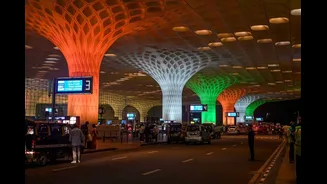
Chhatrapati Shivaji Maharaj International Airport, the world’s busiest single-runway, mixed-mode airport, is preparing to handle more aircraft and passengers—not by building new concrete, but by rewriting the rules of how planes land.
The Airports Authority of India (AAI) has started the process to bring in global technology providers for end-to-end supply, installation, testing, training, and long-term support, with a target to make the system operational before the end of 2028. CNN-News18 has accessed a document that details the plan.
If delivered on schedule, this invisible tech shift could unlock new flight slots, ease congestion, and future-proof India’s busiest airport—proving that sometimes, the biggest infrastructure upgrades happen not on the ground, but in the sky.
With over 55 million passengers and more than 3.3 lakh aircraft movements in 2024-25, Mumbai’s skies are already stretched. And with India’s air travel demand projected to grow steadily over the next two decades, the pressure is only going to rise.
What AAI is Planning
The plan is to move towards precision-based air traffic control, replacing traditional, estimation-heavy methods with machine-enabled decision support. The idea is to introduce an Intelligent Approach system built around Time-Based Separation, allowing aircraft to be sequenced more accurately on final approach.
The result: smoother landings, tighter yet safer spacing between aircraft, and operations that run closer to the runway’s true maximum capacity.
Today, Mumbai airport operates at about 44 to 46 aircraft movements an hour. Variations in spacing, aircraft bunching and peak-hour spillovers often force traffic flow restrictions and increase workload for air traffic controllers.
The new system aims to change that by giving controllers advanced tools that calculate optimal arrival times in real time, factoring in aircraft performance, wake turbulence, and prevailing conditions. “Less guesswork, more precision,” is how one top official described it, while speaking to CNN-News18.
The benefits go beyond capacity. By cutting unnecessary track miles during arrival, airlines stand to save fuel and reduce emissions, while controllers gain breathing space to plan ahead rather than constantly firefight.
Crucially, the system will be integrated with existing automation, surveillance upgrades and digital pilot-controller communications, and will manage approaches for both Mumbai and the upcoming Navi Mumbai airport through a common control framework.
The Challenge Currently
Between April 2024 and March 2025, Mumbai airport handled more than 55 million passengers and over 3.3 lakh aircraft movements, making it the second-busiest airport in India.
All this traffic is managed on a single primary runway handling both arrivals and departures—an operational reality that places Mumbai in a league of its own globally.
As air travel demand in India is projected to grow at an average annual rate of 5.6 percent over the next two decades, the strain on Mumbai’s airspace is only expected to intensify.
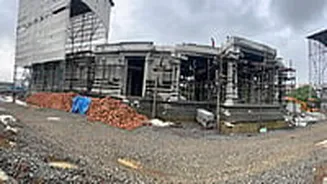
While the upcoming Navi Mumbai airport will absorb a significant share of future growth, Mumbai airport is far from being capped. Terminal 2 is already under expansion to add capacity for another five million passengers annually.
Importantly, the new system will serve not just Mumbai but also the neighbouring Navi Mumbai airport through a common approach control framework, ensuring coordinated and efficient use of airspace in the Mumbai region.
Mumbai ATC has already laid the groundwork. Advanced Arrival Manager and Departure Manager tools are nearing full integration, surveillance has been strengthened through Automatic Dependent Surveillance systems, and digital controller–pilot data link communications are being used for suitably equipped aircraft.
The proposed Intelligent Approach system will sit on top of this ecosystem, fully integrated with the existing ATM automation platform.