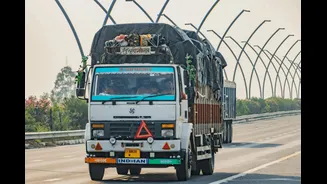








Haryana’s expanding network of highways and expressways is transforming the way people travel, cutting journey times, improving connectivity and strengthening links with neighbouring states. According
to a report by The Indian Express, decades of road development have reshaped the state’s transport landscape, with several major projects already operational and more under construction.
For many residents, Haryana’s expanding highway network has dramatically shortened travel times over the past two decades. Journeys that once took eight to 10 hours have gradually been reduced to around four hours through the development of key corridors such as the Bawal-Panipat Highway and the Trans-Haryana Expressway (NH-152D), also known as the Ambala-Narnaul Expressway.
Haryana’s Strategic Position
Haryana’s location around the National Capital Region (NCR) has made transport infrastructure a key component of its development strategy.
Fourteen of the state’s 22 districts, covering around 25,327 sq km, fall within the NCR, making efficient road connectivity crucial for economic activity, trade and daily commuting.
Both the Bharatiya Janata Party (BJP), which has governed the state for more than a decade, and the Congress, which previously held power for a similar period, have highlighted their contributions to the expansion of the state’s road network.
New Link To Connect Two Major Expressways
Among the latest projects under development is an 86-km road that will connect the Trans-Haryana Expressway with the Delhi-Mumbai Expressway.
Officials believe the link corridor will improve travel between northern and western India while helping reduce traffic congestion across the Delhi-NCR region.
Faster Journeys Across Northern India
Several highway projects are expected to significantly reduce travel times for motorists.
The upgraded Chandigarh-Ambala-Delhi highway is projected to cut the Chandigarh-Delhi journey by around one-and-a-half hours, compared with earlier travel times of up to five hours.
The Delhi-Katra-Amritsar Expressway is expected to bring even greater changes. Once operational, travel between Delhi and Katra could be reduced from 12 to 13 hours to around six hours, while the Delhi-Amritsar journey could fall from seven to eight hours to about four hours.
The Haryana stretch of the expressway, extending from the Kundli-Manesar-Palwal (KMP) Expressway junction to the Kaithal junction on NH-152, has already been completed and is expected to save more than two hours for travellers between Delhi and Kaithal.
Highway Network Has Expanded Rapidly
Official figures illustrate the scale of Haryana’s infrastructure growth over the decades. When the state was formed in 1966, it had just five National Highways covering a combined length of 655 km. By 2014, the network had expanded to 18 National Highways spanning 2,050 km. Since then, another 22 National Highways have added around 1,390 km.
Today, Haryana has approximately 40 National Highways with a combined length of about 3,440 km.
Government Highlights Infrastructure Push
Haryana Public Works (Buildings and Roads) Minister Ranbir Singh Gangwa attributed the pace of development to coordination between the state and Central governments. According to him, close cooperation between the two administrations has accelerated project execution, with additional highway developments planned in the coming years.
Chief Minister Nayab Singh Saini said that over the past 11 years, around 1,719 km of National Highways had been constructed at a cost of Rs 28,582 crore, resulting in every district in Haryana being connected to the National Highway network. The Chief Minister has also directed officials to complete the widening of all 12-foot-wide roads to 18 feet by March 2027.
To support these plans, the state’s infrastructure budget has been increased by 22%, rising from Rs 4,830.73 crore in 2025-26 to Rs 5,893.66 crore for 2026-27.
Major Highway Projects Reshaping Haryana
- Delhi-Katra-Amritsar Expressway (NE-05): The expressway is expected to reduce travel time between Delhi and Katra to around six hours and between Delhi and Amritsar to approximately four hours.
- Chandigarh-Ambala-Delhi Highway:The upgraded route is projected to shorten the Chandigarh-Delhi journey by about one-and-a-half hours.
- Trans-Haryana Expressway (NH-152D): The greenfield corridor, along with its proposed link to the Delhi-Mumbai Expressway, provides improved east-west connectivity and has reduced travel times between Jind, Ambala and Chandigarh to around two hours.
- Dwarka Expressway: The expressway strengthens links between Delhi and Gurugram, easing congestion on NH-48 while improving airport access.
- Gurugram-Rewari NH-352W: The highway is designed to improve connectivity between Gurugram and Rewari, reducing travel times.
- Delhi-Mumbai Expressway Extension: The Haryana section passes through Gurugram, Nuh and Palwal, strengthening connectivity with western India.
- Sonipat-Jind NH-352A: The 80-km highway improves travel between Sonipat and Jind.
- Rohtak-Jind And Narwana NH-352: The route provides smoother connectivity between Jind, Rohtak, Delhi and Punjab.
- Panipat-Dabwali National Highway: The corridor strengthens east-west connectivity by linking Panipat, Karnal, Jind, Fatehabad, Sirsa and western Haryana.
- Ambala-Kala Amb NH-7 And NH-344: The highways improve connectivity between Haryana and Himachal Pradesh while supporting tourism, trade and freight movement.
- Ambala-Shamli Highway (NH-344GM): The project creates a direct transport corridor between Haryana and western Uttar Pradesh.
- Rewari-Ateli Mandi NH-11: Stretching from Rewari into western Rajasthan, the highway is intended to support interstate commerce, tourism and passenger movement.
With new expressways, expanded National Highways and large-scale road widening projects, Haryana’s transport network is undergoing one of its biggest transformations since the state’s formation. As major corridors become operational and new links are added, the focus remains on reducing travel times, strengthening economic activity and improving connectivity both within Haryana and across northern India.