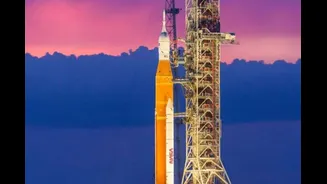

NASA has postponed key milestones for its Artemis II mission, delaying both a crucial pre-launch fuelling test and the earliest possible liftoff of the historic crewed Moon mission.
The delay comes as an
unusual Arctic cold wave grips Florida, bringing freezing temperatures and strong winds to the Kennedy Space Center.
The unexpected weather conditions have prompted NASA engineers to prioritise the protection of the Space Launch System (SLS) rocket and the Orion spacecraft, both of which are highly sensitive to extreme cold.
Florida’s space coast, typically known for its mild climate, is rarely exposed to such conditions.
However, the current cold snap poses a tangible risk to flight hardware, forcing teams to deploy specialised heaters and environmental control systems to safeguard Orion.
NASA officials said the adverse weather made it unsafe to proceed with the mission’s wet dress rehearsal, a critical test that involves loading more than 700,000 gallons of cryogenic propellants into the rocket.
Conducting the operation during freezing conditions would violate safety protocols designed to protect equipment and personnel.
As a result, the space agency has opted to wait for improved weather to ensure the rehearsal can be completed without complications.
Revised Timeline
The wet dress rehearsal, initially planned for the weekend, has now been rescheduled for February 2.
The test is the final full-scale simulation of launch day procedures and is considered the last major technical checkpoint before crewed flight.
Due to the shift, the previously targeted launch windows of February 6 and 7 are no longer feasible.
NASA officials now say the earliest possible launch date for Artemis II is February 8, provided the rehearsal is completed successfully and no further issues arise.
The mission will carry four astronauts, Reid Wiseman, Victor Glover, Christina Koch, and Canadian Space Agency astronaut Jeremy Hansen, on a journey around the Moon, marking humanity’s return to lunar orbit for the first time in more than five decades.