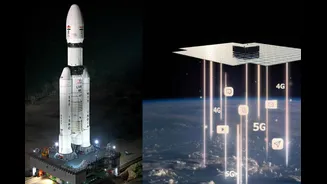










The Indian Space Research Organisation (ISRO) is bidding goodbye to 2025 with a historic LVM3 M6 mission. On December 24, the space agency is set to launch its heavy-lift Launch Vehicle Mark-3 (LVM3) carrying
a satellite that could quietly reshape how the world stays connected.
Unlike earlier missions focused on scientific exploration or national capability, this launch speaks directly to an everyday concern for billions of people: mobile connectivity. Under a commercial agreement with a US-based company, AST SpaceMobile, ISRO will place the BlueBird Block-2 communication satellite into Low Earth orbit (LEO).
The mission is historic on several counts. BlueBird Block-2 will be the largest commercial communications satellite ever deployed in LEO and the heaviest payload launched by the LVM3 from Indian soil.
Yet beyond these record-breaking milestones lies a more consequential story—how this next-generation satellite could transform the global communication landscape by delivering cellular connectivity directly from space to everyday smartphones.
What Is the BlueBird Block-2 Satellite And How Is It Different?
The BlueBird Block-2 satellite is part of a next-generation Low Earth Orbit (LEO) satellite constellation designed to provide space-based cellular broadband connectivity directly to standard smartphones.
This constellation will enable 4G and 5G voice and video calls, texts, streaming, and data for everyone, everywhere, at all times. It features a 223m² phased array, making it the largest commercial communications satellite ever deployed into low Earth orbit.
Unlike conventional satellites that relay signals to ground stations or specialised equipment, BlueBird Block-2 is designed to communicate directly with standard 4G and 5G smartphones.
The satellite effectively functions as a powerful cell tower in space. Using advanced antennas and cellular spectrum, it can connect with unmodified smartphones on Earth, eliminating the need for satellite phones, external antennas, or additional devices.
In practical terms, a regular mobile phone could connect to a satellite overhead, much like it connects to a mobile phone network tower today.
Traditional satellite communication systems have long been associated with bulky hardware, high costs, and limited usability for everyday consumers. Satellite internet services typically require dishes or terminals and often suffer from latency issues, making them unsuitable for seamless mobile use.
The Blue Bird Block-2 works on direct-to-device technology, which integrates with existing mobile networks, using cellular frequencies rather than separate satellite infrastructure.
How It Works
Once a smartphone moves beyond the reach of a cell tower, it can automatically connect to the BlueBird satellite network. From the user’s perspective, nothing changes. Calls go through, messages are delivered, and data services continue to work as they normally would. The only difference is the path the signal takes—travelling upward to a satellite orbiting hundreds of kilometres above Earth instead of to a ground-based tower.
BlueBird satellites are equipped with some of the largest phased-array antennas ever deployed in low Earth orbit, allowing them to capture the extremely weak signals transmitted by standard smartphones. The satellite then relays the signal to a ground station, known as a gateway. Unlike traditional networks that rely on dense infrastructure, only a small number of gateways are needed per country, strategically positioned to ensure optimal coverage and performance.
Because the signal travels such long distances, it is affected by natural delays and the Doppler effect, a slight change in frequency caused by the satellite’s high orbital speed of around 17,000 miles per hour. These challenges are corrected in real time using specialised gateway technology, ensuring the connection remains stable and clear.
From the gateway, the signal is routed into the user’s existing mobile operator network—whether AT&T, Verizon, Vodafone, or one of AST SpaceMobile’s many global partners. The call or data session is then delivered to its destination, functioning just like any other mobile connection, as though it never left Earth.
How Could This Change Communication?
The potential impact of direct-to-smartphone satellite connectivity is far-reaching. Large areas of the world still experience patchy or nonexistent mobile coverage, particularly in remote rural regions, mountainous terrain, deserts, and open seas. Extending ground-based networks into these areas is often expensive, slow, or impractical.
According to the International Telecommunication Union data, more than two billion people remain offline as of 2025, most of them in low and middle-income countries.
A satellite-based cellular network could bridge these gaps, offering reliable connectivity in places long considered unreachable. Beyond convenience, this could transform how people communicate during emergencies.
Natural disasters frequently damage or disable ground infrastructure, cutting off access at critical moments. A space-based network, independent of terrestrial towers, could provide a vital communication lifeline when it is needed most.
For developing regions, the implications are even broader. Improved connectivity can unlock access to digital services, education, healthcare, and economic opportunities, helping narrow the digital divide without waiting for large-scale infrastructure development.
This shift brings satellite communication closer to the everyday mobile experience, rather than positioning it as a niche or last-resort solution.
The aim is not limited to emergency communication, but full-scale mobile services, including voice calls, messaging, and broadband data, delivered straight from space to smartphones already in use.
What Does This Mean For India?
For India, the mission has both technological and strategic importance. Launching BlueBird Block-2 strengthens ISRO’s commercial profile and showcases India’s ability to support cutting-edge global telecom initiatives.
In the longer term, technologies like direct-to-device satellite connectivity could play a role in improving communication in border areas, maritime zones, and disaster-prone regions. The mission also aligns with India’s broader vision of combining space innovation with digital inclusion, positioning the country at the forefront of the next phase of global connectivity.
What’s Next?
The launch of BlueBird Block-2 marks only the beginning of a longer journey. Once in orbit, the satellite will undergo testing before commercial services can begin, and regulatory approvals will be required across different countries.
If BlueBird Block-2 performs as expected, it could mark the beginning of a future where staying connected no longer depends entirely on mobile towers, Wi-Fi routers, or physical infrastructure on the ground.
Meanwhile, competition in space-based connectivity is intensifying, with companies such as Starlink and Amazon’s Project Kuiper pursuing similar ambitions.