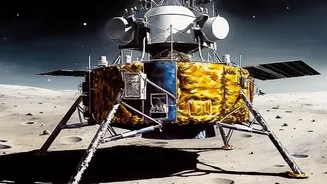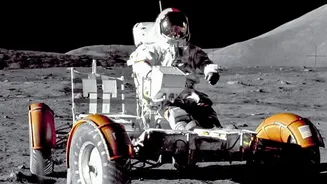






After Venezuela and Greenland Trump wants the Moon. US President Donald Trump’s latest post on the Moon has triggered a debate over who, if anyone, can claim ownership of the lunar surface.
On Monday, Trump
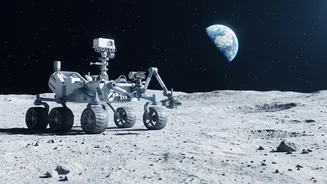
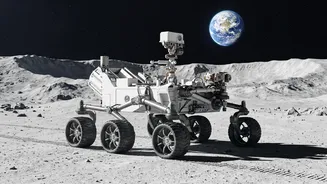
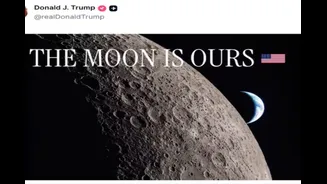
posted an AI-generated image of the Moon carrying a US flag on Truth Social with the caption, “The Moon is ours”, also reported as “THE MOON IS OURS”.
The three-word statement drew attention because the US is a party to the 1967 Outer Space Treaty, which specifically prevents countries from claiming celestial bodies as their territory.
However, Trump did not issue an executive order declaring the Moon US territory. A separate viral screenshot claiming that he had officially declared the Moon a US territory was found to be satire and not a genuine presidential post.
So, Who Owns The Moon? Article II of the 1967 Outer Space Treaty, developed through the United Nations, states that outer space, including the Moon, cannot be subject to national appropriation through sovereignty, occupation or any other means.
Article I also says exploration and use of outer space should benefit all countries.
This means putting a national flag on the Moon does not make the surrounding land part of that country. Countries can own spacecraft, equipment and other objects they send to the Moon, but the lunar surface itself cannot simply become national property.
Trump’s post, therefore, has no legal force and does not change US rights or obligations under the treaty. Legal analysts view it as political messaging rather than a formal sovereignty claim.
Why The Moon Is Back In Focus
The question of lunar ownership is becoming more relevant as countries prepare for a new phase of exploration.
NASA’s Artemis programme and the Artemis Accords involve an expanding group of countries working on principles governing activities around and on the Moon. According to Space.com, 71 countries had signed the accords as of 2026.
Governments and private companies are also looking at lunar resources, long-term research facilities and eventually permanent infrastructure. While the Outer Space Treaty permits exploration, it places limits on what countries can claim as their own.
Commentators say this is contributing to the emergence of “lunar geopolitics”, with the US, China, Russia and private companies advancing lunar programmes and competing over access, presence and future resource use.
Trump’s Broader Space And Geopolitical Messaging
The post came during a wider Truth Social spree in which Trump shared several AI-generated and provocative images and captions aimed at Iran and other geopolitical flashpoints.
These included an image depicting the Strait of Hormuz as a “new U.S. Territory” and another saying “Bye bye, Kharg”, referring to Iran’s oil terminal.
The Moon post also followed Trump’s August 28, 2026 speech at NASA’s Johnson Space Center. There, he honoured the Artemis II crew and spoke about returning to the Moon, establishing a permanent American settlement and eventually travelling to Mars.