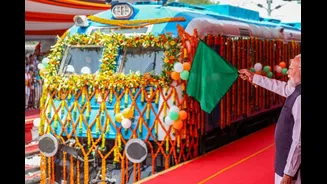








Just over a week after Prime Minister Narendra Modi flagged off India’s first hydrogen-powered passenger train, the project has already crossed an important milestone. Operating on the Jind-Sonipat section
of Northern Railway in Haryana, the train has travelled more than 1,200 kilometres, replacing over 3,200 litres of diesel with a propulsion system that emits only water vapour. The successful pilot has not only demonstrated the viability of hydrogen-powered rail transport in India but has also shifted attention to the next question: where will these trains run next?
The answer is likely to come in phases. While the Jind-Sonipat service remains India’s only operational hydrogen corridor, Indian Railways has already indicated that the next round of trials will move to the Delhi region. Beyond that, a mix of officially identified heritage routes and expert-suggested corridors could shape the future of hydrogen-powered rail travel in the country.
Why Jind-Sonipat Became India’s First Hydrogen Corridor
The 89-km Jind-Sonipat route was not chosen by chance. According to the Ministry of Railways, it offered the right mix of moderate passenger traffic, manageable operating conditions and space to develop India’s first integrated hydrogen rail ecosystem.
Besides the 10-coach train itself, the project includes a dedicated hydrogen production, storage, compression and dispensing facility at Jind. The train is powered by hydrogen fuel cells, which generate electricity through an electrochemical reaction between hydrogen and oxygen. Unlike diesel locomotives, the only direct by-product is water vapour.
The pilot is as much about testing hydrogen storage, refuelling systems and operational safety as it is about running a passenger service. Officials say the experience gained here will determine how quickly the technology can be expanded elsewhere.
Delhi Expected To Be The Next Testing Ground
With the Haryana pilot progressing smoothly, Indian Railways has said the next phase of operations will shift to the Delhi region. While the exact route has not yet been announced, the move is expected to test the train under busier operating conditions and denser passenger traffic than the relatively low-density Jind-Sonipat corridor.
A successful Delhi trial would provide valuable operational data before hydrogen trains are deployed more widely.
Heritage Railways Are High On The Long-Term Roadmap
The biggest clue to Indian Railways’ future plans lies in its ‘Hydrogen for Heritage’ programme.
Under this initiative, Railways has announced plans to develop 35 hydrogen-powered trains for eight heritage and hill railway routes, where conventional electrification may either be environmentally undesirable or technically challenging. The programme is intended not only to cut emissions but also to build domestic expertise in hydrogen propulsion, storage, maintenance and safety.
Although Railways has not officially named all eight routes for deployment, heritage railways are widely seen as the natural fit for hydrogen technology because they continue to rely largely on diesel traction while operating through ecologically sensitive areas.
Could Kalka-Shimla Be Among Them?
Among the strongest candidates discussed by railway experts is the Kalka-Shimla Railway, one of India’s UNESCO World Heritage mountain railways.
The narrow-gauge line presents exactly the type of operating conditions hydrogen trains are designed for. Installing overhead electrification across mountainous terrain is expensive and can alter the heritage character of the railway. Hydrogen trains, on the other hand, can provide zero-emission operations without requiring continuous overhead electric infrastructure.
Earlier prototypes of India’s hydrogen programme had also been linked to the Kalka-Shimla section during the development stage. While the operational pilot eventually moved to the Jind-Sonipat broad-gauge corridor, experts continue to view Kalka-Shimla as one of the most suitable destinations once the technology matures. However, Indian Railways has not officially confirmed the route for future deployment.
Other Routes That Could Benefit
Apart from Kalka-Shimla, experts believe hydrogen trains are best suited for routes where full electrification is either impractical or economically difficult. These include:
- Other heritage mountain railways such as the Darjeeling Himalayan Railway and the Nilgiri Mountain Railway.
- Short diesel-operated branch lines with relatively low passenger volumes.
- Environmentally sensitive corridors where reducing emissions is a priority.
These remain expert assessments rather than officially approved projects.
Hydrogen Will Complement, Not Replace, Electrification
Despite the excitement around hydrogen trains, they are not expected to replace electric trains on India’s main railway network.
Indian Railways has already electrified nearly its entire broad-gauge network, making conventional electric traction the most efficient option on busy routes. Hydrogen is instead being positioned as a clean alternative for the relatively small number of corridors where diesel locomotives are still operational and extending overhead electric wires may not be practical.
Globally, countries such as Germany have followed a similar approach, using hydrogen trains primarily on non-electrified regional and heritage routes rather than replacing electric rail systems.
For now, India’s hydrogen journey has only just begun. The Jind-Sonipat pilot is validating indigenous technology and operational safety, Delhi is expected to host the next phase of trials, and the long-term vision points towards heritage railways and other diesel-dependent corridors. Whether Kalka-Shimla becomes one of the first beneficiaries will ultimately depend on the results of the ongoing pilot and the pace at which India’s hydrogen ecosystem expands.