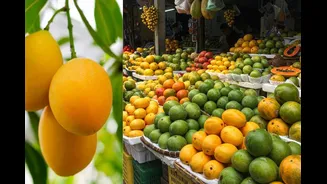

Bengaluru’s fruit markets are witnessing an unusual development this winter with mangoes making an early appearance, months before their traditional summer season. For a city accustomed to seeing mangoes arrive
around March and peak by April and May, the sight of the fruit in early January has sparked curiosity among shoppers and cautious interest among traders.
Wholesale and retail vendors across Bengaluru say supplies of off-season mangoes have been arriving steadily over the past few weeks. While the volumes are not overwhelming, the presence itself is significant enough to raise questions among consumers about quality, safety and pricing.
Which Mangoes Are Available Right Now
Traders say varieties such as Neelam and Banganapalli are currently being sold in Bengaluru markets. These mangoes are largely sourced from orchards in parts of Tamil Nadu and Andhra Pradesh, where off-season cultivation techniques have become increasingly common.
At present, Neelam mangoes are being sold at around Rs 160 per kg, while Banganapalli varieties are priced close to Rs 150 per kg. Sellers point out that these rates are higher than what consumers would typically pay during peak summer months, when supply is abundant and prices soften.
Buyers Curious, But Sales Remain Slow
Despite the novelty factor, traders say actual sales remain subdued. Many shoppers stop to enquire, examine the fruit and ask questions, but walk away without making a purchase. Vendors attribute this hesitation to two main concerns — doubts about artificial ripening and the relatively high prices.
Several consumers associate mangoes eaten out of season with chemical ripening or compromised taste. While some buyers are willing to try a small quantity out of curiosity, most prefer to wait for the natural summer crop, which they believe offers better flavour and aroma.
Why Mangoes Are Arriving Early
Agricultural experts say the early arrival of mangoes is not accidental. In several mango-growing belts of southern India, farmers now follow controlled cultivation practices that allow them to produce fruit outside the traditional season.
These methods involve inducing early flowering by applying specific plant growth regulators to the soil at precise stages of the crop cycle. When done correctly and within prescribed limits, this technique enables farmers to harvest mangoes between October and December, instead of waiting for the summer months.
Experts note that this practice has been adopted to tap into niche markets and fetch higher prices when mango supply is otherwise scarce.
Are Off-Season Mangoes Safe to Eat
According to agricultural specialists, the use of plant growth regulators for inducing flowering is permitted when applied correctly. They emphasise that these substances do not remain as residues in the fruit or soil when used in recommended quantities.
However, experts also point out that consumer scepticism often stems from confusion between flowering induction techniques and artificial ripening practices. While the former is a controlled agricultural method, artificial ripening using banned chemicals is illegal and unsafe.
Traders say clear communication and better awareness are needed to bridge this trust gap, especially when such produce enters urban markets like Bengaluru.
A Market Driven by Curiosity, Not Demand
At present, off-season mangoes in Bengaluru remain more of a novelty than a staple purchase. Vendors say the fruit attracts attention but does not translate into strong demand. Many sellers stock limited quantities to avoid losses, given the slower turnover.
Market insiders believe this trend may continue unless prices ease or consumers develop greater confidence in off-season produce. Some traders expect demand to pick up marginally if supply increases and rates soften, but most agree that peak consumption will only return during the summer months.
What Lies Ahead for Bengaluru’s Mango Market
For now, Bengaluru’s early mango season reflects broader shifts in agricultural practices and market experimentation. While science has enabled farmers to extend the mango calendar, consumer preferences remain rooted in tradition.
Until buyers are convinced about taste, safety and value, off-season mangoes are likely to remain an occasional indulgence rather than a regular purchase. As supplies continue to trickle into the city, traders and consumers alike are watching closely to see whether winter mangoes will ever find a permanent place in Bengaluru’s fruit baskets.