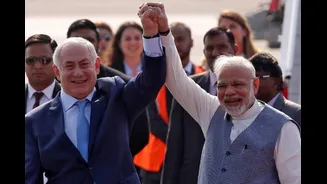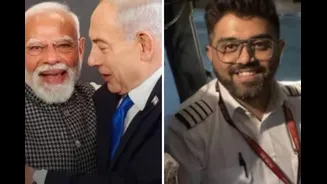


Israeli Prime Minister Benjamin Netanyahu on Thursday invited Prime Minister Narendra Modi to light a torch alongside Indian pilot Smit Machchhar on Israel’s Independence Day, praising the pilot for his
role in thwarting an alleged attempt to hijack a Tel Aviv-bound flight. In a post on X, Netanyahu said Modi had welcomed the invitation and highlighted the longstanding ties between the two countries.
“I spoke with my friend, the Prime Minister of India, Narendra Modi, and invited him to light a torch alongside a brave Indian pilot on Israel’s Independence Day,” Netanyahu said. “Modi thanked me for the invitation and said that, on the ground and in the air, India and Israel are fighting together against terrorism.”
Following the incident, Netanyahu spoke with Machchhar and praised him as a “true hero”. “You are a hero for Israel, India and the entire world. I invite you to light a torch on Israel’s Independence Day,” Netanyahu had told the pilot.
The invitation comes after Israeli President Isaac Herzog earlier this month invited Machchhar to Israel to honour him with the Presidential Award for Civilian Heroism.
WHAT IT MEANS
A Rare National Honour: Lighting the ceremonial flame during Israel’s Independence Day celebrations is considered one of Israel’s highest national honours. Traditionally, this prestigious tribute is strictly reserved for Israeli citizens. Extending this invitation to foreign nationals is a massive diplomatic exception, symbolizing the profound, elite status India holds in Israel’s foreign policy.
A Solidified Anti-Terror Alliance: The move highlights a shared security narrative. Captain Smit Machchhar was honored for thwarting a cockpit threat on a flight to Tel Aviv, prompting PM Modi to state that both nations stand together against terrorism.
Domestic Israeli Politics: The timing—just five days before a pivotal national election where Netanyahu faced a tight race—allowed Netanyahu to leverage his personal rapport with PM Modi to signal strong global standing to voters.
Strategic Balancing vs. Diplomatic Restraint: While Netanyahu amplified the invite publicly, India’s response remained measured:
The Indian Readout: Official statements focused on bilateral ties and West Asian tensions.
Call for Peace: Modi emphasized dialogue, diplomacy, and regional stability.
With celebrations scheduled for May, formal confirmation of Modi’s attendance remained pending from New Delhi.
INDIA-ISRAEL TIES
The invitation reflects a deepening Special Strategic Partnership between India and Israel, anchored in mutual security, counter-terrorism alignment, and high-level personal rapport between Prime Minister Narendra Modi and Prime Minister Benjamin Netanyahu.
Following PM Modi’s state visit to Israel in February 2026, both governments formally elevated their engagement into a Special Strategic Partnership for Peace, Innovation, and Prosperity. Beyond defence and intelligence sharing, cooperation has rapidly scaled across artificial intelligence, quantum computing, cyber security, high-tech manufacturing, water management, and agriculture.
Netanyahu’s spotlight on Captain Smit Machchhar (who thwarted a cockpit assault on a Flydubai flight) ties directly into Modi’s response that “on land and in the air, India and Israel are fighting terrorism together”. The gesture reinforces a public alignment where both nations project a united front against radical threats and cross-border violence.
Netanyahu has openly framed India as a core pillar of Israel’s global diplomatic strategy, viewing New Delhi as a vital friend amid shifting Middle Eastern alignments and international scrutiny. While Israel highlights the warmth and symbolism of the invite, New Delhi’s official readout carefully balances this close friendship with a consistent call for dialogue, diplomacy, and regional stability in West Asia.