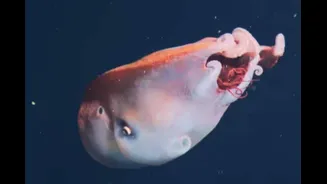









The depths of the ocean are full of enigmas that continue to astonish both scientists and the general public. Whenever one of these mysteries surfaces, it captures worldwide attention. Recently, near Monterey
Bay off the coast of California, USA, researchers recorded a rare and extraordinary sight.
About half a mile beneath the surface, in the dark expanse of the ocean, scientists captured footage of a rare octopus. Over the last 40 years, humans have observed this creature only four times. The video has now sparked widespread fascination. Scientists are particularly intrigued because this octopus differs significantly from typical octopus species in size, diet, and lifestyle.
A Rare Deep-Sea Encounter: The Seven-Arm Octopus
This giant octopus, formally known as Haliphron atlanticus, is commonly called the Seven-Arm Octopus. Although its name implies seven arms, it actually has eight. Experts explain that the male often conceals its eighth arm, used for reproduction, making it appear to have only seven arms.
The species inhabits parts of the ocean where sunlight barely penetrates, known as the deep or ‘Twilight Zone’.
Capturing The Moment
The Monterey Bay Aquarium Research Institute (MBARI) recorded this footage on November 6 using a Remotely Operated Vehicle (ROV) capable of deep-sea exploration.
The octopus was observed about 700 metres (2,300 feet) down in the Twilight Zone, where light is minimal and life remains largely mysterious.
In the footage, the giant octopus was seen holding a red helmet jellyfish, a bioluminescent creature that glows in the dark and usually avoids sunlight.
According to MBARI senior scientist Steven Haddock, the last time this species was observed, it was also eating a jellyfish-like gelatinous organism. This confirmed that even such a large octopus primarily relies on soft, gelatinous prey.
Size And Diet
The female of this species is particularly enormous. Scientists report that females can reach up to 13 feet (4 metres) in length and weigh up to 165 pounds (75 kg), making them among the largest octopus species in the world.
Despite their massive size, their diet is surprisingly light and primarily consists of jelly-like creatures, which continues to amaze researchers.
Scientific Significance
This discovery is remarkable for several reasons:
- The Seven-Arm Octopus has been seen only four times in 40 years.
- The footage confirms previous assumptions about its diet of soft-bodied, gelatinous animals.
- It provides new insights into life in the deep sea, showing that even giant animals can survive on low-energy food sources.
Scientists emphasise that most of the ocean remains beyond human reach. Observing such rare creatures highlights that the diversity of life on Earth is far greater than previously imagined.
This discovery is significant not only for marine biology but also demonstrates that much remains to be explored in the deep sea.