








Japan’s rapidly ageing population, falling birth rate and shrinking workforce have created severe labour shortages across hospitals, factories, warehouses, transport networks and retail stores. Unlike
many countries where AI is seen as a threat to jobs, Japan increasingly viewing it as a solution to keep its economy running.
Takahiro Anno, founder and leader of Team Mirai political party, had in February 2026 proposed to replace workers, including foreign nationals, with AI in order to tackle the country’s ageing society and labour shortages.
The country has been deploying humanoid nursing robots and has automated factories and warehouses not merely to improve productivity but as an economic necessity. Its AI experiment is attracting global attention, and provides a blueprint for countries that aspire to become AI leaders while preparing for long-term demographic change.
Why Does Japan Need AI More Than Most Countries?
Japan’s demographic challenge is unlike that of almost any other major economy. Almost 30% of its population is 65 or above, and its fertility rate is one of the lowest in the country. It recorded 671,236 births in 2025, the lowest annual figure since records began in 1899.
Meanwhile, the number of foreign nationals in Japan has been rising at a pace that offsets roughly 40% of that decline. According to the Immigration Services Agency, there were around 4.125 million foreign nationals in the country at the end of 2025, an increase of over 356,000 from the previous year.
Hospitals struggle to recruit nurses. Elderly care homes cannot find enough caregivers. Manufacturers are short of factory workers. Logistics companies, retailers, hotels and construction firms are also grappling with chronic vacancies.
According to a Reuters survey, two-thirds of Japanese companies say labour shortages are already having a serious impact on their businesses. Forecasts suggest the country could face a shortage of millions of workers over the coming decades if current demographic trends continue.
Unlike the US or Europe, where debates often centre on whether AI will replace workers, Japan faces almost the opposite problem. The challenge is not widespread unemployment—it is the lack of people available to do essential jobs.
A new study from the European Central Bank released in March said that fears about AI-driven job losses may be premature. On average, companies integrating AI are slightly more likely to hire more workers than cut with—with AI-intensive firms about 4% more likely to grow headcounts, and companies investing in the technology roughly 2% more likely to hire than firms that aren’t investing at all.
In the US, Meta, Coinbase and Block have each laid off at least 10% of their employees in recent months and partly blamed AI. About 13,000 jobs were eliminated among the three companies.
How Is AI Filling The Labour Gap?
Japan is experimenting with AI across almost every part of the economy. In offices, generative AI tools are helping employees draft reports, analyse data, prepare presentations and automate repetitive administrative work, allowing workers to focus on higher-value tasks.
Manufacturing has long been one of Japan’s strengths, and factories are becoming even smarter through AI-driven quality control, predictive maintenance and robotics that improve productivity despite smaller workforces.
Industrial giants such as Fanuc have deployed AI-driven automation across factories, while firms like SoftBank Robotics are using intelligent robots in service industries. In Japan, automation is not primarily about replacing workers—it is helping businesses cope with chronic labour shortages in a country where there simply are not enough people to fill available jobs.
Warehouses and logistics companies are increasingly using AI to optimise inventory management, route planning and supply chains as e-commerce expands and delivery workers become harder to find.
Retailers are introducing AI-powered customer service systems, automated checkout technologies and digital assistants to reduce dependence on frontline staff.
Perhaps the most striking example is healthcare and elderly care. On May 28, 2025, Japan’s Parliament (Diet) approved the ‘Act on the Promotion of Research and Development and the Utilisation of AI-Related Technologies’ (AI Promotion Act) to promote research and utilisation of AI to foster socio-economic growth and enhance human productivity.
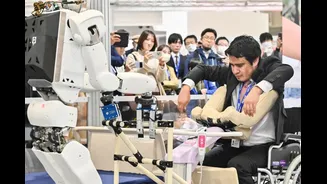
Researchers at Waseda University have developed an AI-powered humanoid robot called AIREC, designed to assist caregivers by lifting patients, changing positions in bed, folding laundry and supporting other physically demanding tasks. The robot is still under development, but it reflects Japan’s determination to use robotics to support one of the sectors facing the greatest staff shortages.
Japan’s service robot market is expected to triple to $2.7 billion by 2030, according to a research firm Fuji Keizai. The government is subsidizing robotics in nursing homes, which face a shortage of 570,000 caregivers by 2040.
Is Japan’s AI Strategy Working?
There are signs that AI is beginning to improve productivity across several industries, but Japan’s transformation remains a work in progress.
Businesses that have adopted AI report improvements in efficiency, while automation is helping companies continue operating despite persistent labour shortages. The OECD also notes that Japanese workers using AI are four times more likely to report that the technology has improved their working conditions rather than worsened them.
The automation-led productivity model has enabled Japan to “partially decouple its economic performance from demographic decline – an achievement that many ageing countries aspire to emulate”, a report by the Observer Research Foundation (ORF) said. However, significant challenges remain.
Many small and medium-sized enterprises lack the financial resources or technical expertise to deploy advanced AI systems. Older employees often require additional training before they can work effectively alongside AI tools. And in sectors such as healthcare, technology cannot replace empathy, emotional support and human judgement.
Even humanoid robots like AIREC are unlikely to enter widespread commercial use before the end of the decade because of technical complexity, safety requirements and high costs.
Is Japan’s AI Experiment A Blueprint For Other Countries?
A World Economic Forum report stressed how Japan’s progress in AI governance demonstrates “long-term planning, data integrity, transparency, technological enablement and workforce readiness as foundations for sustainable and trustworthy AI adoption”.
Japan is also building a regulatory framework to ensure AI is developed responsibly. Its recently enacted AI Act, shaped by the principles of the Hiroshima AI Process, seeks to strike a balance between encouraging innovation and promoting transparency, accountability and collaboration between the government and private sector.
The country has also launched initiatives such as AI Governance Navi, a framework that helps organisations adopt AI responsibly while ensuring human oversight, transparency and ethical standards remain central to its deployment.
Beyond domestic regulation, Japan is positioning itself as a global leader in responsible AI governance. By promoting principles such as trust, transparency and international cooperation through initiatives like the Hiroshima AI Process, Tokyo hopes to help shape common global standards that allow AI to be developed safely while remaining interoperable across countries.
For India, which is enjoying what economists describe as a demographic dividend with its young population, the Japanese experience still carries important lessons.
India is positioning itself as a global AI hub, with domestic start-ups, IT companies and research institutions building AI solutions for clients worldwide. Japanese companies are already investing in India’s technology ecosystem, creating opportunities for Indian firms to develop AI products tailored for ageing economies.
Over the longer term, India will not remain immune to demographic change. Thus, Japan’s experience suggests that AI should not be viewed only through the lens of job displacement. In societies facing worker shortages, AI could become essential for sustaining healthcare systems, manufacturing, logistics and economic growth.
For Japan, the real question is not “will AI take jobs?” It is “what happens when there aren’t enough people to do the jobs?”