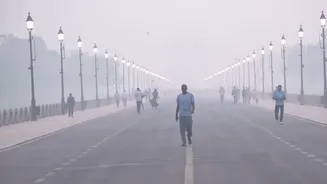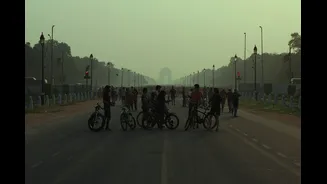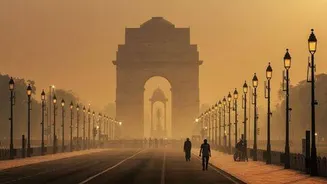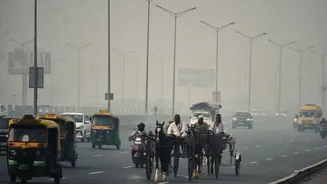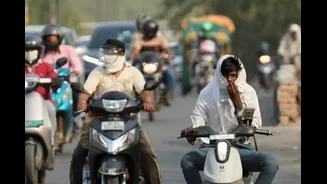





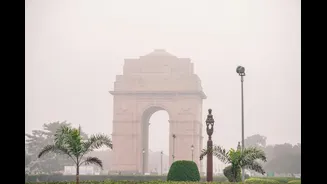


The Commission for Air Quality Management (CAQM) has imposed Stage-I of the Graded Response Action Plan (GRAP) in Delhi-NCR after the national capital’s air quality deteriorated to the ‘poor’ category
on Wednesday, following overnight Dussehra celebrations.
In a statement, the CAQM said that the restrictions have been imposed with immediate effect as Delhi’s air quality has worsened, with the Air Quality Index (AQI) reaching 244 at 2 pm on Wednesday.
It added that it had issued a revised schedule of the GRAP on September 29, 2026, directing all concerned agencies to implement the prescribed measures to mitigate air pollution across the National Capital Region (NCR) and adjoining areas.
“The Commission for Air Quality Management in NCR and adjoining areas has issued revised schedule of Graded Response Action Plan (GRAP) dated 29.09.2026 for implementation with immediate effect by all concerned agencies for mitigating air pollution in NCR…,” the CAQM said in a statement.
Delhi AQI To Stay In ‘Poor’ Category In Coming Days: IMD
The IMD and IITM forecasts also indicated that the AQI was likely to remain in the ‘poor’ category over the coming days, prompting the authorities to activate the first stage of the anti-pollution plan.
According to data from the Central Pollution Control Board (CPCB), Delhi’s Air Quality Index (AQI) stood at 238 at 10 am on Wednesday, marking the first ‘poor’ air quality day of the season. The reading was 59 points higher than Tuesday afternoon’s AQI of 179.
Data from 56 of Delhi’s 59 air quality monitoring stations showed that two locations, Jahangirpuri and Pusa, recorded ‘very poor’ air quality, with AQI readings of 308 and 314, respectively. Meanwhile, 16 monitoring stations, including Anand Vihar, reported ‘moderate’ air quality.
Why Are GRAP Restrictions Imposed?
GRAP restrictions are implemented in four stages based on the severity of air pollution. Stage I applies when the Air Quality Index (AQI) ranges from 201 to 300 (‘Poor’), Stage II when it is between 301 and 400 (‘Very Poor’), Stage III when it falls between 401 and 450 (‘Severe’), and Stage IV when it exceeds 450 (‘Severe Plus’).
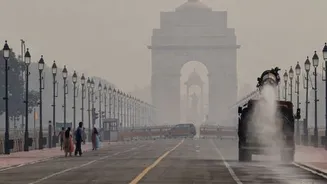
Under GRAP Stage I, several measures are enforced to curb pollution, including regular road sweeping and water sprinkling to control dust, stricter dust management at construction sites, and proper waste disposal. The measures also include inspections of polluting vehicles, improved traffic management, and steps to reduce emissions from industries, power plants and brick kilns.
The deterioration in air quality comes amid seasonal changes, with falling temperatures and fluctuating wind speeds affecting the dispersion of pollutants and contributing to their accumulation in the atmosphere.