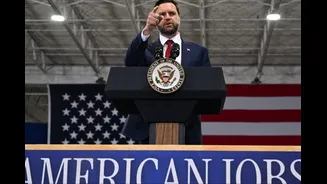






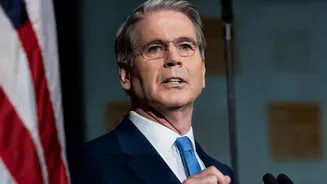

US Vice President JD Vance has backed the Donald Trump administration’s latest move to impose a more than $100,000 fee on new H-1B visas, saying American companies should prioritise hiring and training
workers from within the country.
In a post on X, Vance said, “If an American corporation needs workers, it should hire and train Americans.”
If an American corporation needs workers, it should hire and train Americans. https://t.co/C72ZYmONpK
— JD Vance (@JDVance) August 24, 2026
His remarks came as the Trump administration moved to formalise a proposed $103,265 fee on new H-1B visas for highly skilled foreign workers.
The proposal comes after an earlier $100,000 fee imposed by Trump was blocked by a federal judge and is facing legal challenges.
Trump Administration Proposes Six-Figure H-1B Fee
According to Reuters, the US Department of Homeland Security on Monday released a proposed regulation that would make the $103,265 fee permanent. The proposed rule was posted in the Federal Register and could be finalised by the end of the year.
The earlier fee was temporarily imposed by Trump last year.
However, a federal judge in June ruled that the fee was illegal and blocked the administration from collecting it.
ALSO READ | Trump Admin Moves To Raise H-1B Visa Fee Above $100,000: Why Indians Could Face A Big Blow
A Boston-based appeals court was reviewing that decision, while another court was considering a separate challenge brought by a major business group.
AFP reported that the administration was now presenting the proposed fee partly as a mechanism to recover the costs of administering the US lawful immigration system.
The proposal would be subject to a 30-day public comment period before it could take effect.
H-1B Programme Under Renewed Debate
The H-1B programme allows US employers to hire foreign workers for speciality occupations and currently provides for 65,000 visas annually, along with another 20,000 for workers with advanced degrees.
Reuters reported that such visas previously carried fees generally ranging between $2,000 and $5,000 before Trump’s order.
The new fee, however, would not apply to visas granted to foreign citizens already in the United States on student visas, who account for a large share of new H-1B recipients. It would also not apply to renewals of existing visas.
AFP reported that the programme was created by Congress in 1990 and that the United States currently awards 85,000 H-1B visas annually.
Administration Says Fee Could Favour American Workers
Trump and other critics of the H-1B programme have argued that companies can use the system to replace American workers with cheaper foreign labour.
Business groups and individual companies, however, have argued that the programme is necessary to address shortages of qualified American workers and enable US businesses to recruit highly skilled talent.
ALSO READ | US Sees 15% Drop In Indian Student Applicants In 2025-26 Amid Tighter Visa Rules
The proposed regulation acknowledges that the fee could have an additional effect beyond recovering administrative costs.
According to AFP, the administration says US employers would be less likely to hire an H-1B worker over a qualified and highly skilled American if required to pay an additional $103,265.
The proposal would also be in addition to other applicable fees or payments, including the earlier $100,000 fee imposed under Trump’s presidential proclamation, although that measure is set to expire in September unless extended.
Legal Challenges Expected
The proposed fee is likely to face further legal challenges.
The US Chamber of Commerce, Democratic-led states, and a coalition of unions and employers have already challenged the earlier fee.
Reuters reported that the lawsuits argue that presidential authority to restrict the entry of foreign nationals does not allow the administration to override the law establishing the H-1B programme.
The challengers also argue that the Department of Homeland Security cannot impose fees or taxes to generate revenue without congressional authorisation.
The Trump administration has maintained that the fee is not a traditional tax and that courts have limited authority to question the president’s power to restrict entry into the United States.
India Among Largest H-1B Beneficiaries
The proposed changes could have significant implications for countries whose professionals make up a large share of H-1B workers.
According to AFP, official data showed that Indians accounted for 70 per cent of H-1B workers in fiscal year 2025, followed by China at 12 per cent, with the Philippines, Canada and South Korea also among the countries represented.
Reuters reported that employers registered for about 344,000 H-1B visas last year, a decline of more than 25 per cent from 2024 and less than half the 794,000 visas sought in 2023.
The administration has also introduced enhanced vetting of H-1B applicants and proposed a new selection process that would favour higher-skilled and better-paid workers.
ALSO READ | Trump Admin Plans To Revoke Up To 2 Lakh Tourist, Business Visas Over Asylum Claims