





Mahindra Thar is “the” car for many people across India. For countless enthusiasts, it is more than a vehicle; it is a dream ride. Rugged, powerful, designed for rough terrain and off-road adventures,
the Thar gives a sense of dominance behind the wheel.
But recently, viral videos have shown that for some owners, it also represents a ticket to flaunting authority on city roads, often with dangerous consequences.
‘Mahindra Thar Mein Ye Wali Chiz Aajati Hai Baith Kar’
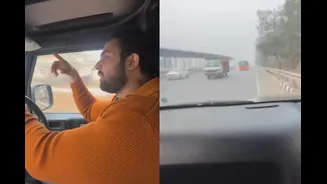
One of the most talked-about videos features a man explaining why he thinks the Thar is so powerful on the road. In the video, the man says, “Mahindra Thar lene ka sabse bada benefit ye hai ki wrong side chalo, koi dikkat nahi kuch nahi. Na koi dipper marega, na koi aapse faltu bolega, koi kuch nahi kahega (The biggest advantage of owning a Thar is that you can drive on the wrong side and no one will bother you. No one will flash their lights, no one will say anything unnecessary, no one will do anything).”
The video was shared on X (formerly Twitter) by a user criticising him: “COVID ended, but another epidemic took over our roads the Thartards mentality virus! This mindset is beyond insane. How does buying a vehicle suddenly delete common sense? It’s honestly shocking and dangerous. If anyone can genuinely figure out what psychological switch flips after buying a Thar, I’ll happily sponsor a full week’s vacation for them! Until then, save your near and dear ones from buying this vehicle as this epidemic is real and spreading fast!”
COVID ended, but another epidemic took over our roads the Thartards mentality virus! This mindset is beyond insane.
How does buying a vehicle suddenly delete common sense? It’s honestly shocking and dangerous.
If anyone can genuinely figure out what psychological switch… pic.twitter.com/aZF519zRdv
— Rattan Dhillon (@ShivrattanDhil1) January 11, 2026
A person added, “It’s a chicken and egg question. Whether buying a Thar creates chemical locha (a chemical issue) in the brain; or those with a chemical locha in the brain buy a Thar.”
Its a chicken and egg question.
Whether buying a Thar creates Chemical locha in the brain; or those with a Chemical locha in the brain buy a Thar.#थारबुद्धी @anandmahindra @DGPHaryana https://t.co/lRNk0Cm9qp— Nachiket Deshpande (@nachiket1982) January 11, 2026
An individual noted, “Not Mahindra’s fault, but inadvertently they have given a tool for public expression of a certain personality type, one driven by rowdiness, fragile egos and attention-seeking behaviour. Unless the govt starts confiscating and scrapping such vehicles publicly, it’s only going to get worse.”
Not Mahindra’s fault, but inadvertently they have given a tool for public expression of a certain personality type, one driven by rowdiness, fragile egos and attention-seeking behaviour.
Unless the govt starts confiscating and scrapping such vehicles publically, it’s only going… pic.twitter.com/mQYQ2I8iI0
— THE SKIN DOCTOR (@theskindoctor13) January 11, 2026
A separate clip from Uttar Pradesh’s Amroha shows a Thar driver performing stunts with a user captioning it: “10 years down the line, we will have mental institutions dedicated to Thar owners. The patients will be known as ‘Thethar.’”
A Thar driver performs stunt in UP's Amroha. 10 years down the line, we will have mental institutions dedicated for Thar owners. The patients will be know as "Thethar". pic.twitter.com/W9RzJX9XSG
— Piyush Rai (@Benarasiyaa) January 12, 2026
With the Mahindra Thar gaining so much attention on Indian roads, it is worth looking deeper into the various issues surrounding the SUV.
What Are The Real-Life Accidents Involving Mahindra Thar?
Although there are no nationwide statistics specifically tracking Thar-related accidents, several high-profile incidents in 2025 have been reported in the media.
August 2025, Delhi (Chanakyapuri): A pedestrian lost their life after a Thar lost control in the area.
September 2025, Gurugram: A Thar collided with a road divider at high speed, resulting in the deaths of five people.
September 2025, Lucknow: Two people were killed when a Thar crashed into an e-rickshaw.
What Are The Police-Reported Incidents Involving Thar Drivers?
September 2025, Gurugram: In this case, where five people were killed, police noted that the driver had been out drinking at a pub prior to the accident.
October 2025, Delhi: A speeding Thar hit a fire officer who was riding a bike. The officer died, and the Thar was seized while the driver fled the scene.
December 2025, Noida: A 17-year-old who rented a Thar crashed into multiple vehicles during a getaway and injured three people. The FIR was registered for rash driving.
January 2026, Ludhiana: A Thar jumped over the median and collided with an oncoming car that killed two siblings. The driver was booked under sections 106(1), 281 and 324(4) of the BNS code.
Haryana DGP OP Singh also commented in November 2025 that Thars are frequently used by “notorious elements” for stunts, which has led authorities to justify targeted checks on these vehicles.
How Safe Is The Mahindra Thar According To Crash Ratings?
4-star Global NCAP rating for adult and child protection.
Thar Roxx variant earned 5 stars from Bharat NCAP.
Have There Been Any Official Comments From Mahindra Regarding Thar Drivers?
Anand Mahindra or any Mahindra official has not publicly addressed the “reckless Thar users” discussion or the Haryana DGP’s remarks.
What Do Psychologists And Experts Say About Thar Drivers’ Behaviour?
Counselling psychologist Esha Mehta told Economic Times that the Thar’s rugged design creates a sense of dominance. This is misinterpreted as aggression.
What Are Key Findings From Studies On Aggressive Driving?
A 2013 study from the Delhi-NCR region notes that car/jeep drivers are involved in 42 per cent of road rage cases, which is ahead of heavy vehicles (37 per cent).
A 2024 study found that SUV drivers often show different driving patterns compared to those in sedans or hatchbacks. It noted that bigger vehicles can sometimes lead to slightly more aggressive behaviour.
Research from 2021 on road rage showed high levels of anger among Indian drivers across all vehicle type,s with younger drivers being more prone to aggressive actions.
In 2025, a study highlighted that personality traits and traffic conditions influence whether drivers behave aggressively or calmly, often more than the type of vehicle they are driving.
What Evidence Exists On Young Drivers In India?
A 2021 study of 405 drivers found that younger males were 2.57 times more likely to speed or overtake aggressively.
Studies in cities show that young men often drive more aggressively due to peer pressure and a tendency to break rules especially in heavy traffic.
Certain personality traits like low agreeableness and high neuroticism, make youth more prone to aggression.
How Do Age And Gender Interact In Driving Aggression?
Male drivers aged 18–30 are two to three times more likely to speed, overtake dangerously and engage in road rage than women or older drivers.
The 18–24 age group shows the riskiest behaviour with young men often ignoring seatbelts and safety rules.
Young women of the same age are generally more cautious and follow traffic rules more closely.
Who Are The Typical Mahindra Thar Owners In India?
Urban aspirational buyers, rural affluent farmers and SUV enthusiasts, but the biggest chunk comes from young urban and semi-urban buyers in North India.
In rural areas, wealthy farmers prefer the Tharwhile in cities, millennials aged around 25–40 buy it.
What Are The Key Demographics Of Thar Buyers?
Most Thar buyers are urban or semi-urban professionals in their late 30s and early 40s with many being first-time Mahindra customers.
A large share of buyers falls in the 25–40 age group .
It is popular in places like Delhi-NCR, Mumbai, Pune and Bengaluru and Tier-2 and Tier-3 towns.
What Are The Affordability Benchmarks For Thar Buyers?
On-road price: Rs 15–25 lakh.
Typical monthly income: Rs 2–5 lakh, with some stretching budgets for status.
Financial model: 20 per cent down, EMI ≤10% income, 4-year loan.
Urban salaried youth (25–35): Rs 2–4 lakh/month.
Rural rich farmers/business owners: Rs 3–6 lakh+, often cash.
Lower-income groups