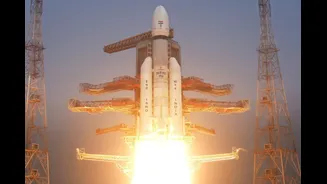

The successful launch of the LVM3-M6 mission has once again highlighted a shift that is becoming steadily more visible in the global commercial space market: India is emerging not just as a capable launch provider,
but as a structurally more viable alternative to the United States and Europe for heavy satellites.
The latest mission, carried out using the Indian Space Research Organisation’s (ISRO) Launch Vehicle Mark-3 (LVM3) and executed under a commercial agreement between NewSpace India Limited, the commercial arm of ISRO, and US-based AST SpaceMobile, placed the BlueBird Block-2 satellite into Low Earth Orbit (LEO).
BlueBird Block-2 is part of AST SpaceMobile’s next-generation direct-to-mobile broadband constellation and is the largest commercial communications satellite ever placed in Low Earth Orbit. Weighing 6100 kg, it is also the heaviest payload ever launched from Indian soil. Prime Minister Narendra Modi also hailed the successful launch, calling it “a significant stride in India’s space sector.”
Powered by India’s youth, our space programme is getting more advanced and impactful.
With LVM3 demonstrating reliable heavy-lift performance, we are strengthening the foundations for future missions such as Gaganyaan, expanding commercial launch services and deepening global… pic.twitter.com/f53SiUXyZr
— Narendra Modi (@narendramodi) December 24, 2025
The LVM-3 is one of the heavy launch vehicles on the market, along with SpaceX’s Falcon-9 and the European Space Agency’s (ESA) Ariane 6. The fact that a US operator chose India’s LVM3 is central to understanding how global launch economics are shifting.
What Do India’s Own Cost Figures Tell Us About LVM3?
The first element of that shift lies in India’s cost structure. The Union Cabinet’s sanctioned budget of Rs 4,338 crore for ten LVM3 rockets provides the clearest benchmark for India’s heavy-lift costs. This approval places the per-vehicle cost at roughly Rs 433 crore, which translates to about $52 million. That figure represents the government-level cost of building the rocket itself.
How Do Comparable US Rockets Price Their Heavy-Lift Missions?
When compared with American launch vehicles available to operators like AST SpaceMobile, the price difference becomes immediately visible. SpaceX’s Falcon Heavy, one of the most powerful operational rockets in the world, typically ranges between $90 million and $150 million, depending on mission configuration. These figures reflect publicly known commercial rates and US government contracts.
United Launch Alliance’s Atlas V, used extensively for NASA and national security missions, has published contract values between $109 million and more than $153 million.
In this range of rockets, a satellite operator preparing to launch a payload in the five- to six-tonne class encounters significantly higher commercial costs in the United States.
Why Is India Structurally Cheaper Than Western Launch Providers?
The core question is not simply why India is cheaper, but why its cost structure remains consistently lower than Western systems even when those systems employ advanced cost-saving measures such as reusability. The answer lies in the way India builds, operates and prices its rockets.
India’s overall manufacturing and labour costs are significantly lower than those in the United States and Europe, and ISRO’s rockets are produced within a government-run, non-profit framework rather than a private commercial environment. This keeps overheads and structural costs lower than those associated with Western launch providers, where private-sector pricing models, higher labour costs and extensive mission-assurance structures influence final launch prices.
In the United States, heavy-lift missions operate under very different assumptions. SpaceX’s reusability has lowered launch prices across the global market, but the company must still accommodate margins, high-intensity testing and stringent mission-assurance requirements for government customers. Insurance considerations, staffing costs and regulatory structures further expand the cost base.
Under these conditions, even a partially reusable Falcon Heavy launch cannot match the lower floor price of a state-built Indian system like LVM3.
What Factors Do Satellite Operators Consider When Choosing India?
The economics become even clearer from the operator’s point of view. A satellite like BlueBird Block-2 must account for its mass, target orbit and the capacity band of available rockets. LVM3 carries up to 4,200 kilograms to Geosynchronous Transfer Orbit and significantly more to Low Earth Orbit, making it suitable for mid-heavy communications satellites without pushing into the higher-priced category of more powerful Western rockets.
Commercial engagement is another part of the picture. NewSpace India Limited functions as the single-window commercial interface for ISRO’s launch vehicles, which allows foreign customers consistent pricing structures, defined contracting processes and predictable mission management. NSIL’s commercial expansion provides additional assurance: the company reported 43 per cent revenue growth in FY25, reaching Rs 2,940 crore, driven largely by LVM3 commercialisation. Its mandate now includes commercial launches, satellite manufacturing, leasing, and technology transfers, strengthening the maturity of India’s commercial interface.
Also, NSIL’s experience in handling large foreign campaigns, including its deployment of 72 OneWeb satellites across two LVM3 missions, has strengthened international confidence in India’s ability to execute complex launches.
For AST SpaceMobile, which is building a global direct-to-mobile broadband constellation, LVM3 offered a combination of lift capability, demonstrated reliability and an accessible commercial arrangement through NSIL. These factors collectively positioned India as a viable option alongside Western launch providers for a satellite in this mass class.
How Does India’s Reliability Record Influence These Decisions?
India’s cost competitiveness coincides with steady improvements in launch cadence, reliability and mission sophistication. The LVM3 has carried India’s flagship lunar missions Chandrayaan-2 and Chandrayaan-3, completed multiple operational flights and handled two major OneWeb missions. The BlueBird Block-2 launch marks LVM3’s third fully commercial mission and sixth operational mission, a track record that reinforces its dependability for high-value commercial payloads. Its reliability record provides the confidence needed for foreign operators to entrust large, high-value spacecraft to the vehicle.
The LVM3-M6 mission therefore reflects more than a price advantage. It shows that India has reached a point where cost, reliability and launch capacity converge to create a compelling commercial offering.
What Does This Mean For India’s Role In Global Launch Markets?
The LVM3-M6 mission demonstrates a broader strategic trend: India is positioning itself to capture a larger share of the global commercial launch market at a moment when demand is rising. It is cheaper than the United States and Europe, more reliable than many launch providers and capable of carrying payloads that small-lift companies cannot accommodate.
The LVM3-M6 mission is therefore not just a demonstration of India’s engineering capacity. It is a marker of India’s consolidation in a global market where cost and reliability determine strategic decisions. When an operator evaluates launch options and finds India to be the more viable destination, it reflects a structural advantage rooted in India’s manufacturing ecosystem, government-backed cost models and a maturing commercial interface.
As ISRO continues advancing LVM3 capabilities and NSIL expands its commercial engagements, India’s role in satellite launches is poised to grow further.