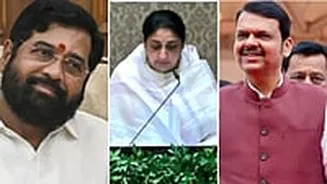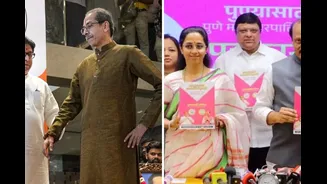




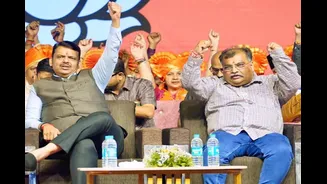
They came together after massive showdowns, stood by each other and even posed for photographs, the Thackerays and the Pawars, however, could not convince Maharashtra that they could give them an efficient
administration. The result? The disastrous drubbing in the Brihanmumbai Municipal Corporation (BMC) and Pune Municipal Corporation (PMC), both of which will now be ruled by the Bharatiya Janata Party-led Mahayuti.
What went wrong for Thackerays?
In 2022, Eknath Shinde split the Shiv Sena in the middle, taking away a chunk of its MLAs, MPs and key corporators and leaders. For Uddhav Thackeray, this came as a jolt. After multiple appeals to Shinde, he finally conceded defeat. While many questioned how he could have remained oblivious to such a massive development happening in a state where he was then the CM, some hoped for relief in the Supreme Court (SC). Before the SC could rule, in a haste, Thackeray resigned, thus ensuring there was no decision to overturn or reinstate him.
Will #BMCElectionResults have an impact on alliances at the state level?
“Alliances will be impacted on both the sides; Continuance of Ajit Pawar in Mahayuti seems dicey; I see Uddhav Thackeray going back to Congress”: @AmanKayamHai_
“All these parties (Shiv Sena UBT,… pic.twitter.com/TeAgMYzSNm
— News18 (@CNNnews18) January 16, 2026
The sympathy wave ran high, which even benefitted Thackeray in the 2024 Lok Sabha elections. The overconfidence and lack of clarity in his alliance with the Congress and Nationalist Congress Party-Sharad Pawar, in contrast with the Mahayuti’s laser-focused campaign, strategy and ground work, undid all of it within a few months in the Maharashtra assembly elections.
With nowhere to go, Thackeray then joined hands with his estranged cousin for 20 years – Maharashtra Navnirman Sena (MNS) chief Raj Thackeray, who although adored for his oratorical skills, has never managed to convert it into votes in the elections, barring his debut years.
As Shinde claimed the Thackeray legacy, asserting Uddhav diluted it by allying with the Congress and even NCP-SP, Uddhav and Raj looked to reclaim it. They started with the Marathi imposition plan in schools and went ahead with bashing industrialists or the development seen in the city on ground. For all their tall claims, the Mahayuti gave proof of what it could do at the helm.
While the Thackerays somehow realised and even got the optics of the Thackeray name right, it failed to understand the core issues why the split was eventually accepted by Maharashtra.
1. Dilution of Thackeray legacy: Shinde had said the alliance diluted the Hindutva and Marathi agenda. While Uddhav reiterated that Bal Thackeray’s Hindutva was inclusive, he did not break away the alliance with Congress and NCP intact even after the split. While the move may have been a survival tactic, it further reinforced Shinde’s logic, especially in the semi-urban pockets.
2. Marathi agenda: Sena patriarch Bal Thackeray re-instilled the pride of being Marathi in the minds of the population at a time when the mills were shutting and being Marathi was even looked down upon. The party that was formed tapped into the angst of the common Marathi man in the 1960-70s. Uddhav and Raj, while speaking of Marathi manoos, miscalculated the depth of the issue in 2026, mainly at a time when social media has literally brought people and the world at the tip of your finger. Moreover, they failed to gauge the preferences of the Gen-Z and millennial voters, who aim for or work in multinational corporate spaces. A case in point: During the campaigning, Raj stoked the anti-‘outsider’ sentiment, which he had used as the MNS launchpad way back in 2006, and even used an anti-south Indian slogan used by Bal Thackeray while referring to BJP’s Tamil Nadu leader K Annamalai. Clearly, the 1980s’ slogan didn’t click.
Moreover, the elections came almost four years late, so people had to be reminded of the hardships and of what the Sena could and did in the BMC in the past and what the elections were about. While their manifesto did that, Uddhav and Raj’s rally speeches remained largely confined to the Hindu-Marathi-Gujarati narrative and a seemingly anti-development, pro-environment stance. Aaditya seemed to raise the issues that mattered, but what went viral was his mimicry of the CM rather than the promises.
3. Number game: In 2017, the Shiv Sena had won 84 seats, BJP 82 seats; in 2012, the Sena won 75 seats, BJP 31; in 2007, Shiv Sena won 84 seats; BJP 28 seats; in 2002, the Shiv Sena 97 seats and BJP 35 seats. The fact is the Sena had not come to power in the previous four elections on its own.
So the math was simple, to win the BMC, the Thackerays had to eat into the vote share of the BJP, which saw a massive jump after the 2014 Modi wave. What happened on Friday? Even as the numbers are still being calculated, the BJP seems to have retained its vote share to a large extent, while the share of the Sena now stands divided between Shinde Sena, UBT and MNS. UBT won around 60 seats and MNS around 20. A calculated strategy with a fresh message could have easily pushed the bar, analysts feel, as the Shinde Sena, too, hasn’t seen a major surge in BMC.
महाराष्ट्राचे आभार !
राज्यातील उत्साही जनतेने एनडीएच्या जनहितकारी आणि सुशासनाच्या अजेंड्याला आपले आशीर्वाद दिले आहेत!
विविध महानगरपालिका निवडणुकांचे निकाल हे दर्शवितात की महाराष्ट्रातील जनतेशी एनडीएचे नाते अधिक दृढ झाले आहे. आमच्या कामगिरीचा अनुभव आणि विकासाची दृष्टी जनतेच्या…
— Narendra Modi (@narendramodi) January 16, 2026
What next for Thackerays?
Not ruling the BMC means a shortage of funds and lack of clout in the country’s financial capital. Moreover, it could also lead to many more leaders and supporters switching sides. It was a battle for survival and it has been lost, the Thackerays now face the uphill task of reinvigorating the cadre, building the base, all while they may not have not enough funds. A carefully curated strategy focussed on retaining and adding to the party support, while not aiming only for small-term power gains, would be needed. Not easy, but definitely necessary.
Why the Pawars couldn’t grab power in Pune and Pimpri-Chinchwad?
Even as politics always works on alliances, which even voters understand, the massive switches that parties resort are unpalatable at times.
In case of the Nationalist Congress Party (NCP), the split was more of a family matter for power. Many, including the ED, were stated as factors, but it was apparent that Ajit Pawar was not aligned with Sharad Pawar’s plan of the eventual handling of the party with the involvement of Supriya Sule. Ajit Pawar left, got the symbol, key leaders, a great score in the elections and even managed to defend it with logic, saying staying in power is key for a politician, felt analysts. He joined the state government as the deputy CM with respectable numbers to bargain.
However, for the Pune and Pimpri-Chinchwad civic elections, he joined hands with the SP or Sharad Pawar-Sule faction. The Pimpri-Chinchwad corporation, considered one of the richest after Mumbai’s, was held by Sharad Pawar’s undivided NCP in 2012 (83 seats). It lost (37 seats) it to the BJP in 2022. The BJP has added to the gains this time. The NCP has not managed to change its 2017 tally much.
In case of Pune, in 2017 elections, the BJP was on 97 and NCP 39 seats. Here, too, the saffron party has made massive gains, which of course cost the NCP massively.
Did the coming together work wonders? Could they come back to power? Certainly not.
The party which lost of the majority in these civic elections in the previous election itself could not convince people of their “uniting for cadre” agenda. While they didn’t make major gains, the losses, too, weren’t grave.
What next for Pawars?
During the campaign, Fadnavis spoke of how Ajit Pawar did not stick to the alliance dharma and spoke against the BJP. This could have an impact in the state going forward, although Ajit Pawar “100%” denied such a possibility.
Then comes another issue. Can Sule and Ajit Pawar reunite like the Thackerays? If the unity had worked, maybe, but the buzz is likely to die down with the poor show.