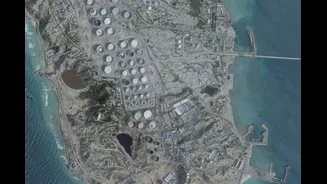





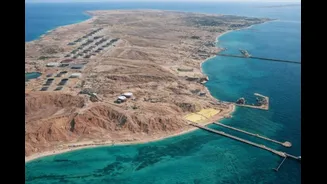
If there’s one thing Donald Trump wants more than a victory in Iran, it’s Kharg Island. The US President has vowed that a failure by Iran to agree to a deal to end the war could see the United States “completely
obliterating” the oil hub. A day earlier, he had said the United States could take the island, eyed by the Pentagon for ground operations, “very easily”.
As America weighs the option of capturing Kharg Island, through which roughly 90 per cent of Iran’s oil exports flow, the idea may look like a decisive economic strike. However, recent reports suggest the risks could outweigh the gains.
Here are three key problems the Trump administration may face in its endeavour:
A Sitting Duck Under Fire
Kharg’s biggest weakness is also what makes it attractive, the fact that it is highly exposed. The island lies close to Iran’s mainland within easy range of missiles, drones, and naval attacks, making it difficult to defend once occupied.
ALSO READ | How Much Oil Does Iran Have And Why Is Kharg Island On Trump’s Wishlist?
According to Associated Press, experts warn US troops on Kharg would be “highly vulnerable” to sustained Iranian strikes, putting lives at risk without guaranteeing control.
Reuters adds that threats could include naval mines and drone attacks similar to Ukraine-style warfare, making the island a constant battlefield.
This means taking Kharg may be quick but defending it could be relentless.
2. Logistics Could Break the Operation
Even if captured, Kharg would be extremely hard to sustain militarily. The troops would rely on constant resupply by sea/air but Iran could disrupt supply lines at any point. This essentially means isolation turns the island into a vulnerable outpost.
Military analysts cited by Reuters note that even a small occupying force would need heavy logistical backing and protection, stretching resources over time.
At the same time, Kharg’s infrastructure is densely packed with pipelines, storage, and terminals, meaning any conflict risks damaging the very asset being targeted.
This means in modern warfare, supply chains, and not just firepower, determine success.
3. Escalation Without Decisive Gains
Most significantly, seizing Kharg could trigger a much wider conflict without delivering a knockout blow.
ALSO READ | 66% Americans Want Quick End to Iran War, Poll Shows, As US Weighs Risk Of Oil Price Spike
Iran could retaliate across the Gulf and beyond. Also, threats extend to chokepoints like the Strait of Hormuz, which could push up oil prices further and destabilise world economy. Another concern could be regional proxies opening up new fronts.
Experts quoted by Associated Press say occupying Kharg is unlikely to force Iran to surrender, with alternatives like blockades potentially more effective.
Meanwhile, energy analysts warn any attack or disruption could send global oil prices soaring and widen the war, with spill-over risks across West Asia. This reveals a core risk where there would be a major escalation but with limited strategic payoff.
The bottom line is that Kharg may be Iran’s economic lifeline but for an occupying force, it could quickly become a military liability rather than a decisive advantage.