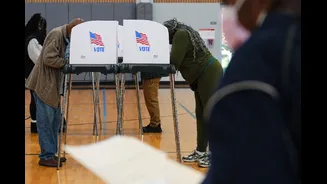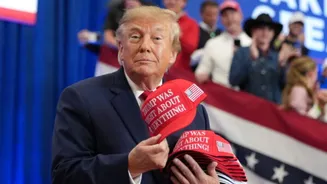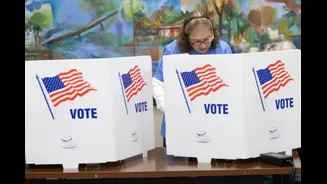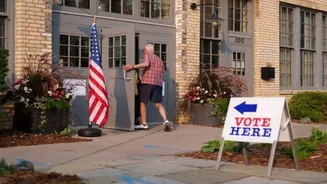








US President Donald Trump has reacted to the results of the 2026 US midterm elections, claiming that Republicans would have won “in a landslide” had he himself been on the ballot.
In a post on Truth Social,
Trump said he was not a candidate in the elections but asserted that his presence on the ballot would have changed the outcome in favour of the Republican Party.
Follow LIVE Updates Here
“I wasn’t on the Ballot and if I was, we would have won IN A LANDSLIDE! Thank you for your attention to this matter,” Trump wrote, signing off as “President DONALD J. TRUMP”.
His remarks came as early election results and exit polls pointed to significant Democratic gains, with voters expressing dissatisfaction over the state of the US economy, the rising cost of living and the direction of the country under his administration.
Voters Express Discontent Over Economy, Trump’s Policies
According to Reuters, the midterm elections saw an electorate in a sour mood, with early results and exit polls indicating widespread unhappiness with Trump’s agenda.
Nearly nine in 10 voters identified the cost of living as a crucial or major factor influencing their vote, according to exit polls conducted by SSRS on behalf of a consortium of US media organisations, including major television networks and the Associated Press.
The findings also indicated that nearly two-thirds of voters blamed Trump for high prices, while three-quarters said they were either angry or dissatisfied with the direction of the country.
Trump had returned to the White House in 2024 on a promise to bring inflation under control. However, Reuters reported that his tariffs on foreign goods and the US war against Iran had added to the economic difficulties faced by many Americans.
The President had also faced criticism over his response to rising costs, with his popularity declining amid voter concerns about affordability.
Trump’s Handpicked Candidates Face Setbacks
The election results also brought setbacks for several candidates backed by Trump, raising questions about the impact of his endorsements on Republican electoral prospects.
Reuters reported that Trump’s handpicked Senate candidates in South Carolina and North Carolina, Darline Graham and Michael Whatley, lost their respective races.
In Texas, Republican Ken Paxton was struggling against Democratic Senate candidate James Talarico.
The results were particularly significant because some of these contests were being fought in states where Republicans had initially been expected to perform strongly.
Trump had campaigned extensively for Republican candidates, undertaking a 19-state campaign blitz in the weeks leading up to the elections. However, early Democratic victories suggested that his campaign appearances had done little to improve his standing among voters.
Exit polls also indicated declining Republican support among Black men, Latinos and younger voters, pointing to a weakening of the coalition that had helped Trump secure victory in 2024.
Democrats Make Gains Beyond Traditional Battlegrounds
The emerging results also indicated that Democratic gains were extending beyond traditional battleground states.
Democrat Annie Andrews’ victory over Graham in South Carolina marked a significant development, with Democrats not having won a US Senate race in the state this century.
Democrats were also leading in Kansas, where the party had last won a Senate seat in 1932. In Texas, Talarico’s contest against Paxton was another closely watched race, as a Democratic victory would mark the party’s first Senate win in the state in 38 years.
By 10 pm ET, US media outlets had projected that Democrats would win back control of the House of Representatives, with the party also positioned to secure a sizeable majority.
However, as Reuters noted, regaining control of Congress would bring its own challenges for Democrats. While the party would be expected to address voters’ economic concerns, its legislative options would remain limited by Trump’s presidential veto power.