








On January 7, 2026, the Centre issued the notification for the next Census of India, formally setting the process in motion after a prolonged delay caused by the Covid-19 pandemic. The census will be conducted
in two phases, beginning with the house listing and housing census from April 1, 2026.
The exercise will be carried out by the Office of the Registrar General and Census Commissioner of India under the Ministry of Home Affairs (MHA). Apart from conducting the decennial census, the office is responsible for planning, training, data collection, processing, and publication. The current Registrar General and Census Commissioner is Mrityunjay Kumar Narayan. The office has existed as a permanent institution since the 1950s and works closely with state-level census directorates.
The upcoming census will introduce several new features, including digital data collection, a self-enumeration option, a dedicated mobile application, and the inclusion of caste-related data.
Below is a detailed question-and-answer explainer on what citizens can expect in the first phase of the census.
Q. What happens in the first phase of Census, commonly referred to as house listing?
The Census of India is a massive administrative and statistical exercise conducted once every 10 years. This cycle, however, has been delayed by nearly 5-6 years due to the pandemic. The first phase, known as the house listing and housing census, will be conducted between April 1 and September 30, 2026. The second phase, the population census, is scheduled for February 2027. Nearly 30 lakh personnel are expected to be deployed nationwide for the entire exercise.
Q. Why is your house registered in the first phase?
The objective of the first phase is to prepare a comprehensive and accurate frame of all residential and non-residential structures in the country. This provides the backbone for the population census that follows.
During this phase, enumerators record details about the physical condition of the house, along with access to amenities such as drinking water, electricity, toilets, and cooking facilities. Information on household assets such as televisions, vehicles, and internet access is also collected. These datasets are crucial for designing housing schemes, welfare policies, poverty estimation, and equitable resource allocation.
Q. Will the census also function as a National Population Register (NPR)?
Yes. The house listing exercise will also facilitate the updating of the National Population Register (NPR). Since the census is conducted household by household, it necessarily supports the creation and revision of population registers. This is why the exercise is carried out through door-to-door enumeration.
Q. What exactly happens during the first round of enumeration?
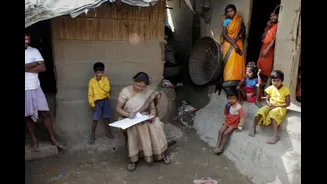
Census personnel will visit households with a structured questionnaire to collect housing-related information. The fieldwork for each area is expected to be completed within a stipulated time frame. For the first time, citizens will also have the option of self-enumeration. From March 15, households can submit details online through the official census portal or mobile application. Field staff will use tablets or mobile devices for data entry, which will be uploaded to a central system, allowing real-time monitoring and improving data accuracy.
Q. What information will census staff collect from your home?
Enumerators will record the type and condition of the house, the number of rooms, and ownership status, whether the house is owned, rented, or provided by an employer. Vacant houses will be marked accordingly. They will also note the usage of the structure (residential, commercial, or mixed) along with details of basic amenities such as water supply, electricity, toilets, kitchens, and cooking fuel. Information on household assets like televisions, refrigerators, vehicles, and internet connectivity will also be collected.
Q. What information will not be collected in the first phase?
No personal or demographic information is collected during the house listing phase. Details such as names, age, gender, education, or occupation of individuals are part of the second phase, the population census.
Q. What if someone owns more than one house?
The first phase counts houses, not owners. Each structure is listed independently, regardless of who owns it. If a house is rented out, details related to the tenant household are recorded. If it is vacant, it is marked as such, though information on amenities is still collected. Owning multiple houses does not attract any scrutiny. Census data is collected purely for statistical purposes and is not linked to taxation, property verification, or individual assessment.
Q. Who are the people who visit homes for census work?
Census work is typically carried out by personnel appointed by state governments or local administrations. These often include school teachers, patwaris, Anganwadi supervisors, municipal staff, or panchayat employees. All enumerators carry official government identity cards and census authorization letters, which citizens are entitled to verify.
Q. What happens if someone refuses to cooperate?
The census is a constitutional and statutory exercise. Willfully providing false information or refusing to participate is an offence under the Census Act, 1948, and may attract penalties, including fines.
Q. Is census data considered a legal document?
No. Census records do not have legal standing. They cannot be used as proof of residence, citizenship, or entitlement. No document verification is carried out during census enumeration.
Q. How, then, is census data used by the government?
Census data forms the foundation of policymaking and governance. It is used for delimitation of Lok Sabha and Vidhan Sabha constituencies, determining boundaries of municipal bodies and panchayats, planning welfare schemes, and framing reservation and development policies.
Q. What happens if census officials visit and the house is locked?
This is a routine situation and accounted for in census protocols. If a house is found locked, the enumerator makes a temporary note and often leaves a marker or message. Information may be sought from neighbours for preliminary identification.
Census staff are required to make multiple visits, usually two or three, at different times of the day to ensure working households are not missed. Only if a house remains closed for an extended period may it be recorded as vacant or temporarily locked. Legal issues arise only in cases of deliberate and repeated refusal to cooperate.