






The world has a way of surprising us, especially when it comes to geography, because Earth is full of details that don’t always make it into everyday conversations. Recently, an Instagram video brought
together some “strangest” geography-related facts that have caught the attention of many viewers.
The video walks through different parts of the world and details how continents, mountains, lakes and islands carry stories shaped by time and nature.
Australia and the US Were Once Connected
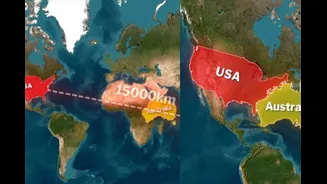
The video explains that even though Australia and the United States now sit far apart, their coastlines tell an old story. When viewed closely, the west coast of Australia lines up closely with the east coast of the United States, “as if the two continents were once puzzle pieces that drifted away over time.”
Research suggests that around 1.7 billion years ago, parts of present-day Queensland in Australia were connected to North America. This happened when both regions were part of a massive supercontinent known as Nuna or Columbia. When the landmass later broke apart, that section stayed attached to Australia leaving behind what scientists describe as a fragment of North America on the Australian continent.
View this post on Instagram
A Lake In Finland That Matches The Country’s Shape
Another part of the video takes viewers to Finland, where a lake looks exactly like the country itself. Called Lake Naitokainen, this is not a natural formation. It is a man-made pond created in 1991 in Kittilä, Lapland. It is built on the slope of Vesikkovaara hill and shaped to copy Finland’s outline at a scale of 1:10,000. Locals often call it “Finland Lake” or “Suomi Järvi.”
The Spot Farthest From Any Ocean
The clip also mentions a place known as the Eurasian Pole of Inaccessibility (EPIA), which is the point on Earth farthest from any ocean. It lies in China’s Xinjiang region, close to the Kazakhstan border in the Dzoosotoyn Elisen Desert. It is roughly 2,645 kilometres away from the nearest coastline.
A Mountain That Changes Climate With Height
In Africa, there is a mountain that is so tall and isolated that it creates distinct climate zones as you move upward. It is Mount Kilimanjaro in Tanzania. At the base of this mountain, conditions are warm and humid with rainforest-like weather. As elevation increases, temperatures drop sharply and at the summit, glaciers and snow remain despite the mountain standing above tropical plains.
At Uhuru Peak, temperatures can fall as low as minus 29 degrees Celsius.
An Island Inside A Lake With Lakes Of Its Own
The final segment of the video focuses on Manitoulin Island in Canada. Located in Lake Huron, it is the largest freshwater island in the world that covers about 2,766 square kilometers. What makes it even more unusual is that the island contains over 100 lakes and some of those lakes have islands within them. Manitoulin Island is also an important cultural area for the Anishinaabe people and is known for its natural landscapes. Visitors can reach it by road through the Little Current Swing Bridge or by ferry from Tobermory.