






In the quiet industrial town of Bhaluka in Mymensingh district, 25-year-old factory worker Deepu Das met a gruesome end on December 18, 2025. Accused without evidence of making derogatory remarks about
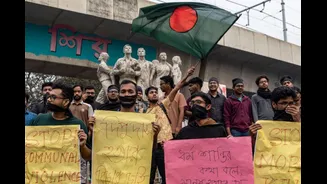
Islam during a workplace event, Das was dragged from his garment factory by a frenzied mob. He was beaten severely, hanged from a tree, doused in kerosene, and set ablaze while still alive. Investigations later revealed no proof of the alleged blasphemy, pointing instead to workplace rumours that escalated into deadly violence. This horrific act was not isolated; it ignited a wave of targeted attacks against Hindus, underscoring a pattern of unchecked communal aggression. Within a month, at least five Hindus were killed in similar mob-driven assaults. On December 2, 42-year-old Prantos Karmakar was gunned down in Narsingdi district amid escalating tensions. On December 24, Amrit Mondal was beaten to death in Rajbari’s Pangsha upazila, labelled as extortion-related but fitting the broader trend of minority targeting. A 42-year-old garment factory guard was shot dead on December 30 in Mymensingh, marking the third killing in that area within two weeks. Then, on December 31, 50-year-old businessman Khokon Chandra Das was stabbed, doused in petrol, and set on fire in Shariatpur; he succumbed to his injuries on January 1, 2026. These deaths, often justified under pretexts like blasphemy or personal disputes, reveal a systematic erosion of safety for Hindus. Compounding the terror, a 40-year-old Hindu widow was gang-raped on January 5, 2026, in Kaliganj, Jhenaidah district. Two men, Shahin and Hasan, stormed her home, assaulted her after she refused to pay extortion money, tied her to a tree, cut off her hair, and filmed the act for further humiliation. She was rescued by locals and hospitalised, with police confirming the abuse and arresting the perpetrators. This incident, occurring on the same day as Das’s fatal attack, highlights the vulnerability of Hindu women to sexual violence amid the chaos. Bangladesh’s Hindu population, already in steep decline, faces an existential crisis. From 33 per cent in 1901 to 22 per cent in 1951, it dropped to 13.5 per cent in 1971 and further to 7.95 per cent in 2022, equating to about 13.1 million people. Factors like emigration, lower fertility rates, and higher neonatal mortality among Hindus have accelerated this trend, with Khulna division seeing the sharpest fall of 1.33 per cent between 2011 and 2022. This violence is no anomaly; it is a brutal reminder that the 2024 coup ousting Sheikh Hasina, the formation of Muhammad Yunus’s interim government, and the path to February polls are orchestrated steps toward Islamisation. The advisers chosen and policies pursued reflect a fundamentalist ploy, prioritising radical elements over secular governance. The demographic shift in Bangladesh is not merely statistical; it is a consequence of sustained persecution. Post-independence, Hindus fled en masse due to targeted violence during the 1971 Liberation War and subsequent instability. Between 1964 and 2001, an estimated 8.1 million Hindus emigrated, averaging 219,000 annually. By 2011, the Hindu share had dwindled to 8.5 percent, and recent censuses show continued exodus driven by land grabs, assaults, and institutional bias. In the interim government’s tenure since August 2024, over 2,442 incidents of violence against minorities have been documented, including killings, sexual assaults, and temple attacks. The Bangladesh Hindu Buddhist Christian Unity Council reported 92 incidents in the first quarter of 2025 alone, with 11 killings and three rapes. Yunus has dismissed these as “fake news”, but the pattern is undeniable: minorities, especially Hindus, are scapegoated amid political transitions, accelerating their departure and further entrenching Muslim-majority dominance. The surge in attacks since December 2025 is no coincidence; it sets the stage for the February 12, 2026, elections. The death of youth leader Sharif Osman Hadi on December 18, 2025, triggered riots, arson, and mob violence, with Hindus bearing the brunt. In the ensuing chaos, media offices were torched, shrines desecrated, and minorities lynched under blasphemy pretexts. By early January 2026, at least 12 Hindus had been killed in December alone, with reports of homes burned and families displaced. These acts are trailers for a larger agenda: to intimidate minorities, suppress secular voices, and polarise the electorate along religious lines. The interim government’s response — arrests in some cases but overall dismissal of communal motives — emboldens radicals. With over 2,900 violent incidents against minorities under Yunus’s watch, the violence primes the ground for fundamentalist groups to dominate the polls, turning them into a referendum on Islamisation rather than democratic renewal. Bangladesh’s February 12, 2026, elections transcend routine politics; they are a pivotal referendum on the nation’s religious identity. Scheduled under Yunus’s interim government, the polls follow the 2024 uprising that ousted Hasina, dissolving parliament and banning her Awami League. With 2,582 candidates vying for 300 seats, the vote will shape Bangladesh’s trajectory amid calls for a “July Charter” referendum to curb executive powers and enhance institutional autonomy. Yet, the elections are less about governance and more about entrenching Islamism. Fundamentalist groups like Jamaat-e-Islami and Hefazat-e-Islam, long marginalised, now seek constitutional validity through alliances. Jamaat manoeuvres for an Islamist coalition, while Hefazat opposes such unity on doctrinal grounds but aligns with parties eyeing electoral gains. A victory for these forces could formalise Sharia-based policies, accelerating Bangladesh’s shift from secular roots to an Islamist state. Tarique Rahman’s dramatic return on December 25, 2025, after 17 years in London exile, positions him as the frontrunner for prime minister if the BNP wins. Son of Khaleda Zia, Rahman led the BNP remotely, cleared of past corruption charges post-Hasina’s fall. His barefoot arrival symbolised humility, but his pledges for unity mask deeper concerns. The BNP, historically centre-right, has recalibrated amid Jamaat’s resurgence. It formally severed ties with Jamaat in August 2024 but now woos Hefazat and smaller Islamists to counter Jamaat’s alliances. Past coalitions, like the 2001-2006 BNP-Jamaat government, saw Islamist influence grow, with policies favouring radicals. If BNP returns to power, its “softer” stance toward Jamaat and Hefazat could place it under Islamist control, prioritising religious agendas over secular reforms. In this Islamist trajectory, Hindus face extinction. Already reduced to under 8 percent, ongoing violence—over 258 incidents in the first half of 2025 alone—drives further emigration. Mob lynchings, rapes, and property seizures create an unlivable environment, with minorities fleeing to India or elsewhere. Post-election, if fundamentalists gain legitimacy, systemic persecution could erase Hindu presence entirely, fulfilling a de facto ethnic cleansing. Foreign policy demands nuance, avoiding limited views. Yet, with Hindus under siege, India must intervene diplomatically to safeguard them. Pressuring Dhaka for accountability, supporting refugee inflows, and countering radical narratives are essential, though this merits measured focus amid broader geopolitical complexities. Bangladesh stands at a precipice. The February polls could cement Islamisation, validating extremists and extinguishing minorities. Or, they might restore pluralism — but only if the world demands it. The violence against Hindus is a clarion call: ignore it, and Bangladesh’s secular soul perishes.
The author teaches journalism at St Xavier’s College (autonomous), Kolkata. His handle on X is @sayantan_gh. Views expressed in the above piece are personal and solely those of the author. They do not necessarily reflect News18’s views.