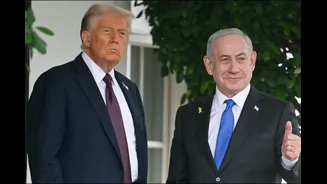







US President Donald Trump had told Israeli Prime Minister Benjamin Netanyahu during a meeting in Florida in December last year that he would support Israeli strikes on Iran’s ballistic missile programme
if Washington and Tehran failed to reach a nuclear deal, CBS News reported on Sunday, citing two sources familiar with the talks.
According to the report, discussions within the US national security establishment have since begun examining how Washington might assist Israel in the event of renewed strikes. Two US officials said talks among senior military and intelligence figures have focused less on whether Israel would act and more on what support the United States could provide.
Options under consideration reportedly include aerial refuelling for Israeli aircraft and the sensitive issue of securing overflight permission from countries along the possible flight path.
However, it remains unclear which nations would allow their airspace to be used. Jordan, Saudi Arabia and the United Arab Emirates have all publicly said they would not permit their territory to be used for strikes on Iran or for attacks launched by Iran.
ALSO READ: Trump And Netanyahu Agreed US Should Increase Pressure On Iran Over Oil Exports To China: Report
The developments come as the Trump administration pursues renewed negotiations with Tehran over its nuclear programme. Iran’s Foreign Minister Abbas Araghchi travelled to Switzerland earlier today, ahead of a second round of talks with US officials later this week.
During his visit to Geneva, Araghchi is expected to meet Swiss and Omani counterparts, as well as the head of the International Atomic Energy Agency, Rafael Grossi.
Tehran and Washington resumed indirect negotiations in Muscat on February 6, months after earlier talks collapsed following a 12-day conflict triggered by Israeli air strikes on Iran last June.
Uncertainty remains over Iran’s stockpile of more than 400 kilogrammes of uranium enriched to 60 percent purity. On Sunday, Netanyahu said that any agreement must require Iran to remove all enriched uranium and dismantle its enrichment capability entirely.
Iran has signalled some openness to compromise. Deputy Foreign Minister Majid Takht-Ravanchi told the BBC that Tehran could consider limits on its uranium stockpile if the US lifts sanctions. “If we see the sincerity on their (American) part, I am sure we will be on a road to have an agreement,” he said.
Switzerland has long acted as an intermediary between the two countries, representing US interests in Iran since diplomatic ties were severed after the 1980 hostage crisis.
(With inputs from agencies)