




The question of enriched uranium has once again moved to the centre of escalating tensions between the United States and Iran. As backchannel talks and public signalling intensify, the nuclear issue is no
longer a distant technical concern, it is the central bargaining chip, the red line, and the source of global anxiety about what comes next. Follow Live updates here
That was underscored on Thursday when US President Donald Trump claimed that Iran was prepared to hand over its enriched uranium stockpile to the United States, an assertion swiftly and categorically denied by Iran. The sharp contradiction highlights how both sides are using the issue of enriched uranium not just as a matter of nuclear policy, but as a tool of strategic messaging. It is this factor that will decide the fate of the next round of the US-Iran talks, after the first round failed.
What Is Enriched Uranium?
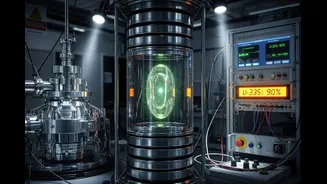
Uranium, in its natural form, is not immediately useful for either nuclear power or weapons. It must first be processed to increase the concentration of a rare isotope known as uranium-235 (U-235). This process is called enrichment.
Natural uranium contains only about 0.7 per cent U-235, with the overwhelming majority being uranium-238, which cannot sustain a nuclear chain reaction. Through complex technologies, most commonly gas centrifuges, scientists can increase the share of U-235 to make the material usable.
At lower levels of enrichment (around 3–5 per cent), uranium is suitable for civilian nuclear reactors, where it is used to generate electricity. But as enrichment levels rise, so does its potential for military use. Uranium enriched beyond 20 per cent is classified as highly enriched uranium, and once it reaches around 90 per cent, it is considered weapons-grade.
How Much Enriched Uranium Is Needed For A Nuclear Weapon?
The answer depends on both the level of enrichment and the sophistication of the weapon design. However, broad estimates from nuclear experts provide a useful benchmark.
To build a single nuclear weapon, roughly 25 kilograms of uranium enriched to 90 per cent is typically considered sufficient. Alternatively, about 40-42 kilograms of uranium enriched to 60 per cent could be further processed to weapons-grade and used for one bomb
What makes this particularly concerning is that the step from 60 per cent to 90 per cent enrichment is relatively quick compared to the earlier stages. In technical terms, most of the effort required to enrich uranium is already completed by the time it reaches 60 per cent.
How Much Enriched Uranium Does Iran Have?
According to recent assessments by the International Atomic Energy Agency and other diplomatic sources, Iran has accumulated a significant stockpile of enriched uranium, including approximately 400–450 kilograms of uranium enriched up to 60 per cent, and a much larger stockpile of lower-enriched uranium (below 20 per cent), which can be further enriched if needed.
This puts Iran in a position where, if it chose to take the next step, it could theoretically produce enough weapons-grade material for multiple nuclear weapons within a relatively short time frame.
However, there is an important caveat. International monitoring has become more limited in recent years, meaning that while these figures are widely cited, they are not verified with complete certainty in real time.
Why This Matters In US-Iran War
The dispute over enriched uranium is not just about numbers or percentages, it is about intent, trust, and timing. For the United States and its allies, Iran’s growing stockpile represents a shrinking “breakout time,” or the period needed to produce weapons-grade material. For Iran, the stockpile is leverage, a way to extract concessions and assert strategic autonomy.
In the end, enriched uranium sits at the centre of it all and has become one of the most powerful political tools in the world.