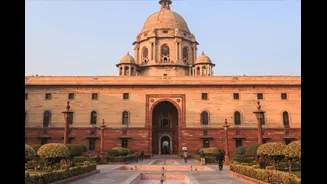


For decades, North Block and South Block have represented the nerve centre of the Indian government. Behind their imposing sandstone façades, some of the country’s most consequential decisions were taken
— on the economy, national security, foreign policy and governance. Now, these corridors of power are set for a dramatic transformation. The Union Cabinet’s approval for the ₹3,230-crore Yuge Yugeen Bharat Museum marks more than the creation of another cultural institution. It is an attempt to convert two of independent India’s most recognisable government buildings into a national statement on civilisation, heritage and India’s place in the world. The project, approved by the Cabinet Committee on Economic Affairs chaired by Prime Minister Narendra Modi, will transform the North and South Block complex into what the government says will be the world’s largest museum in terms of display area. With more than one lakh square metres of exhibition space planned, the proposed museum would have a larger display area than some of the world’s most famous institutions, including the Louvre, the British Museum and the Hermitage. But the scale of the project is only one part of its significance. The symbolism of the location is difficult to miss.
NORTH BLOCK AND SOUTH BLOCK
North Block and South Block have traditionally housed some of the most powerful ministries of the Union government. Their conversion into a public museum is closely linked to the broader transformation of the Central Vista, where government offices are being relocated and a new administrative architecture is taking shape.
The adaptive reuse of the two historic buildings allows the government to give them a new purpose without dismantling their architectural identity.
The challenge, however, will be to strike a balance. North Block and South Block are heritage structures in their own right. The government has said the project will preserve their historic character, façade and architectural integrity, with minimal intervention. Instead of treating the buildings merely as shells for a modern museum, the existing courtyards, corridors and rooms are expected to become part of the visitor experience.
In effect, the buildings themselves will become part of the exhibition.
The Yuge Yugeen Bharat Museum is also significant because of the story it intends to tell.
India already has museums dedicated to art, archaeology, individual leaders, regions and specific periods of history. The proposed institution seeks to do something much broader — present India’s journey as a continuous civilisation.
That is reflected in its proposed galleries, which will cover subjects ranging from architecture and cityscapes to mathematics, astronomy, languages, scripts, faith, spirituality, trade and the movement of ideas.
The underlying idea is to move beyond a conventional chronological account of kings, empires and political events. Instead, the museum proposes to connect different strands of Indian civilisation — its knowledge systems, artistic traditions, cultural practices and intellectual exchanges — across centuries.
This is also where the project enters a larger debate about how India tells its own story.
For the Modi government, cultural institutions have increasingly become part of a wider effort to foreground civilisational identity and present India’s history through what it describes as an Indian perspective. The Yuge Yugeen Bharat Museum fits squarely into that larger cultural and political vision.
The question will be whether such an ambitious civilisational narrative can accommodate the enormous diversity and complexity of India’s past without reducing it to a single, simplified storyline.
That will depend substantially on curation.
AMBITIOUS PROJECT
The numbers associated with the project underline its ambition. Around 1.8 million objects have been identified from the National Museum, other museums under the Ministry of Culture, 52 Archaeological Survey of India site museums, state museums and private collections for possible display at the Yuge Yugeen Bharat Museum.
The first gallery, themed around “Adornment”, is expected to open in the later part of 2027 in North Block. The larger project is planned to be implemented in phases between 2026-27 and 2030-31.
A modular approach is being adopted to add galleries gradually. This phased model is important because the project is simply too large to be viewed as a conventional museum construction exercise. It involves conservation, collection management, exhibition design, technology integration and the movement of artefacts on an unprecedented scale.
The real test will therefore not just be how many objects the museum possesses, but how effectively it interprets them.
A museum with millions of objects can overwhelm visitors. The success of Yuge Yugeen Bharat will depend on whether it can turn an enormous collection into a coherent and engaging experience.
The government is betting heavily on technology to make that possible. The museum is expected to combine traditional displays with augmented reality, virtual reality and artificial intelligence-based experiences. There will also be dedicated spaces for children, performance areas, retail outlets and food courts.
This reflects a fundamental shift in how major museums are now conceived.
The modern visitor does not necessarily want to walk through endless galleries filled with objects and labels. The emphasis increasingly is on immersive storytelling and interpretation.
TECH HELP
For Yuge Yugeen Bharat, technology could help recreate lost cities, explain ancient scientific concepts, visualise trade routes or bring historical environments to life. But technology will also have to serve the history, rather than become the attraction itself.
Perhaps the most ambitious number attached to the project is the proposed footfall. The museum is being designed for up to 30,000 visitors a day and as many as one crore visitors annually.
That would place it among the world’s most heavily visited cultural destinations. To manage such numbers, the government plans timed entry and structured crowd-management systems. The scale of visitor infrastructure will be as important as the galleries themselves.
A museum of this size could transform the way Delhi is experienced by tourists. Located in the heart of the capital, between some of the country’s most important public and historical spaces, it has the potential to become a major stop for both domestic and international visitors.
The government is also looking at revenue generation through ticketing, guided tours, digital experiences, events, venue rentals, food and beverage services and retail. There is also a clear international dimension to the project.
Countries increasingly use museums and cultural institutions as instruments of soft power. The Louvre, the British Museum and the Smithsonian are not simply repositories of objects; they are institutions that shape global perceptions of history, culture and national identity. The Yuge Yugeen Bharat Museum appears designed to perform a similar role for India.
By creating a single institution capable of presenting the sweep of India’s civilisational journey, the government hopes to build a major international cultural destination.
That ambition explains the comparisons with global museums.
Yet comparisons based purely on size may not ultimately matter as much as intellectual and curatorial credibility. The world’s most influential museums are defined not just by square metres, but by the quality of their collections, scholarship and storytelling.
For Yuge Yugeen Bharat, the challenge will be to combine scale with substance. The ₹3,230-crore project will also have an economic dimension. Its construction and eventual operation are expected to generate jobs for artisans, designers, conservation experts, researchers, museologists, performers and technology professionals.
The government is also looking to encourage domestic manufacturing of museum materials and products under the broader Make in India framework.
But the project’s biggest impact may be symbolic. North Block and South Block were built during the colonial era and later became symbols of the Indian state. Their transformation into a museum dedicated to India’s civilisational journey represents a striking change in their institutional identity.
The spaces that once housed the machinery of government are now being recast as spaces where citizens and visitors will encounter a much longer story — one that predates the modern Indian state by thousands of years.
The Yuge Yugeen Bharat Museum will therefore be judged on more than its size or its ₹3,230-crore price tag.