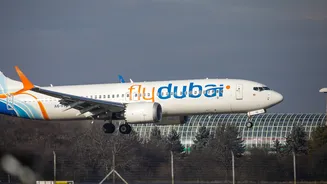










A routine Flydubai flight from Dubai to Tel Aviv turned into a mid-air security scare on Wednesday after the aircraft sent out emergency signals, abruptly changed course over Saudi Arabia and briefly transmitted
the international code associated with a hijacking.
Israeli fighter jets were scrambled, senior officials went into emergency consultations and fears grew that Flight FZ1073, carrying around 180 people, had been taken over. But the picture changed after the Boeing 737 landed safely in Saudi Arabia.
Israeli officials subsequently said the incident was not a hijacking. Instead, reports pointed to a violent confrontation between the two pilots inside the cockpit, with passengers describing screams, blood and a sudden dive by the aircraft.
According to reports, Israel has now classified the incident as an attempted terrorist attack, with speculation that the pilot who allegedly attempted to hijack the plane tried to commit a 9/11-style attack. Israeli channel N12 reported citing sources that the deputy pilot who tried to crash the plane Was Omani while the main pilot was Emirati.
Here is what happened and what we know so far.
How The Scare Began
Flydubai Flight FZ1073 departed Dubai International Airport for Tel Aviv’s Ben Gurion Airport on Wednesday morning.
About two hours into the flight, the aircraft transmitted squawk 7700, the internationally recognised transponder code indicating a general emergency. Flight-tracking data showed the aircraft turning away from its planned route as it flew over the region of Saudi Arabia.
The situation became far more alarming when the aircraft briefly transmitted squawk 7500. Code 7500 is used to indicate unlawful interference with an aircraft and is internationally associated with a hijacking or attempted hijacking.
Israeli authorities were unable to establish contact with the aircraft at the time. With dozens of Israeli citizens believed to be on board, the possibility of a hijacking immediately became a serious concern.
Israeli Air Force fighter jets were scrambled towards the aircraft, while Prime Minister Benjamin Netanyahu and senior security officials held emergency consultations.
The Aircraft’s Frightening Movements
The flight-tracking data added to the alarm. According to data cited by The Times of Israel, around two hours and 15 minutes into the flight, the Boeing 737 suddenly plunged from approximately 34,000 feet to around 17,000 feet in less than a minute, while its speed rose sharply.
The aircraft subsequently climbed somewhat before descending again, eventually flying at roughly 15,000 feet for a period. The unusual altitude changes appeared to indicate that the aircraft was being manually controlled rather than simply following its normal automated flight profile.
For passengers inside the cabin, however, the situation was even more terrifying.
Passengers Report Screams, Blood In Cockpit
As the aircraft’s movements triggered concern on the ground, passengers began reporting what appeared to be a violent incident inside the plane.
One passenger told Israel’s Channel 12 that passengers heard screams before the cockpit was opened. “We heard screams on the plane. Then they opened the cockpit and we saw blood,” the passenger said, alleging that a pilot had been stabbed with a pocketknife.
First images from @flydubai flight: one of the passengers with blood on his shirt https://t.co/zfJ4UsDeaO pic.twitter.com/XDLzuz0DbE
— Amichai Stein (@AmichaiStein1) September 30, 2026
Another passenger, identified as Noam, told the channel, “Screams began on the plane, by passengers who realised what was happening.”
She said passengers understood that one of the pilots had been stabbed and seriously wounded and that the aircraft subsequently began to descend rapidly. “It was very scary,” she said.
Reuters separately reported that the mother of a passenger, Yasmin Abu Kasis, said her daughter had heard screaming and seen a man take a knife and put a pilot on the floor, with blood present in the cockpit. These accounts have not been independently verified in full.
From Suspected Hijacking To Pilot Fight And Terror Attack Attempt
The biggest breakthrough came as the aircraft approached Saudi Arabia. The flight landed safely at Tabuk Airport in northwestern Saudi Arabia, after having diverted from its route.
Once the aircraft was on the ground, Israeli security sources indicated that the emergency signals had been triggered by an altercation between the pilots.
Reuters reported, citing an Israeli official speaking anonymously, that the pilots had become involved in a physical altercation and that the emergency signals were transmitted during the confrontation.
The Israeli Prime Minister’s Office subsequently said the incident was not believed to have been a hijacking.
However, Israeli officials have cautioned that key questions about the pilot’s intentions remain unanswered. An Israeli official told The Jerusalem Post that it was still unclear whether the pilot intended to hijack the aircraft and divert it to Israel, crash it, or carry out what the official described as a “9/11-style attack”. The official said what was clear was that the pilot had sought to hijack the aircraft.
Separately, an Israeli source said the identity of the pilot who allegedly carried out the stabbing was still being investigated, including whether he was from the Middle East. These claims remain part of the ongoing investigation and have not been independently established.
However, latest reports say Israel was classifying the incident as an attempted terror attack. According to Jerusalem Post, Israeli officials said that a pilot attempted to hijack the aircraft. The earlier assessment ruling out a hijacking has now been changed.
An Israeli official told The Jerusalem Post that crew members and Israeli passengers subdued the pilot. The official said the aircraft lost roughly 4,000 metres of altitude during the struggle. Israeli security agencies are assessing the incident as a suspected act of terror, while the pilot’s intended destination or target remains under investigation.
Why Did The Aircraft Send The Hijack Code?
The aircraft first transmitted the general emergency code 7700, then the unlawful-interference code 7500, and later transmitted 7700 again before landing in Tabuk, according to flight-tracking data cited by Reuters.
It is not yet clear whether one of the pilots intentionally transmitted the hijacking code, whether it was sent during the struggle, or precisely what happened inside the cockpit at each stage.
There are also more dramatic reports circulating about what happened between the pilots, including claims that one pilot attempted to deliberately crash the aircraft and that the other pilot, with help from passengers, intervened.
These reports remain unconfirmed at this stage. The confirmed official position is that the incident was not a hijacking and that a physical altercation between the pilots was involved.
All passengers, meanwhile, were reported safe after the aircraft landed at Tabuk. Flydubai confirmed that Flight FZ1073 had experienced an “incident” while en route to Tel Aviv and had diverted to Tabuk, where it landed safely.
“Our teams are working closely with the relevant authorities,” the airline said, adding that further updates would be issued once additional confirmed information became available.
Because Israel and Saudi Arabia do not have formal diplomatic relations, getting the Israeli passengers back home required additional arrangements.
Flydubai subsequently said it was sending another aircraft to Tabuk to take the stranded passengers onward to Tel Aviv. The Israeli Prime Minister’s Office also said the situation was “under control” and that steps were being taken to bring the Israeli passengers safely back to Israel.
What We Know
At this stage, the broad sequence is clear. Flight FZ1073 left Dubai for Tel Aviv. It declared a general emergency, later transmitted a hijacking/unlawful-interference code, changed course and experienced dramatic altitude changes. Israeli fighter jets were scrambled amid fears of a hijacking. The aircraft then landed safely at Tabuk in Saudi Arabia.
After landing, officials ruled out a hijacking and linked the emergency to a confrontation between the pilots.
Passenger accounts indicate that there was a violent struggle in or around the cockpit, with at least one passenger reporting blood and the use of a knife. But crucial details, including what triggered the confrontation, who initiated it, why the 7500 code was transmitted and exactly how control of the aircraft was affected, remain under investigation.
The Flydubai scare started off being a hijack alert and later appeared to have been a serious in-flight cockpit incident rather than a hijacking. However, Israel media reports are now going back to the hijacking attempt claims and also a possible terror attack attempt which was averted by passengers and two other crew on the plane.