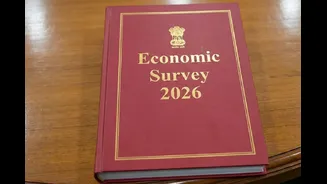

The Economic Survey 2025-26, tabled by Finance Minister Nirmala Sitharaman on Thursday in the Lok Sabha, expects the Indian economy to grow in the range of 6.8-7.2 per cent in the next financial year 2026-27.
The country’s key economic document, which has a total of 16 chapters, has a separate chapter on artificial intelligence (AI).
The Economic Survey document, prepared by the Economic Division of the Department of Economic Affairs in the Ministry of Finance and formulated under the supervision of the chief economic adviser, provides insights into the state of the economy and various indicators for 2025-26 (April-March), as well as an outlook for the next fiscal.
According to the government’s First Advance Estimates released on January 7, the country’s GDP is estimated to grow at 7.4% in the current FY26 despite global challenges amid the tariff war.
India’s economy grew 6.5 per cent in FY25 and 8.2 per cent in FY24, according to the data.
Growth projections and past trends
India’s actual economic growth has often exceeded the projections made in the Economic Survey. According to an analysis cited by PTI, the economy is expected to grow at 7.4 per cent in 2025-26, higher than the 6.3-6.8 per cent growth projection made in the pre-Budget document last year.
In 2023-24, GDP growth came in at 9.2 per cent, well above the Economic Survey’s estimate of 6-6.8 per cent. Growth in 2024-25 stood at 6.5 per cent, broadly in line with the Survey’s projected range of 6.5-7 per cent.
However, the projection was missed in 2022-23, when actual growth was 7.6 per cent compared with the Survey’s estimate of 8-8.5 per cent. In 2021-22, no growth projection was made due to pandemic-related uncertainty, though the economy expanded by 9.7 per cent, largely on account of a low base. In 2020-21, GDP contracted by 5.8 per cent following the COVID-19 outbreak and nationwide lockdowns.