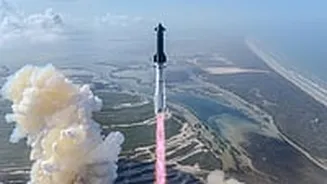








SpaceX’s massive Starship spacecraft completed a largely successful test flight on Friday, splashing down in the Indian Ocean after a mission that showcased major upgrades to the rocket system.
The spacecraft
lifted off shortly after 5:30 pm local time (2230 GMT). Although the mission experienced a few technical issues, SpaceX employees erupted in celebration during the company’s livestream as the upper stage completed its planned fiery but controlled splashdown.
“Splashdown confirmed!” the company posted on X after the mission concluded.
The flight was primarily aimed at testing redesigns introduced in the latest version of Starship. During the mission, the third-generation spacecraft performed a maneuver to flip upright and reignite its engines for control, despite one engine failing during flight.
Starship also deployed 22 mock satellites, including two designed to capture images of the spacecraft’s heat shield for further analysis.
However, the spacecraft did not achieve its intended orbit after one engine malfunctioned during the initial burn phase.
“I wouldn’t call it nominal orbital insertion,” company spokesperson Dan Huot said, while adding that it was “within bounds” of a previously analyzed trajectory.
After separating from the upper stage, the Super Heavy booster failed to complete its boost-back burn and plunged uncontrolled into the Gulf of Mexico. SpaceX had not planned to recover the booster, though the company had aimed for a more precise return.
SpaceX owner Elon Musk praised the mission on X, calling the flight “epic.”
“You scored a goal for humanity,” he said.
Splashdown confirmed! Congratulations to the entire SpaceX team on the twelfth flight test of Starship! pic.twitter.com/XXBAtryPpL
— SpaceX (@SpaceX) May 22, 2026
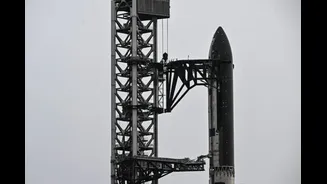
Friday’s mission came a day after an earlier launch attempt was aborted because of a technical issue. Musk later explained on X that “the hydraulic pin holding the tower arm in place did not retract,” adding that the problem was fixed overnight.
The latest test marked Starship’s 12th flight overall and its first in seven months. The upgraded version stands more than 407 feet (124 metres) tall when fully stacked, making it larger than previous models.
The mission also carries significance for NASA, which has contracted SpaceX to develop a modified version of Starship for its Artemis lunar programme aimed at returning humans to the Moon.
Clayton Swope, an aerospace expert at the Center for Strategic and International Studies, told AFP that “the upgraded version of Starship did most of what SpaceX hoped it would do during the launch.”
At the same time, he cautioned that more work remained before Starship would be ready for future lunar missions.
“There is a long way to go and many more test flights before Starship is ready for the next Artemis mission,” Swope said.
Ahead of launch, NASA Administrator Jared Isaacman appeared on SpaceX’s pre-launch programme and said: “We’re looking forward to seeing this fly, because hopefully at some point in the not-too-distant future we’re going to join up in Earth orbit.”
Following the mission, Isaacman congratulated SpaceX on X for “a hell of a V3 Starship launch.”
“One step closer to the Moon…one step closer to Mars,” he added.
(With inputs from AFP)